For the Waterdeep Trading Company, some ideas are valuable because they should never move beyond parchment. Restricted and volatile materials sit in that space. They promise force, speed, and leverage, yet they also carry risk that can harm workers, cities, and the balance sheet.
Research in this context is not about mixing, testing, or producing. It is about deciding early, clearly, and defensibly whether an idea should stop before any contract, caravan, or vault door is opened.
This article outlines how feasibility research is conducted for restricted materials. It integrates mining reality, custody discipline, routing analysis, and full risk costing into a single go/no-go decision.
Restricted Materials as a Research Category
Restricted materials are regulated inputs that remain stable when sealed and separated, yet become dangerous when mishandled or combined. Cities permit the extraction and movement of materials only for licensed civic, mining, or construction purposes.
The research question is simple.
Can the company source, store, move, insure, and account for these materials without crossing legal, ethical, or public safety lines?
If that answer is not a clear yes, research ends.
Why Feasibility Comes Before Trade
Feasibility research exists to stop bad ideas cheaply.
Before any agreement is signed, three questions must be answered.
Is the supply real across seasons and regions?
Is custody defensible from the point of extraction to the final handover?
Does total cost still make sense once risk replaces optimism?
Failure on any point is a stop, not a delay.
Mining Reality and Supply Truth
Mining defines availability long before pricing or routing is discussed. This table shows the sources of restricted inputs and the verification procedures employed in the research.
Research records historical output, shutdowns, and disruptions by region code. Forest closures, flooded caverns, and failed roads are treated as expected events rather than surprises.
Custody as a Feasibility Gate
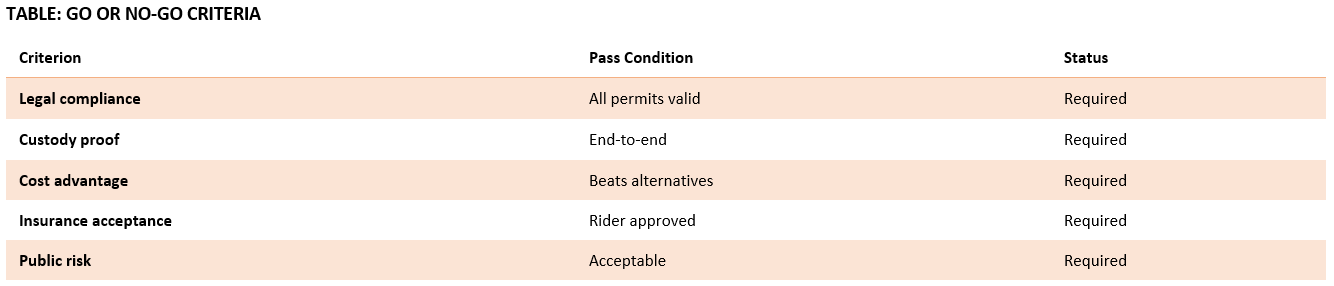
If custody cannot be proven on paper, the feasibility fails immediately. This table lists the controls that must be in place before approval.
Custody is not an operational detail. It is a research filter.
Routing Without Handling
Routes are evaluated as paper exercises using prior caravan logs, guard rosters, and weather records. No trial movement occurs. This table shows why routing is a research activity.
If a route cannot be defended in writing, it does not advance.
Costing Research Before Orders Exist
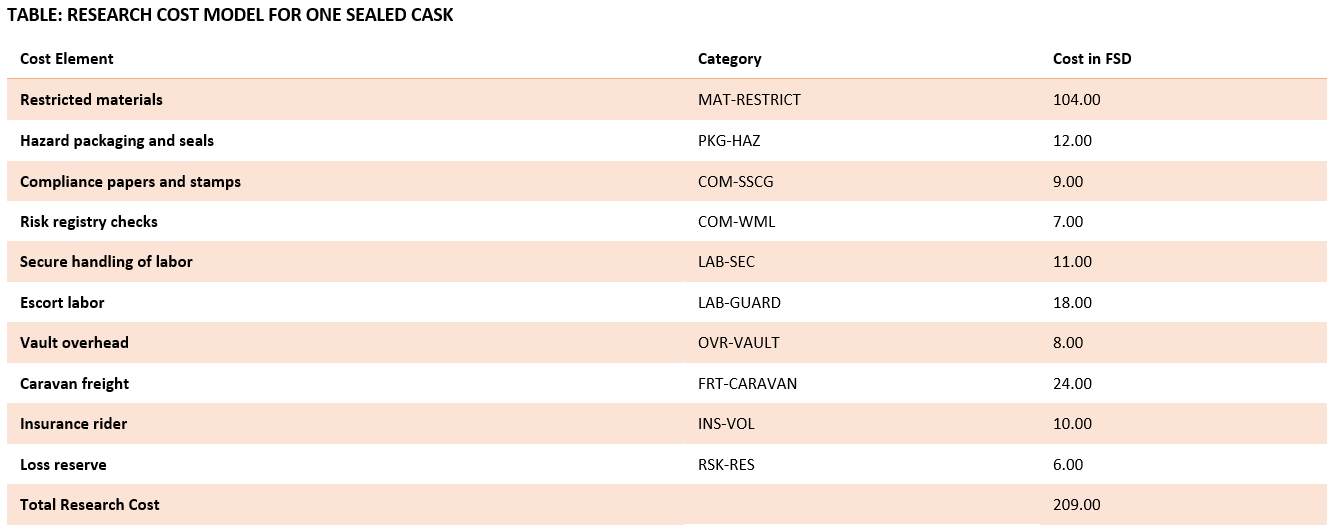
Research costing is intended to reveal hidden weight early. This table presents a conservative cost view in FSD that includes compliance and risk considerations.
This total is then compared to non-restricted alternatives. In many cities, spellwork or mechanical methods cost less once risk is priced honestly.
Alternatives as Part of Feasibility
A feasibility study is incomplete without substitutes. This table supports risk-aware decision-making.
Alternatives often end the discussion.
Governance and the Final Gate
Research closes with a joint review. City law, temple guidance, and guild policy are considered together. One objection is sufficient to stop the effort.
Final Thoughts
Most ideas should remain unbuilt. Feasibility research proves that restraint is a core business skill. When mining limits, custody exposure, routing risk, and full cost are placed side by side, many proposals end prematurely.
That outcome protects workers, cities, and the coin. That is success.
Support the AD&D365 Project on Patreon. To grow this world, we’ve launched an official Patreon page where supporters can access exclusive content, tools, and training labs, and even influence the project’s future. Your support fuels more than just development; it expands the guildhall, forges new scrolls, and empowers the next generation of configuration wizards. Begin your journey: https://www.patreon.com/adnd365/
A Grateful Salute to ourPatrons. To all those who stand behind the vision, thank you for helping bring this world to life. Our Benefactors, Andre Breillatt and Eryndor Fiscairn‡, your boundless generosity fuels the arcane core of this project. Without your magic, the weave would falter. OurApprentices, the spell engines turn, and the training labs thrive thanks to our current Apprentices: Michael Ramirez and Andreth Bael’Rathyn‡. Special thanks to our past Apprentices, whose contributions helped us get here: Ralf Weber, Wendy Rijners, Shashi Mahesh, Julia Tejera, Ben Ekokobe, Tiago Xavier, Naveen Boyinapelli, Marcos Tadeu Wolf, Kathryn Greene, Jason Brown, Mark Christy, and Ashish Singh. Our Initiates, Jeff Stiles,Harry Burgh, Jesper Livbjerg, Peter Lorre, Gregory Brigden, and Martin Grahm, your commitment marks the start of the deeper path, stepping beyond mere observation into the active shaping of this realm.Our Followers, your steady presence along the journey is a beacon of encouragement: Rusty Cavalier,Eric Shuss, Sunil Panchal, Sarah D. Morgan, Nick Ramchandani, Daniel Kjærsgaard, and Tomasz Pałys. And our Voyeurs, ever watching from the shadows, clearly intrigued… but not enough to part with a single gold piece. Your silent curiosity is noted and mildly judged.
Want to design your own economic models in Faerûn? Get your own AD&D365 Environment and guides at adnd365.com/start, and request access to the public view of the current database at https://public.adnd365.com – Login npc@adnd365.com, Password N0nPl@yC#822!
Across the Sword Coast, trade moves at the pace of hooves and turning wheels. From short runs between Waterdeep wards to long caravan routes toward Baldur’s Gate or Silverymoon, wagons and horses take constant strain. The Waterdeep Trading Company treats wagon wheels and horseshoes as managed assets, not afterthoughts. Poor timing on replacement leads to broken axles, lame horses, lost cargo, and missed contracts. Careful tracking keeps goods moving and costs predictable.
This article explains how the company monitors wear, records inspections, and determines when to replace wheels and shoes before failure.
What This Management Covers
Wagon wheel and horseshoe management is the practice of tracking usage, condition, and service life of the two most-stressed components in overland transport. It applies to company-owned wagons, leased caravans, and draft or riding horses assigned to trade routes.
The goal is simple. Replace parts early enough to avoid breakdowns, but not so early that coin is wasted.
Why It Matters
A failed wheel or a thrown shoe rarely happens near a city forge. Breakdowns delay deliveries, expose cargo to theft, and drive repair costs far above planned maintenance costs.
For the Waterdeep Trading Company, this affects:
Route reliability and delivery promises
Caravan safety and animal welfare
Maintenance budgets and cost control
Accurate pricing of long-haul contracts
Tracking Wagon Wheel Wear
Each wagon is assigned a wheel set record. Inspections are logged at defined intervals, typically upon route completion or at set distances traveled.
Wear is judged on rim thickness, spoke cracks, hub looseness, and iron band condition.
Each indicator is marked as Green, Amber, or Red in the maintenance log. Red status blocks the wagon from assignment.
Tracking Horseshoe Wear
Horseshoes are tracked per horse, not per route. Different animals wear shoes at different rates based on weight, gait, and load.
Farriers inspect shoes during rest stops and at stables. Records note nail tightness, shoe thinning, and hoof edge damage.
Any sign of gait change moves the horse to inspection status, even if the shoe looks intact.
Replacement Decision Rules
The company uses clear rules to avoid debate in the field.
Wheels are replaced based on condition, not age. A lightly used city wagon may keep wheels for years, while a mountain route wagon may need them twice a season.
Horseshoes follow shorter cycles and are replaced on a planned schedule unless they show early wear.
These rules allow caravan masters to act without waiting for head office approval.
Worked Example: Luskan Trade Run
A wagon assigned to the Waterdeep to Luskan route returns after 420 miles. Inspection shows rim thinning marked Amber and a minor spoke crack on one wheel.
The wheel is set to Red due to the crack. Replacement is scheduled before the next run. The cost is posted as planned maintenance rather than emergency repair.
At the same time, two draft horses show loose nails but no gait issues. Shoes are reset, not replaced, saving material cost while keeping the animals fit.
Accounting and Records
Maintenance costs are posted to route or fleet cost centers. Planned replacements are budgeted. Emergency repairs are tracked separately to highlight avoidable failures.
This allows Greta Ironfist and the Arcane Treasurers to see which routes cause excess wear and adjust pricing or routing.
Realms Aware Considerations
Road conditions vary sharply across Faerûn. Stone roads near Waterdeep are gentle on wheels but challenging on shoes. Forest tracks damage spokes. Coastal routes rust iron bands faster.
Seasonal weather also matters. Spring mud loosens hubs, winter ice chips hooves. Records always note season and route type.
Final Thoughts
Wagon wheels and horseshoes decide whether trade flows or stalls. By treating them as tracked assets, the Waterdeep Trading Company avoids roadside failures and keeps its promises to customers across the Sword Coast.
Careful inspection, clear rules, and steady records turn simple iron and wood into reliable trade tools.
Support the AD&D365 Project on Patreon. To grow this world, we’ve launched an official Patreon page where supporters can access exclusive content, tools, and training labs, and even influence the project’s future. Your support fuels more than just development; it expands the guildhall, forges new scrolls, and empowers the next generation of configuration wizards. Begin your journey: https://www.patreon.com/adnd365/
A Grateful Salute to Our Patrons. To all those who stand behind the vision, thank you for helping bring this world to life. Our Benefactors, Andre Breillatt and Eryndor Fiscairn‡, your boundless generosity fuels the arcane core of this project. Without your magic, the weave would falter. Our Apprentices, the spell engines turn, and the training labs thrive thanks to our current Apprentices: Michael Ramirez and Andreth Bael’Rathyn‡. Special thanks to our past Apprentices, whose contributions helped us get here: Ralf Weber, Wendy Rijners, Shashi Mahesh, Julia Tejera, Ben Ekokobe, Tiago Xavier, Naveen Boyinapelli, Marcos Tadeu Wolf, Kathryn Greene, Jason Brown, Mark Christy, and Ashish Singh.Our Initiates, Jesper Livbjerg, Peter Lorre, Gregory Brigden, and Martin Grahm, your commitment marks the start of the deeper path, stepping beyond mere observation into the active shaping of this realm. Our Followers, your steady presence along the journey is a beacon of encouragement: Rusty Cavalier,Eric Shuss, Sunil Panchal, Sarah D. Morgan, Nick Ramchandani, Daniel Kjærsgaard, and Tomasz Pałys. And our Voyeurs, Harry Burgh, Abdelrahman Nabil, and Basil Quarrell, ever watching from the shadows, clearly intrigued… but not enough to part with a single gold piece. Your silent curiosity is noted and mildly judged.
Want to design your own economic models in Faerûn? Get your own AD&D365 Environment and guides at adnd365.com/start, and request access to the public view of the current database at https://public.adnd365.com – Login npc@adnd365.com, Password N0nPl@yC#822!
Trade in Faerûn is governed by cost control, timing discipline, and careful handling of risk, both mundane and arcane. From the docks of Waterdeep to the long caravan roads leading to Baldur’s Gate and the portal halls of Silverymoon, the Waterdeep Trading Company succeeds because it plans routes with precision. Each route type reflects a specific trade pattern, chosen to balance distance, volume, urgency, and security.
This article explains the most common route types used by the Waterdeep Trading Company and provides worked examples for each. Each example breaks the route into legs, showing distance, pickup and drop-off quantities, and cost per leg. This level of detail supports both logistics planning and ledger review.
What Route Types Are
A route type defines the movement pattern used to transfer goods between locations. It determines whether a caravan travels directly to a single destination, visits several locations in sequence, loops back to its origin, or passes through a central hub. Selecting the correct route type reduces wasted travel, improves delivery timing, and protects valuable or sensitive goods.
Why Route Details Matter
Breaking routes down to the leg level enables the Waterdeep Trading Company to manage operations and finances in tandem. This structure enables caravan masters and Arcane Treasurers to calculate accurate cost-per-segment, track inventory movement by location, allocate expenses for profitability review, and improve loading and unloading control at intermediate stops.
Common Route Types in Faerûn
The table below lists the primary route types used by the Waterdeep Trading Company and the situations in which each is applied.
Worked Examples with Route Legs
Each example below begins with a short scenario, followed by a level-by-level table. Fixed fees are applied after travel costs to show the full route impact.
Direct Route Example
Enchanted swords are shipped from Waterdeep to Baldur’s Gate with no delay permitted. The table below shows how travel costs accumulate along the route.
Additional costs include a guard fee of 50.00 FSD and a magical stabilizer cost of 25.00 FSD.
The total route cost is 150.00 FSD.
Milk Run Example
A single caravan departs Waterdeep, serves Amphail, Rassalantar, and Secomber, then returns. This route combines delivery and pickup activity across several stops.
Fixed costs include a guard fee of 60.00 FSD and loading and unloading charges of 30.00 FSD per stop.
The total route cost is 120.00 FSD.
Circular Route Example
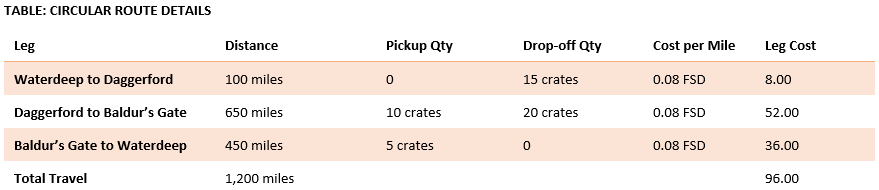
A regional loop runs from Waterdeep to Daggerford, onward to Baldur’s Gate, then back to Waterdeep. This route supports steady regional demand.
Additional costs include guard fees of 100.00 FSD and lodging costs of 40.00 FSD.
The total route cost is 236.00 FSD.
Hub and Spoke Example
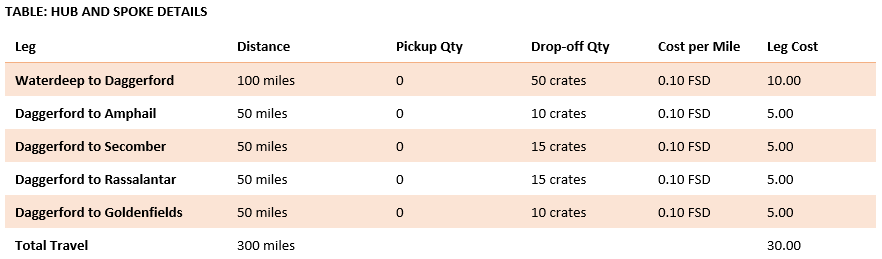
Goods move from Waterdeep to a hub in Daggerford, then outward to Amphail, Secomber, Rassalantar, and Goldenfields.
A hub handling fee of 50.00 FSD is applied.
The total route cost is 80.00 FSD.
Portal Route Example
Rare spell kits are transferred from Waterdeep to Silverymoon using an arcane portal.
A portal toll of 200.00 FSD and a magical stabilizer cost of 50.00 FSD are applied.
The total route cost is 250.00 FSD.
Route Comparison Summary
The table below provides a single view of all route options using total distance and total cost. This view is used during planning councils and budget reviews.
This summary highlights how different routing strategies trade distance for fixed fees, consolidation, or speed.
Final Thoughts
Detailed route planning gives the Waterdeep Trading Company complete visibility into how goods and coin move together. By tracking distance, quantities, and cost at the leg level, the company improves control, reduces waste, and supports reliable trade across Faerûn. Milk runs serve small settlements, hub routes scale distribution, direct routes protect valuable cargo, and portal routes support urgent needs. Each route type has a clear place when applied with discipline.
Support the AD&D365 Project on Patreon. To grow this world, we’ve launched an official Patreon page where supporters can access exclusive content, tools, and training labs, and even influence the project’s future. Your support fuels more than just development; it expands the guildhall, forges new scrolls, and empowers the next generation of configuration wizards. Begin your journey: https://www.patreon.com/adnd365/
A Grateful Salute to Our Patrons. To all those who stand behind the vision, thank you for helping bring this world to life. Our Benefactors, Andre Breillatt and Eryndor Fiscairn‡, your boundless generosity fuels the arcane core of this project. Without your magic, the weave would falter. Our Apprentices, the spell engines turn, and the training labs thrive thanks to our current Apprentices: Michael Ramirez and Andreth Bael’Rathyn‡. Special thanks to our past Apprentices, whose contributions helped us get here: Ralf Weber, Wendy Rijners, Shashi Mahesh, Julia Tejera, Ben Ekokobe, Tiago Xavier, Naveen Boyinapelli, Marcos Tadeu Wolf, Kathryn Greene, Jason Brown, Mark Christy, and Ashish Singh.Our Initiates, Jesper Livbjerg, Peter Lorre, Gregory Brigden, and Martin Grahm, your commitment marks the start of the deeper path, stepping beyond mere observation into the active shaping of this realm. Our Followers, your steady presence along the journey is a beacon of encouragement: Rusty Cavalier,Eric Shuss, Sunil Panchal, Sarah D. Morgan, Nick Ramchandani, Daniel Kjærsgaard, and Tomasz Pałys. And our Voyeurs, Harry Burgh, Abdelrahman Nabil, and Basil Quarrell, ever watching from the shadows, clearly intrigued… but not enough to part with a single gold piece. Your silent curiosity is noted and mildly judged.
Want to design your own economic models in Faerûn? Get your own AD&D365 Environment and guides at adnd365.com/start, and request access to the public view of the current database at https://public.adnd365.com – Login npc@adnd365.com, Password N0nPl@yC#822!
Across the Sword Coast, community halls, temples, schools, and guild shelters often host fundraisers to fund repairs, sponsor apprentices, or support relief efforts after storms or skirmishes. The Waterdeep Trading Company has long participated in these events by supplying goods at a reduced internal price, thereby allowing the fundraiser to retain the surplus from sales. This practice blends goodwill with proper ledger control, giving community groups a safe way to raise coin while keeping company accounts sound.
This article explains how these events are prepared, priced, tracked, and settled within the company. It is written in the style used by the Arcane Treasurers and the Records Office, combining clear trade practice with Faerûnian flavor.
What These Fundraiser Events Are
A fundraiser event is a temporary partnership between the Waterdeep Trading Company and a local group. Goods are supplied at a price below the normal selling price, often at or slightly above cost. The fundraiser sells them at a standard market price during an event such as a harvest fair, temple supper, or guild apprenticeship drive. The fundraising group retains the positive difference, and the company records the revenue reduction as part of its community contribution ledger.
Why This Matters
These events strengthen ties with communities across the Sword Coast. They also require careful accounting, since goods leave company stock at one price yet retail on the street at another. The company must track the inventory, the reduced price, the contribution value, and any unsold items returned from the fundraiser.
How the Company Handles the Process
Event Setup
The Records Office creates an internal event record with: • Fundraiser name and sponsor • Dates of the event • Goods offered • Discounted fundraiser price • Expected quantities
The Arcane Treasurer team reviews the discounted price to ensure it covers basic costs.
Pricing and Inventory Release
Goods are transferred from the central storehouse at a special fundraising price. This avoids confusion with regular wholesale or retail orders. Freight or handling costs are either waived or absorbed into the community contribution line.
Sales and Settlement
When the fundraiser concludes, the group submits its sales scroll, which shows quantities sold and coins collected. The fundraiser retains the surplus between the retail price and the discounted purchase price. The Waterdeep Trading Company posts revenue only for the discounted amount. Any unsold goods are returned to stock at the same reduced value.
Components of the Fundraiser Arrangement
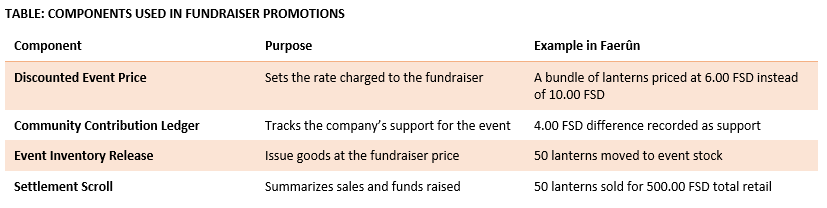
The table below introduces the core elements of these events, enabling all clerks to reference them during setup, and outlines the key components of the fundraiser setup and how each supports the event.
Worked Example
A temple in the North Ward hosts a winter cloak drive. The Waterdeep Trading Company agrees to supply wool cloaks at a reduced price.
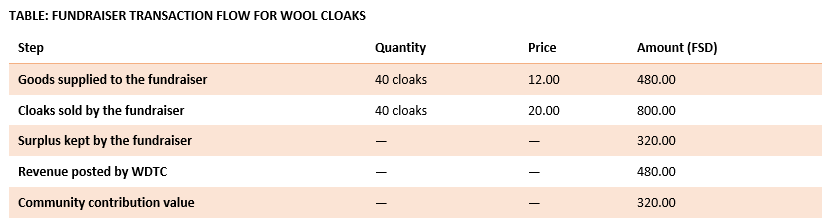
The retail price of each cloak is 20.00 FSD. The fundraiser price is 12.00 FSD. The temple sells them for full price and keeps the surplus.
This table walks through the financial results using simple numbers.
The temple raises 320.00 FSD to help residents in need. The Waterdeep Trading Company reports fair revenue from the reduced price and records the support in its community contribution ledger.
Realms Aware Considerations
Regional demand affects which goods are best for fundraisers. Cloaks do well in the North. Lanterns do well in Luskan. Dry goods or herbal kits resonate in smaller towns. The principle remains the same across all provinces: provide suitable goods, apply a responsible discount, and maintain clean accounts.
Final Thoughts
Fundraiser promotions demonstrate how trade can serve the common good while adhering to proper accounting practices. Community groups gain needed support, and the Waterdeep Trading Company strengthens its standing across Faerûn through dependable and fair dealings.
Support the AD&D365 Project on Patreon. To grow this world, we’ve launched an official Patreon page where supporters can access exclusive content, tools, and training labs, and even influence the project’s future. Your support fuels more than just development; it expands the guildhall, forges new scrolls, and empowers the next generation of configuration wizards. Begin your journey: https://www.patreon.com/adnd365/
A Grateful Salute to Our Patrons. To all those who stand behind the vision, thank you for helping bring this world to life. Our Benefactors, Andre Breillatt and Eryndor Fiscairn‡, your boundless generosity fuels the arcane core of this project. Without your magic, the weave would falter. Our Apprentices, the spell engines turn, and the training labs thrive thanks to our current Apprentices: Michael Ramirez and Andreth Bael’Rathyn‡. Special thanks to our past Apprentices, whose contributions helped us get here: Ralf Weber, Wendy Rijners, Shashi Mahesh, Julia Tejera, Ben Ekokobe, Tiago Xavier, Naveen Boyinapelli, Marcos Tadeu Wolf, Kathryn Greene, Jason Brown, Mark Christy, and Ashish Singh.Our Initiates, Jesper Livbjerg, Peter Lorre, Gregory Brigden, and Martin Grahm, your commitment marks the start of the deeper path, stepping beyond mere observation into the active shaping of this realm. Our Followers, your steady presence along the journey is a beacon of encouragement: Rusty Cavalier,Eric Shuss, Sunil Panchal, Sarah D. Morgan, Nick Ramchandani, Daniel Kjærsgaard, and Tomasz Pałys. And our Voyeurs, Harry Burgh, Abdelrahman Nabil, and Basil Quarrell, ever watching from the shadows, clearly intrigued… but not enough to part with a single gold piece. Your silent curiosity is noted and mildly judged.
Want to design your own economic models in Faerûn? Get your own AD&D365 Environment and guides at adnd365.com/start, and request access to the public view of the current database at https://public.adnd365.com – Login npc@adnd365.com, Password N0nPl@yC#822!
Ownership in Faerûn carries weight in both coin and standing. A share in the Waterdeep Trading Company grants a vote in council meetings, a portion of seasonal surplus, and a clear place within the guild’s long history. Greta Ironfist relies on equity shares to invite investment while keeping the company’s direction firm and stable.
This article explains how shares work within the company, how they support expansion across the Sword Coast, and how equity accounts in the Faerûn Standard Chart of Accounts record every change in ownership.
What Equity Shares Are
An equity share represents a unit of ownership. Common shares grant one vote and a portion of surplus. Preferred shares grant early surplus rights but no vote. Guildmaster shares belong only to Greta Ironfist and carry weighted voting strength.
Shares allow the company to raise funds for new routes, enchanted storage, and protection contracts. They also create a path for dedicated workers to share in long-term success.
Why Equity Shares Matter
Shares determine who guides the company. They allow outside investors to support major plans while keeping authority in the hands of confirmed shareholders. They help fund caravan lines, warehouse expansions, and arcane upgrades without drawing on moneylenders.
The share ledger maintained by the arcane treasurers keeps every transfer clear. The Scriveners’, Scribes’, and Clerks’ Guild verifies each scroll before it enters the official record.
Share Classes Used in the Company
The Waterdeep Trading Company uses three classes of shares.
This table shows how each class participates in votes and surplus.
This structure encourages investment without weakening leadership.
Equity Accounts Used for Share Management
Ownership activity is recorded in a series of equity and liability accounts. These accounts come from the Faerûn Standard Chart of Accounts and include both existing accounts and new ones created to support preferred shares, guildmaster shares, surplus tracking, and treasury share activity.
This combined table brings all share-related accounts together, making the overall structure clear.
This structure supports transparent reporting in both regular seasons and expansion periods.
Worked Example: Preferred Share Issue
The council votes to open a new trade route to Calimport. To fund the enchanted crates, caravan guards, and advance payments to Rashemi traders, the company issues 500 preferred shares at 100.00 FSD each. The nominal value is 80.00 FSD, and the remaining 20.00 FSD per share becomes share premium.
This strengthens the company’s position without altering council control.
Worked Example: Surplus Declaration
At season’s end, the council declares a surplus distribution of 12,000.00 FSD.
Payment later clears the liability.
Realms Aware Notes
Share values may rise or fall with supply routes, arcane costs, seasonal demand, or shifting regional tariffs. Trade lines in Luskan or the North may require preferred share structures to attract outside backing.
The Scriveners’, Scribes’, and Clerks’ Guild must seal every transfer scroll before it becomes valid. This keeps the ledger clean and reduces disputes in high-value share exchanges.
Final Thoughts
A strong share structure supports the Waterdeep Trading Company as it grows. These accounts keep every change in ownership clear, protect decision-making rights, and ensure that surplus is shared fairly. With a unified ledger and well-defined share classes, the company stands ready to expand across Faerûn with confidence.
Support the AD&D365 Project on Patreon. To grow this world, we’ve launched an official Patreon page where supporters can access exclusive content, tools, and training labs, and even influence the project’s future. Your support fuels more than just development; it expands the guildhall, forges new scrolls, and empowers the next generation of configuration wizards. Begin your journey: https://www.patreon.com/adnd365/
A Grateful Salute to Our Patrons. To all those who stand behind the vision, thank you for helping bring this world to life. Our Benefactors, Andre Breillatt and Eryndor Fiscairn‡, your boundless generosity fuels the arcane core of this project. Without your magic, the weave would falter. Our Apprentices, the spell engines turn, and the training labs thrive thanks to our current Apprentices: Michael Ramirez and Andreth Bael’Rathyn‡. Special thanks to our past Apprentices, whose contributions helped us get here: Ralf Weber, Wendy Rijners, Shashi Mahesh, Julia Tejera, Ben Ekokobe, Tiago Xavier, Naveen Boyinapelli, Marcos Tadeu Wolf, Kathryn Greene, Jason Brown, Mark Christy, and Ashish Singh.Our Initiates, Jesper Livbjerg, Peter Lorre, Gregory Brigden, and Martin Grahm, your commitment marks the start of the deeper path, stepping beyond mere observation into the active shaping of this realm. Our Followers, your steady presence along the journey is a beacon of encouragement: Rusty Cavalier,Eric Shuss, Sunil Panchal, Sarah D. Morgan, Nick Ramchandani, Daniel Kjærsgaard, and Tomasz Pałys. And our Voyeurs, Harry Burgh, Abdelrahman Nabil, and Basil Quarrell, ever watching from the shadows, clearly intrigued… but not enough to part with a single gold piece. Your silent curiosity is noted and mildly judged.
Want to design your own economic models in Faerûn? Get your own AD&D365 Environment and guides at adnd365.com/start, and request access to the public view of the current database at https://public.adnd365.com – Login npc@adnd365.com, Password N0nPl@yC#822!
The Waterdeep Trading Company has grown into one of the most respected builders of crafted goods across the Sword Coast. Many requests are small enough to be filled with stocked items, yet the most valuable work comes from large commissions. These include reinforced wagons for mercenary companies, enchanted devices for mage guilds, and custom tools for noble households. These builds require planning, steady coordination between workshop and finance, and careful tracing of every coin. Project fabrication brings structure to these builds by joining project accounting with manufacturing.
What It Is
Project fabrication treats each commission as a controlled project while using manufacturing to perform the physical crafting. This keeps the build organized and allows both the workshop master and the finance scribe to follow the same plan from start to finish.
A project holds the financial structure. A production order holds the physical process. The two flow together through shared postings.
The project stores budgets and estimated costs
Production orders consume materials and record labor
Actual postings feed directly into the project ledger
Final cost is compared to initial expectations
Customers receive clear costed invoices backed by project records
Why It Matters
Custom builds in Faerûn often involve rare materials, high labor skill, and strict guild expectations. Without a firm structure, these builds risk cost overruns, missing components, or disputes with customers.
Project fabrication supports the Waterdeep Trading Company by allowing the team to:
Plan every major step of a build before work starts
Estimate raw materials, manual labor, and arcane labor with accuracy
Track real usage and compare it to the original budget
Maintain compliance with guild rules for enchantments and hazardous materials
Produce clear cost reports for customers, nobles, and guild auditors
Identify which commissions bring profit and which ones drain resources
Components of a Project Fabrication Build
This approach includes several connected steps, each essential for building complex work with clarity.
A project record in the ledger
A set of cost categories that define how coin is tracked
Estimates for planned materials and labor
Production orders that carry out the physical crafting
Postings of real materials, labor, overhead, and freight
A final cost review
Invoicing tied to actual cost with markup applied
Each part supports the others, giving the company a full view of cost from the first steel bar picked to the last sigil carved.
Key Data Structures
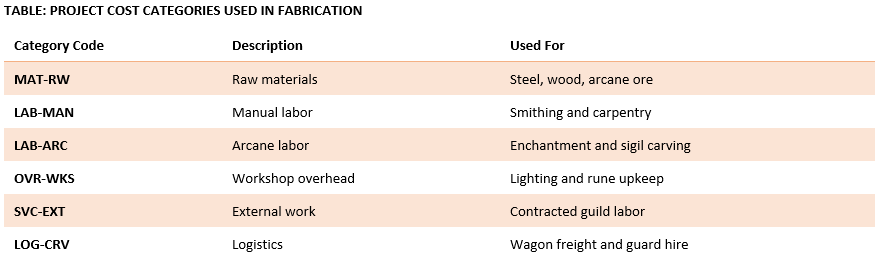
This section explains the main cost categories used for any project fabrication job. These categories serve as the backbone for all postings. When materials, labor, or services are consumed, they are assigned to a category.
This ensures consistency across all builds, whether the team is crafting a simple reinforced chest or a fully enchanted wagon.
Crafting large items requires a steady supply of reliable components. The materials listed below form the foundation of most major builds. Some are mundane, such as hardwood beams, while others are rare and sensitive, such as mithral thread or arcane shards. Their cost and reliability directly influence final project cost.
Project Setup
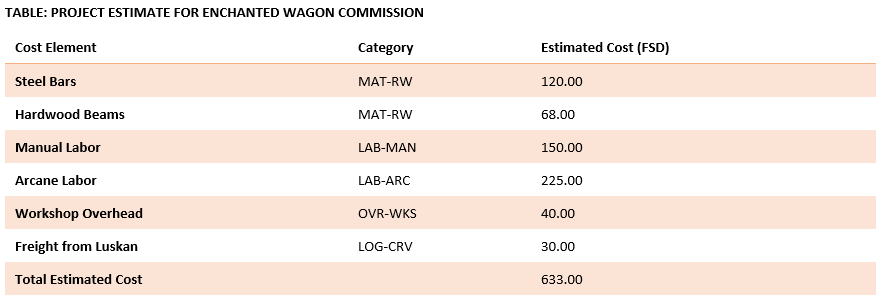
Before the workshop begins its first cut, strike, or engraving, the finance team sets up a structured project in the ledger. This project forms the financial shell that will collect all costs. The project includes expected materials, estimated labor hours, and overhead plans. Once the estimate is recorded, the workshop master can release the build to the production floor.
Below is an example of the kind of estimate recorded before work begins. It represents the best understanding of required effort at the time of planning.
Linking Manufacturing to the Project
Manufacturing carries out the physical work, yet every action taken there must connect back to the project. By tying a production order to the project record, the company ensures that:
Material pick lists send cost directly into the project
Labor recorded through job cards posts to the project ledger
Overhead and machine time follow the same path
Report as finished updates both inventory and the project
This connection prevents lost cost and ensures that every hour and item used can be traced.
Worked Example: Enchanted Wagon Commission
A noble from the North Ward requests a frost resistant wagon with reinforced panels and runic protection. This build requires steel shaping, carpentry, resin application, and two layers of arcane engraving. The following examples show the postings captured during the build.
Step 1. Material Consumption
All materials pulled from inventory must be posted against the project. This not only records consumption but also updates the project cost in real time. Variances often begin here, especially when additional steel or rare materials are used.
Step 2. Labor Recording
Labor is the heart of fabrication. It reflects both the time and the skill needed to complete a build. Manual labor covers shaping and construction, while arcane labor involves sigil carving, magical reinforcement, and binding spells. Both must be tracked with precision.
Step 3. Overhead and Logistics
Every project requires the workshop itself, from lamp oil to rune plates that keep the forge steady. Freight costs also appear often, especially when raw materials must travel from Luskan, Mirabar, or even Baldur’s Gate. These costs must be added to the project to give a complete picture of the build.
Step 4. Final Project Cost
The final cost summary brings all elements together. This allows the finance scribe and the workshop master to compare the estimate with the actual build. Any gap is reviewed to improve future planning.
The original estimate was 633.00 FSD. The real cost was 840.00 FSD. Most of the difference came from higher labor effort and additional material consumption. These findings help refine future estimates for similar enchanted wagons.
Realms Aware Considerations
Faerûn is a land shaped by guilds, trade routes, and regional laws. These factors must be considered during project fabrication.
Some provinces require special permits for arcane labor
Transporting mithral, cold iron, and arcane cores requires guarded freight
Frost seasons in the North raise demand for insulated builds
Mage guilds often require logs of spellwork hours and sigil layers
Coastal cities have higher workshop overhead due to saltstone protection rituals
These factors influence cost, planning, and scheduling.
Final Thoughts
Project fabrication allows the Waterdeep Trading Company to maintain clarity from the first planned cost to the final enchanted seal. By linking project accounting to manufacturing, the company ensures every coin, every nail, and every rune is tracked with care. This system brings order to complex work and strengthens customer trust in every commission.
Support the AD&D365 Project on Patreon. To grow this world, we’ve launched an official Patreon where supporters can gain access to exclusive content, tools, training labs, and even influence the future of the project. Your support fuels more than just development , it expands the guildhall, forges new scrolls, and empowers the next generation of configuration wizards. Begin your journey: https://www.patreon.com/adnd365/
A Grateful Salute to Our Patrons. To all those who stand behind the vision, thank you for helping bring this world to life. Our Benefactors, Andre Breillatt, and Eryndor Fiscairn‡, your boundless generosity fuels the arcane core of this project. Without your magic, the weave would falter. Our Apprentices, the spell engines turn, and the training labs thrive thanks to our current Apprentices: Michael Ramirez and Andreth Bael’Rathyn‡. Special thanks to our past Apprentices, whose contributions helped us get here: Ralf Weber, Wendy Rijners, Shashi Mahesh, Julia Tejera, Ben Ekokobe, Tiago Xavier, Naveen Boyinapelli, Marcos Tadeu Wolf, Kathryn Greene, Jason Brown, Mark Christy, and Ashish Singh.Our Initiates, Jesper Livbjerg, Peter Lorre, Gregory Brigden, and Martin Grahm, your commitment marks the start of the deeper path, stepping beyond mere observation into the active shaping of this realm. Our Followers, your steady presence along the journey is a beacon of encouragement: Eric Shuss, Sunil Panchal, Sarah D. Morgan, Nick Ramchandani, Daniel Kjærsgaard, and Tomasz Pałys. And our Voyeurs, Harry Burgh, Abdelrahman Nabil, and Basil Quarrell, ever watching from the shadows, clearly intrigued… but not enough to part with a single gold piece. Your silent curiosity is noted, and mildly judged.
Want to design your own economic models in Faerûn? Get your own AD&D365 Environment and guides at adnd365.com/start, and request access to the public view of the current database at https://public.adnd365.com – Login npc@adnd365.com, Password N0nPl@yC#822!
In the ever-evolving markets of Faerûn, where trade flows through cities like Waterdeep, Calimport, and Neverwinter, the Waterdeep Trading Company (WDTC) has mastered the art of pricing not just as a tactic, but as a philosophy. Whether wooing noble houses or clearing surplus from the warehouse, WDTC applies a variety of pricing strategies to meet demand, encourage loyalty, and maintain dominance across the Realms.
This article explores the diverse pricing incentives and models in use today, revealing how the company leverages both magical and mundane economics to drive trade.
What It Is: Pricing Strategies Explained
Pricing strategies define how the WDTC sets, adjusts, or discounts its prices based on market conditions, customer behavior, or product lifecycle. These incentives range from structured trade policies to flexible merchant decisions, shaped by guild partnerships, regional scarcity, and arcane forecasting.
Why It Matters
Without dynamic pricing, inventory stagnates, customer loyalty fades, and regional trade collapses under the weight of surplus and seasonal variance. Strategic incentives ensure that:
Excess stock is cleared efficiently
Loyal clients are rewarded
Demand can be created or shifted on command
Profitability is maintained even in turbulent markets
Support the AD&D365 Project on Patreon
To grow this world, we’ve launched an official Patreon where supporters can gain access to exclusive content, tools, training labs, and even influence the future of the project. Your support fuels more than just development , it expands the guildhall, forges new scrolls, and empowers the next generation of configuration wizards. Begin your journey: https://www.patreon.com/adnd365/
A Grateful Salute to Our Patrons
To all those who stand behind the vision, thank you for helping bring this world to life.
Our Benefactor, Andre Breillatt, your boundless generosity fuels the arcane core of this project. Without your magic, the weave would falter.
Our Apprentices, the spell engines turn and the training labs thrive thanks to our current Apprentices: Michael Ramirez and Andreth Bael’Rathyn (Name obfuscated to protect their identity).
Special thanks to our past Apprentices, whose contributions helped us get here: Ralf Weber, Wendy Rijners, Shashi Mahesh, Julia Tejera, Ben Ekokobe, Tiago Xavier, Naveen Boyinapelli, Marcos Tadeu Wolf, Kathryn Greene, Jason Brown, Mark Christy, and Ashish Singh.
Our Followers, your steady presence along the journey is a beacon of encouragement: Sunil Panchal, Sarah D. Morgan, Nick Ramchandani, Daniel Kjærsgaard, and Tomasz Pałys.
Our Voyeurs, Harry Burgh, Abdelrahman Nabil, andBasil Quarrell, ever watching from the shadows, clearly intrigued… but not enough to part with a single gold piece. Your silent curiosity is noted, and mildly judged.
Core Incentive Strategies Used by WDTC
The Waterdeep Trading Company employs a wide array of pricing models, tailored to product lifecycle, inventory level, and customer segment. Below is a breakdown of key strategies:
Realms-Aware Considerations
Faerûn is far from homogenous. Pricing incentives must flex across:
Regional Economies: A village’s buying power is not equal to a merchant enclave like Amn. WDTC adjusts incentives accordingly using modifiers like the Economy Modifier and Demand Index.
Guild Regulations: Pricing below market minimums in cities like Waterdeep can draw attention from merchant guilds. Flash sales are thus regionally authorized.
Supply Chain Disruption: When teleportation fees increase due to leyline instability, certain discounts are suspended, or offset with alternate incentives.
Festivals and High Holy Days: Pricing may shift due to demand spikes or religious restrictions on trade.
WORKED EXAMPLE: Bulk Purchase Discount – Crates of Ginger Ale in Amn
Context: The proprietor of The Swaying Bough, a well-established tavern on the edge of Esmeltaran in Amn, places a recurring monthly order with the Waterdeep Trading Company. The drink of choice this season is the Sparkroot Ginger Ale, brewed in Athkatla and prized for its fizzy bite and preservation charms.
Standard Pricing:
Product: Sparkroot Ginger Ale
Unit Price (single bottle): 5.19 FSD
Crate Size: 12 bottles
Bulk Pricing Threshold: Orders of 5 or more crates
Narrative Summary: When the quartermaster from the Waterdeep Trading Company reviews the order in the pricing ledger, the incentive engine within the sales scroll identifies that the order qualifies for bulk pricing. The system reconfigures the per-bottle price automatically and applies it to the invoice. A merchant-signed agreement confirms the updated amount.
A small note is added to the delivery parchment: “Thank you for stocking Sparkroot in quantity. Your bulk pricing rate of 4.60 FSD has been applied across all crates. Consider enrolling in a replenishment contract to lock this rate for the next three months.”
Merchant Response: “I was able to offer a discounted pint to travelers without cutting into margin,” said Elva Rosebottom, tavernkeeper of The Swaying Bough. “They emptied the kegs faster than a bard’s purse.”
WORKED EXAMPLE: Seasonal Clearance – Fireproof Cloaks in Calimport
Context: In the coastal city of Calimport, the summer sun bakes the streets and causes enchanted items to flicker and sweat. With temperatures already high, few are interested in winter gear or flame-resistant clothing, especially when most local fire sources are magical and well contained.
The Waterdeep Trading Company finds itself with 42 units of Fireproof Cloaks originally enchanted for the northern markets of Luskan and Mirabar. These cloaks were shipped south in error and now rest unsold at the Calimport warehouse.
Age in Inventory: 62 days (30 days is average turnover)
Seasonal Status: Out of season
Clearance Discount: 30%
Trigger Event: Warehouse supervisor flags the cloaks as out-of-season stock. The pricing engine applies a Seasonal Clearance Adjustment per standard policy for non-perishables held over 60 days in the wrong climate.
Price Breakdown with Incentive Applied: 75.00 FSD × 30% discount = 22.50 FSD off Final Sale Price: 52.50 FSD per cloak
Additional Note on Margin: The original cost to produce and ship the cloaks was 38.00 FSD per unit, including enchantment fees and teleport tolls. New margin after discount = 52.50 – 38.00 = 14.50 FSD per cloak
Sales Strategy: A targeted promotion is sent to guild-certified smithies and flame-related tradesmen:
“Brace for the heat with last season’s flame-wear. Protective, enchanted, and now offered at midsummer rates while supplies last. Ideal for furnace workers, forgehands, and alchemists.”
Result:
34 out of 42 cloaks sold within 3 days
8 units held in reserve for barter during the upcoming festival
Warehouse space cleared for autumn imports
Merchant Feedback: “I’ve been scorched twice this season already,” said Zol Margrin, a Calimport forgewright. “I don’t care what season it is. For 52.50 FSD, give me two cloaks and make it fast.”
WORKED EXAMPLE: BOGO – Health Elixirs at the Daggerford Apothecary
Context: A traveling merchant named Fennel Whistlebottom stocks a small shop near the gates of Daggerford, specializing in minor magical aids and common adventuring supplies. With trade routes temporarily closed due to bandit raids in the Ardeep Forest, foot traffic from adventurers has increased, and so has the demand for Health Elixirs.
To capitalize on this, the Waterdeep Trading Company issues a 2-week Buy One Get One Free (BOGO) promotion on their standard Elixir of Minor Restoration to move high-stock inventory nearing its arcane shelf limit.
Product Details:
Item: Elixir of Minor Restoration (restores 1d8 + CON mod HP)
Standard Price per Vial: 18.00 FSD
Inventory on Hand (Local Warehouse): 220 vials
BOGO Offer: Buy 1 vial, get 1 free
Max Promotion Quantity per Customer per Day: 4 paid + 4 free = 8 total
Transaction Example: Fennel purchases 10 vials in one visit under the BOGO program.
Pre-Incentive Cost: 10 vials × 18.00 FSD = 180.00 FSD (But under BOGO, the customer pays for only 5 vials and receives 10)
The pricing scroll detects the eligible product and auto-applies the BOGO rule
Promotional flag is shown on the invoice
All free vials are still tracked in inventory and flagged as non-billable
Outcome:
Fennel resells at 14.00 FSD locally, undercutting local healers without harming his margin
80% of the warehouse’s stock clears in under 10 days
Customers receive a free parchment scroll with each pair explaining how to enroll in a potion subscription program
Merchant Feedback: “These flew off the shelf faster than a pixie on pixie dust,” Fennel said. “The free vial got them through the door. The quality brought them back.”
WORKED EXAMPLE: VIP Customer Pricing – Dried Meats for Mike’s Meals
Context: Mike’s Meals, a premier provisioning company based in Baldur’s Gate, supplies rations to adventuring companies, merchant caravans, and city guards across the Western Heartlands. As a certified VIP Client of the Waterdeep Trading Company, Mike’s account is flagged for automatic pricing advantages due to high order volume, timely payments, and long-standing contract terms.
Product Details:
Item: Smoked Boar Jerky (standard travel ration)
Standard Price per Serving: 3.00 FSD
VIP Discount Rate: 10%
Monthly Standing Order: 100 servings
Standard Cost Without VIP Pricing: 3.00 FSD × 100 = 300.00 FSD
Discounted VIP Price Calculation: 300.00 FSD × 10% = 30.00 FSD discount Total After VIP Discount:270.00 FSD
System Behavior: When the order is logged through the Trade Network Stone (TNS), the account identifier is matched to Mike’s VIP profile. Pricing scrolls auto-adjust and apply a VIPPRC-10 incentive code on the sales order.
Additional Perks:
Priority pick and pack in the Baldur’s Gate warehouse
Free crate reinforcements for fragile shipments
Quarterly rebate of 2% based on total annual spend
Operational Note: The VIP rate is not visible to general customers and is stored under tiered pricing matrices in the Company’s Incentive Ledger.
Customer Feedback: “We’re provisioning twelve expeditions this tenday,” said Mike, founder of Mike’s Meals. “That 30 gold stays in my pouch and buys healing poultices. WDTC keeps my margins strong.”
WORKED EXAMPLE: Bundle Pricing – Adventurer’s Survival Set
Context: The Waterdeep Trading Company partners with Lara’s Fine Fabrics and More to produce a travel-ready Adventurer’s Survival Set. This bundled kit includes essential gear commonly purchased together at the start of expeditions, targeting both solo wanderers and company supply officers.
Bundle Contents:
1 Woven Satchel (reinforced canvas with leather tie)
10 Trail Rations (jerky, dried fruit, waybread)
1 Waterskin (holds 2 quarts, sealed with pine resin)
Individual Prices (If Purchased Separately):
Woven Satchel: 12.00 FSD
Trail Rations (10 × 1.25 FSD): 12.50 FSD
Waterskin: 2.00 FSD Total Standalone Cost:26.50 FSD
Bundle Offer Price: 20.00 FSD per set Bundle Savings: 26.50 – 20.00 = 6.50 FSD Percentage Savings: 24.5%
Sales Mechanics:
The bundle is given a single item number in the inventory master (ADVSURV-BNDL)
All components are consumed in stock upon sale via Kit Disassembly Logic
Discounts are shown at the kit level, not on individual lines
Promotion Strategy: A small parchment tag attached to the satchel reads:
“May your rations stay dry and your boots stay moving. This bundle saves coin and time, just like a true adventurer should.”
Outcome:
300 kits sold within a week of the Harvest Moon Festival
Popular among novice adventurers and independent rangers
Warehouse space freed up by moving bulk trail ration stock
Merchant Feedback: “These bundles practically sell themselves,” said Lara. “And they keep my satchel line moving through the slow season.”
WORKED EXAMPLE: Aging Inventory Reprice – Willow Slap Wine in Baldur’s Gate
Context: The Waterdeep Trading Company maintains a cellar depot just outside the Black Dragon Gate in Baldur’s Gate, used to store high-end consumables and luxury items. One particular item, Willow Slap Wine, a strong white varietal from the Greenfields, has lingered longer than expected due to an overstock error and a sudden swing in market preference toward red fruit wines.
With the shipment unsold for over 180 days (well beyond the 90-day optimal turnover), it is flagged for Aging Inventory Reprice by the system’s Inventory Valuation Scroll.
Adjusted Price Calculation: 12.75 FSD × 25% = 3.19 FSD discount New Clearance Price:9.56 FSD per bottle
Inventory on Hand: 94 bottles across 3 warehouse racks
System Actions:
The pricing engine applies incentive code AGEDISC-25
Bottles are reclassified from “Standard” to “Clearance” stock status
Shelf placement updated to “Front of House – Discount Display” in warehouse manifest
Marketing Message: A placard reads:
“Bottled six moons ago, now ripe for your coin. Same vintage, fresher price. While supplies last.”
Outcome:
72 bottles sold within the first 5 days
Remaining inventory used as part of a promotional pairing with cheese bundles
Stock rotation policy updated to flag similar high-tier wines after 60 days
Customer Feedback: “I don’t care if it’s old,” said Gorvik the Dockhand, cradling a bottle. “It’s 9 coin and still sings on the tongue. This’ll do for dinner and dice night.”
WORKED EXAMPLE: Flash Sale – Chill Bear Saison in Silverymoon
Context: The bardic celebration known as Starfall’s Eve descends upon Silverymoon, bringing a wave of travelers, street performers, and celebratory feasts. With a surplus shipment of Chill Bear Saison ale arriving unexpectedly from the Ice Lakes region, the Waterdeep Trading Company sees an opportunity to capitalize on the festivities.
The warehouse in Silverymoon initiates a 3-day Flash Sale tied directly to the festival, both to drive volume and to avoid cold storage costs on surplus stock.
Product Details:
Item: Chill Bear Saison (6-pack of seasonal ale)
Standard Price: 6.14 FSD per pack
Flash Sale Price: 4.50 FSD per pack
Sale Duration: 3 days only
Limit: 2 six-packs per customer, per day
Inventory on Hand: 180 six-packs
Flash Sale Mechanics:
Sales ledger updated with event code FLASHSTAR-SMY
Magical ink on shelf labels changes color during active flash periods
Clerks are issued enchanted click-beads to track customer quantity limits at point of sale
Pricing Calculation for a Customer Purchase: 2 six-packs × 4.50 FSD = 9.00 FSD Compared to normal price: 2 × 6.14 = 12.28 FSD Customer Savings: 3.28 FSD per transaction
Festival Tie-In Message:
“Celebrate Starfall’s Eve with a chilled mug of lake-sprung brew. Priced to dance off the shelves, for three days only!”
Outcome:
Entire inventory of 180 six-packs sold in under 48 hours
Additional foot traffic to WDTC’s booth increased sales of salted nuts, cheese wedges, and corked drinking horns
Sale flagged as a success and archived for reuse during Shieldmeet
Customer Feedback: “I came for the lute fights, but stayed for the ale,” said Harvala Moonsong, a traveling performer. “I bought two packs, then came back in a cloak pretending to be my own sister to buy two more.”
WORKED EXAMPLE: New Product Launch Price – Crystallized Honey Brandy in Waterdeep
Context: A newly commissioned distillery out of the Golden Hills introduces Crystallized Honey Brandy, a gleaming spirit infused with slow-melted gnomish sugar crystals and bee-stirred honeycomb. The Waterdeep Trading Company secures exclusive rights to its distribution and launches the product in Waterdeep’s Trades Ward, timed with the mid-season Guildhall Market.
To encourage trial purchases, the item is assigned a 30-day Launch Price, lower than its expected long-term retail value.
Item registered in inventory master with pricing flag LAUNCH-30D
Launch price is valid only in Waterdeep and select trial markets
After 30 days, price auto-adjusts via scheduled pricing scroll refresh
Shelf Signage Message:
“New arrival from the Golden Hills! One month only. First sip sweetens the tongue, second sip stirs the soul. Try it now for 19 coin.”
Promotional Enhancements:
Free tasting station at the Trades Ward
Purchase includes a miniature branded crystal stirrer (cost offset by marketing fund)
Outcome:
238 of 300 bottles sold during the 30-day launch window
Customer reviews submitted via sending stones prompted a second order
Item promoted to full release in Neverwinter and Athkatla based on pilot success
Customer Feedback: “I bought it because the bottle looked like a dwarven temple. I bought more because it tasted like sunrise in a beehive,” said Elgren Stormbrew, a dwarven jeweler.
WORKED EXAMPLE: Customer Group Discount – Twilight Wheat Ale for Innkeepers
Context: The Waterdeep Trading Company classifies customers into trade-based groups using magical scroll identifiers linked to their account profiles. One such group is INNKEEPERS-GUILD, which includes licensed taverns, inns, wayhouses, and mead halls registered with the local hospitality guilds.
The product in focus is Twilight Wheat Ale, a crisp beverage brewed from moonlight-harvested wheat near Baldur’s Gate, popular among both travelers and townfolk alike.
Product Details:
Item: Twilight Wheat Ale (bottled, 500 ml)
Standard Price per Bottle: 3.26 FSD
Customer Group: INNKEEPERS-GUILD
Group Discount Rate: 10%
Order Size: 100 bottles (5 crates of 20)
Standard Pricing Calculation: 3.26 FSD × 100 = 326.00 FSD
Discounted Pricing Calculation: 10% of 326.00 = 32.60 FSD Final Price After Discount:293.40 FSD Effective Unit Price: 2.93 FSD
System Behavior:
Account flagged under INNKEEPERS-GUILD using embedded tags in the customer ledger
Upon order entry, pricing engine auto-applies discount via rule GRPDISC-INN10
No clerk intervention required, discount is embedded in the pricing tier
Additional Benefits to Group Members:
Priority access to seasonal variants
Early notification of price shifts
Eligibility for festival co-branding and signage
Marketing Message to Group:
“Innkeepers of Faerûn, your casks flow more freely when backed by trade loyalty. Enjoy 10% off Twilight Wheat Ale all season long, exclusively for our partners in hospitality.”
Outcome:
Repeat orders from inns in Elturel and Beregost surged 18%
Stronger ties with the Faerûnian Hospitality Guild led to exclusive rights for two new product launches
Minimal sales effort required due to embedded logic and group association
Customer Feedback: “Twilight Wheat keeps our patrons seated, singing, and returning,” said Barla Fenn, owner of The Copper Tankard. “And the discount helps me keep my own books in the black.”
WORKED EXAMPLE: Territory-Based Pricing – Pure Lord Cider in Icewind Dale and Calimport
Context: Pure Lord Cider, brewed with frost apples from the Greypeak foothills, is widely consumed across the Sword Coast. Its price, however, is anything but fixed. While cities near the orchards enjoy plentiful stock and low shipping fees, far-flung regions, especially those in arid climates, experience pricing shifts based on distance, scarcity, and magical preservation costs.
The Waterdeep Trading Company employs a Territory Pricing Engine to account for such factors. Below, we examine pricing for two drastically different cities: Icewind Dale and Calimport.
Product Details:
Item: Pure Lord Cider (750 ml bottle, frost-sealed)
Customer Note: “Standard pricing due to proximity and regular caravan delivery via Silverymoon Way.”
Calimport Pricing
Base Price: 7.08 FSD
Adjusted Price: 7.08 FSD × 1.25 = 8.85 FSD
Modifier Explanation:
Arcane chillers required to prevent spoilage in desert transit
Portal waystations taxed by the Calimport Arcane Freight Consortium
No local orchards = full import reliance
Label Tag (Calimport):
“Imported Cold – Enchanted for freshness. Pricing reflects rarity and distance.”
System Actions:
Sales order origin triggers region code CAL-TERR25
Modifier stack applied via regional price rules
Inventory tagged as High-Value Consumable
Outcome:
Icewind Dale moves volume and supports bundling with other beverages
Calimport sells at a luxury price point, but with fewer volume discounts
Local taverns in Calimport use this rarity to their advantage, charging over 12 FSD per bottle
Customer Feedback: “This cider makes it through the desert, cold and crisp. I’d pay ten coin just for the taste of winter,” said Rasheem al-Fael, proprietor of The Sapphire Hookah.
WORKED EXAMPLE: Arcane Subscription Pricing – Potion of Vitality in Neverwinter
Context: The Neverwinter Enclave of Rangers requires a steady monthly supply of Potions of Vitality, used to sustain patrols through the crags and forests beyond the city walls. Rather than place separate orders each tenday, the Enclave opts into the WDTC’s Arcane Subscription Program, a magical agreement that ensures auto-replenishment, predictable costs, and loyalty-based pricing.
Product Details:
Item: Potion of Vitality (minor grade, restores endurance over time)
Standard Retail Price: 35.00 FSD per vial
Subscription Term: 12 months
Monthly Delivery: 10 vials
Subscription Discount Rate: 18%
Additional Benefit: Priority delivery via winged courier sigil
Standard Annual Cost Without Subscription: 35.00 FSD × 10 vials × 12 months = 4,200.00 FSD
Total Savings Over 1 Year: 4,200.00 – 3,444.00 = 756.00 FSD
System Setup:
Customer agreement flagged with ARC-SUB-VIT
Orders auto-generated by the Monthly Requisition Ritual
Invoices billed at fixed rate regardless of market fluctuations
Cancellation requires a 60-day notice scroll and a dispel ritual overseen by the WDTC Pricing Scribe
Subscription Contract Clause (Excerpt):
“The undersigned shall receive no less than ten (10) units of said potion per moon cycle, sealed and certified, with price fixed by the initial agreement, guarded against escalation by binding glyph.”
Outcome:
The Enclave receives potions without delay or need for reordering
Annual savings allow for reallocation of coin to rare equipment purchases
WDTC secures guaranteed monthly revenue and optimized production planning
Customer Feedback: “We don’t miss a patrol or potion anymore,” said Captain Ellana Wildleaf. “WDTC’s subscription saved more than coin, it saved us from rationing in the cold months.”
WORKED EXAMPLE: Trade-In Credit – Merchant Scale Upgrade in Elturel
Context: Dandor’s Weights & Wares, a general goods merchant in Elturel, uses a decade-old steel scale for weighing coin, spice, and contract bundles. With enchantment stability beginning to flicker and the weight stones becoming uneven, Dandor seeks a replacement.
The Waterdeep Trading Company offers a new Weight-Calibrated Scale enchanted with permanent leveling runes and improved ledger compatibility. Rather than discard the old scale, Dandor uses WDTC’s Trade-In Credit Program to reduce his purchase cost.
Product Details:
New Item: Precision Rune-Weighted Scale (enchanted, ironwood base)
List Price: 60.00 FSD
Old Scale Value (Appraised): 10.00 FSD
Trade-In Credit Applied: Full appraised value deducted
Final Price Paid: 50.00 FSD
System Behavior:
Sales clerk logs the product return into the Item Recovery Register
Trade-in ID: TRDCRD-SCL10 is applied to the new order
Old scale is transferred to Rework Division for potential resale, scrap, or apprentice training stock
Ledger Entry (Simplified):
Inventory Out (New): 60.00 FSD Inventory In (Used): 10.00 FSD Customer Charged: 50.00 FSD
Customer Note on Invoice:
“Thank you for participating in WDTC’s Trade Advancement Program. Your old item has been credited 10.00 FSD toward this purchase.”
Outcome:
The merchant receives a modern, calibrated scale at a discounted rate
The old unit enters the reclamation stream for additional margin recovery
WDTC deepens merchant trust while promoting higher-tier equipment
Customer Feedback: “I didn’t expect my old rust-bucket to be worth anything. Getting ten coin off the new scale made it an easy decision,” Dandor said, adjusting the new balance with a grin.
WORKED EXAMPLE: Early Payment Discount – Invoice Settlement by the Silverymoon Academy
Context: The Academy of Natural and Arcane Sciences in Silverymoon places a bulk order for enchanted laboratory glassware and alchemical reagents. As a well-funded institution with disciplined bookkeeping and predictable treasury cycles, the Academy qualifies for WDTC’s Early Payment Discount program.
This incentive offers a modest discount when full payment is received ahead of standard terms, common among large customers with steady income streams.
Invoice Details:
Order Value: 500.00 FSD
Standard Terms: Net 30 (payment due in 30 days)
Early Payment Window: Within 10 days of invoice
Discount Rate: 2%
Calculation of Early Payment Discount: 500.00 FSD × 2% = 10.00 FSD discount Total Amount Due if Paid Early:490.00 FSD
Academy Payment Timing: Invoice issued on 1st of Eleint Payment received on the 7th of Eleint → Within early payment window Discount applied automatically
System Behavior:
The invoice includes notation: “2% discount if paid within 10 days”
Upon receipt of payment, the system applies rule EARLYDISC-2 and closes the transaction at 490.00 FSD
Cashflow updated in treasury ledger under “Accelerated Settlement Gains”
Invoice Footer Message:
“Thank you for your prompt payment. Your 2% early settlement discount has been applied.”
Outcome:
The Academy saves 10.00 FSD on the transaction
WDTC receives coin 23 days ahead of schedule
This liquidity is used to expedite delivery payments to the artisan glassmakers in Hillsfar
Customer Feedback: “Our quarterly budget appreciates even a small discount,” said Scholar-Magister Tenelra Voss. “Plus, we like to be in good standing with our reagent supplier.”
Final Thoughts
The Waterdeep Trading Company does not treat pricing as a static tag but a living enchantment. Discounts become levers of influence, incentives become tools of loyalty, and pricing itself becomes a spell of persuasion cast across the markets of Faerûn.
Whether it’s a struggling merchant clearing crates of stale cider or a noble court seeking a volume deal on mead for a wedding feast, pricing strategy transforms commerce into an art form.
Want to design your own manufacturing models in Faerûn?
In the crowded markets of Waterdeep, surrounded by crates of smoked meats, arcane components, and enchanted goblets, a new product has arrived that promises something rare in Faerûn—a perfect night’s sleep. Introducing the Mattress of Sleeping, a marvel of magical textilecraft now available exclusively through the Waterdeep Trading Company.
This isn’t your average hay-stuffed pallet or travel-worn cot. The Mattress of Sleeping is a guild-certified luxury good, crafted for nobility, adventurers, and weary traders alike. Whether you dwell in a castle keep or sleep beneath the stars, this mattress transforms rest into restoration.
Table of Contents
What It Is: Detailed explanation of the Mattress’s magical composition, source guilds, and enchantments
Why It Matters: The economic, tactical, and wellness impact of restorative sleep across guilds and realms
Key Features: A breakdown of the mattress’s enchantments and magical construction components
Recommended For: Target customer groups including adventurers, nobles, and provisioning officers
Price and Availability: Retail pricing, size options, and bulk order procedures
Quantity-Based Pricing Chart: Tiered pricing incentives for guilds, caravans, and estate provisioning
The Mattress of Sleeping vs. Other Rest Solutions in Faerûn: Comparison table showing value relative to alternative products on the market
Bill of Materials: Mattress of Sleeping: Full component list, including magical materials, labor codes, and overhead elements
Routing: Mattress of Sleeping: Manufacturing workflow from textile cutting to enchantment and packaging
Final Thoughts: Closing remarks on the role of magical rest in the prosperity of Faerûn
What It Is
The Mattress of Sleeping is an enchanted sleep surface imbued with minor restorative magics. Created through a partnership with the Grand Artisans League and the Arcane Upholsterers Consortium, the mattress is layered with cloud-fibre padding, sewn with silken threads from Amnian moon spiders, and inscribed with subtle runes of calm and stillness.
Upon lying down, the user feels an immediate easing of tension and fatigue. The mattress neutralizes minor discomforts, encourages deep sleep, and passively resists nightmares and common magical disturbances. Many report waking with full energy—even after short rests.
Why It Matters
Rest is essential in every guild charter and campaign logbook. A well-rested adventurer makes fewer mistakes. A trader who sleeps soundly haggles more shrewdly. Even spellcasters with grueling memorization rituals have praised the mattress for accelerating the mental clarity needed at dawn.
Support the AD&D365 Project on Patreon. To grow this world, we’ve launched an official Patreon where supporters can gain access to exclusive content, tools, training labs, and even influence the future of the project. Your support fuels more than just development , it expands the guildhall, forges new scrolls, and empowers the next generation of configuration wizards. Begin your journey: https://www.patreon.com/adnd365/
A Grateful Salute to Our Patrons. To all those who stand behind the vision—thank you for helping bring this world to life. Our Benefactor, Andre Breillatt — Your boundless generosity fuels the arcane core of this project. Without your magic, the weave would falter. Our Apprentices — The spell engines turn and the training labs thrive thanks to our current Apprentices: Michael Ramirez and Andreth Bael’Rathyn (Name obfuscated to protect their identity). Special thanks to our past Apprentices, whose contributions helped us get here: Ralf Weber, Wendy Rijners, Shashi Mahesh, Julia Tejera, Ben Ekokobe, Tiago Xavier, Naveen Boyinapelli, Marcos Tadeu Wolf, Kathryn Greene, Jason Brown, Mark Christy, and Ashish Singh. Our Followers — Your steady presence along the journey is a beacon of encouragement: Sunil Panchal, Sarah D. Morgan, Nick Ramchandani, Daniel Kjærsgaard, and Tomasz Pałys. Our Voyeurs — Harry Burgh and Abdelrahman Nabil, ever watching from the shadows, clearly intrigued… but not enough to part with a single gold piece. Your silent curiosity is noted—and mildly judged.
Want to design your own manufacturing models in Faerûn? Get your own AD&D365 Environment and guides at adnd365.com/start, and request access to the public view of the current database at https://public.adnd365.com (Login npc@adnd365.com, Password “N0nPl@yC#822!”)
Key Features
The mattress is also flame-resistant, waterproof, and folds magically into a bundle the size of a standard satchel—ideal for teleportation, caravan use, or skyship travel.
Recommended For
Guild lodges and outposts in remote areas
Adventuring parties with irregular rest cycles
Traders on long journeys across the Sword Coast
Nobility seeking luxuries without vulnerability
Price and Availability
The Mattress of Sleeping is priced at 350.00 FSD and can be purchased directly at any Waterdeep Trading Company warehouse or via arcane order scroll. Available in standard (twin), longhouse (double), and wyvern (king) sizes.
Bulk pricing available for guild purchases. Contact your regional provisioning officer for discounts on orders of five or more.
This structure encourages outfitting entire barracks, inns, or trade fleets with high-quality rest surfaces while rewarding long-term provisioning partnerships with the Waterdeep Trading Company.
The Mattress of Sleeping vs. Other Rest Solutions in Faerûn
In the bustling trade routes of Faerûn, quality sleep is a rare luxury—and often an expensive one. For adventurers, merchants, and nobles alike, choosing the right rest solution means balancing cost, comfort, and magical utility. The Mattress of Sleeping, crafted and sold by the Waterdeep Trading Company, sets a new standard not only in enchantment but in value.
To help prospective buyers make an informed decision, the following table compares the Mattress of Sleeping to several other rest products available from regional vendors and traveling suppliers.
As seen in the comparison, the Mattress of Sleeping strikes a rare balance between utility, enchantment, and affordability. It is more accessible than higher-tier arcane rest solutions and far more effective than mundane options, making it ideal for both personal and professional outfitting.
For guildmasters provisioning barracks, or merchant captains outfitting a fleet, there is no better blend of magic, price, and practicality.
Bill of Materials: Mattress of Sleeping
This table outlines the components and subassemblies required to craft one unit of the enchanted Mattress of Sleeping. All components are listed with quantities, cost categories, and brief descriptions.
Total Material Cost, Labor, and Overhead are rolled up into standard costing for consistent financial tracking.
Routing: Mattress of Sleeping
The routing defines the sequence of operations required to manufacture the mattress, from material preparation through final enchantment.
Each routing step can be associated with specific cost centers and time reporting in the AD&D365 production ledger. Capacity planning, worker assignments, and magical interference risks should be considered, especially for Steps 30–40.
Final Thoughts
In a world of dragonfire, shifting politics, and sleepless nights under alien moons, a restful slumber is more than comfort—it is defense. The Mattress of Sleeping is the newest tool in the Waterdeep Trading Company’s mission to empower, protect, and prepare Faerûn’s bravest and boldest.
Get yours today. Your dreams—and your waking hours—will thank you.
















 A Tinkerers Notebook