Archive

Tag Archives: ttrpg

Inside the workshops, forges, distilleries, and alchemical halls of Faerûn, production is never fully calm. Heat, magic, labor, weather, and supply all press against the work at once. The Waterdeep Trading Company accepts that no day of manufacturing is ever routine, even when the process is well known.

Every batch forged, every potion brewed, every enchantment laid carries the weight of a hundred small variables. A blacksmith’s fatigue. A sudden chill in the stone. A rune drawn half a degree off true. These moments, small as they are, compound into delays, waste, rework, or triumph.

This article provides comprehensive dice-rolling tables that model manufacturing events. These tables introduce risk, delay, loss, gain, and insight into production runs. They serve as narrative, training, and simulation tools to explain why strong controls, buffers, and records matter in the workshops of the Realms.

Each table is rolled at a defined point in the manufacturing cycle. Results should be logged as production notes, variances, or incident records. Over time, these records reveal patterns that inform better planning, stronger controls, and smarter resource allocation.

The Waterdeep Trading Company does not fear these problems. It embraces them. Because understanding variance is the first step toward mastering it.

When to Roll: Timing and Frequency

Use these tables at clear moments in the production flow. Not every table must be rolled every time. The goal is pressure, not chaos. The following guidelines help determine when rolling is appropriate.
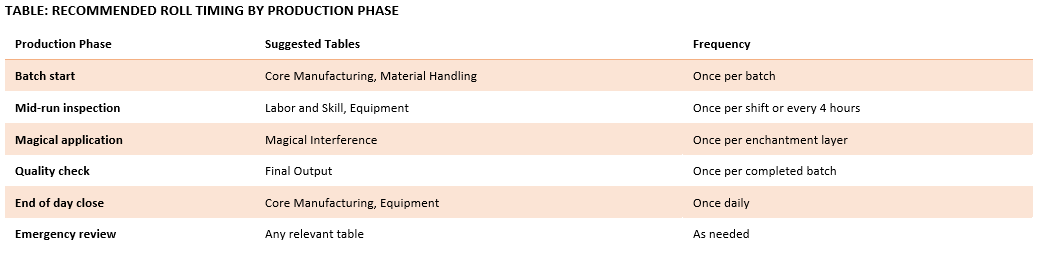
For high value items such as enchanted weapons, magical scrolls, or alchemical elixirs, roll more frequently. For bulk goods like rope, nails, or simple cloth, roll once per day or once per large batch.

Core Manufacturing Event Roll

This table represents the general state of the shop floor during a production run. Roll once per batch using a d20. This is the foundational role that sets the tone for all other checks.
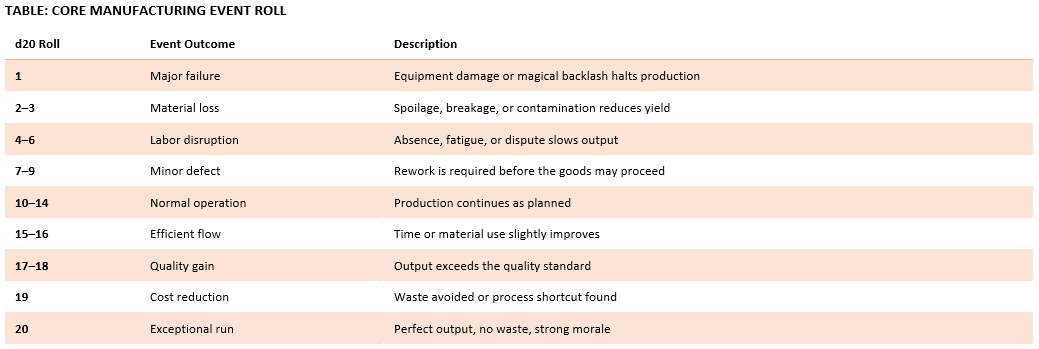
This table sets the batch tone and indicates which deeper tables should be rolled next. A major failure on this roll means you should roll on the Equipment table to determine what broke. Material loss triggers a Material Handling roll to understand the source.

Material Handling Events

This table shows how raw goods are issued, stored, or staged. Roll a d12 when materials are drawn into production. Material events often explain inventory discrepancies identified during cycle counts or month-end reconciliations.
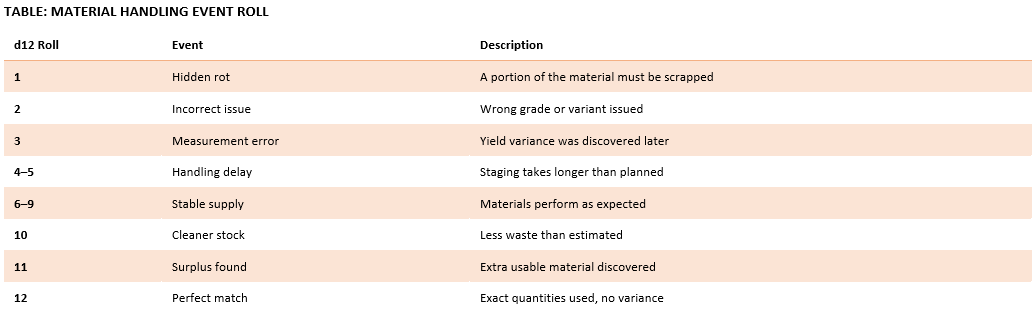
When a material event occurs, the production scribe must record it on the batch traveler. Hidden rot may result in an immediate shortage that requires additional requisitions. Measurement errors often appear during final reconciliation when expected versus actual usage is compared.

Labor and Skill Events

This table reflects the people doing the work. Roll a d12 during mid-run inspection. Labor is the most variable component in any workshop, and these events capture the human element behind every forged blade and stitched boot.
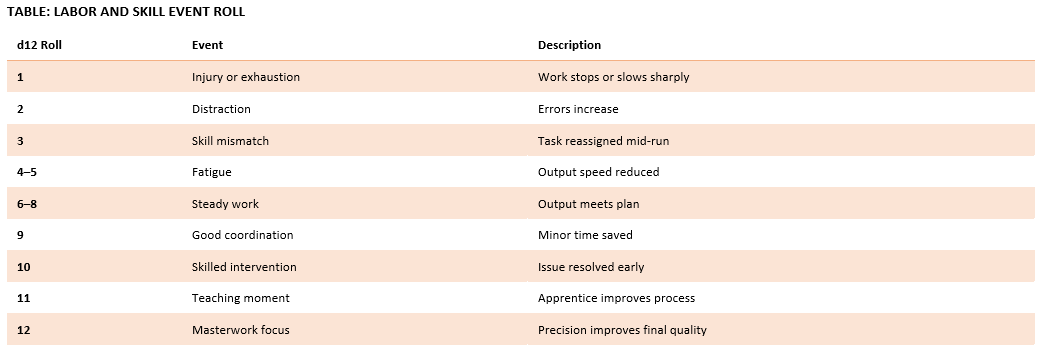
Labor events often affect both speed and quality at once. An injury may halt work for hours while a replacement is found. A teaching moment may slow the current batch but improve future runs. These outcomes should be recorded in the labor log and reviewed during weekly production meetings.

Equipment and Tool Events

This table represents tools, furnaces, presses, stills, or arcane devices. Roll a d10 when equipment is heavily used. Equipment is the backbone of consistent output, and failures here cascade into cost overruns and schedule delays.
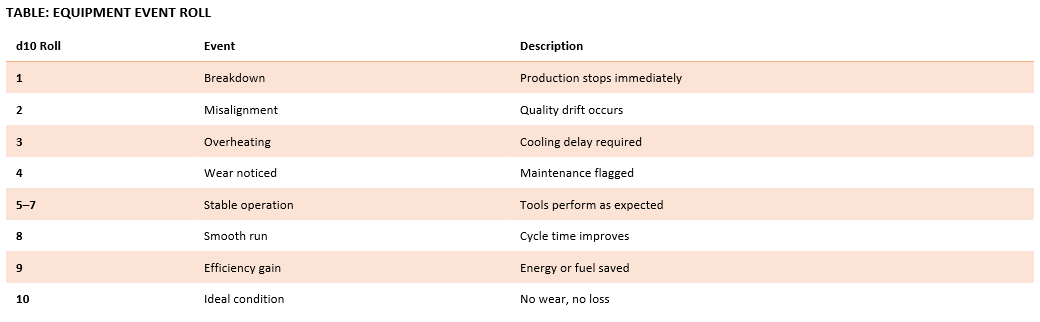
Equipment events explain maintenance backlogs and unplanned downtime. A breakdown on roll 1 requires an immediate repair work order and may delay shipments by days. Efficiency gains on roll 9 should be documented so the workshop master can replicate the conditions in future runs.

Magical Interference Events

If magic is involved, roll this table once per batch using a d8. Magical production introduces unique risks tied to ambient arcane energy, rune stability, and spell containment. Even experienced enchanters cannot fully control every variable.
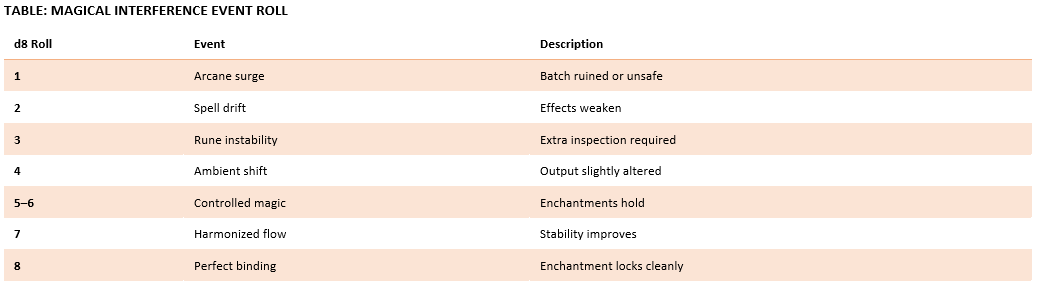
Magical events often justify extra inspection steps or batch holds. An arcane surge on roll 1 may require the entire batch to be destroyed and disposed of safely. Perfect binding on roll 8 means the enchantment is exceptionally stable and may command a premium price.

Final Output and Packaging Events

This table reflects what happens after production finishes. Roll a d12 at batch close. Final output events determine whether goods are ready for shipment, need rework, or exceed expectations.
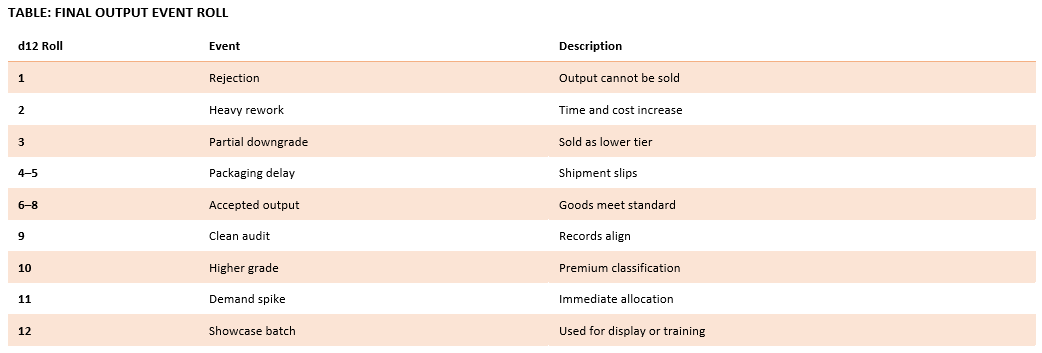
This table often feeds pricing and allocation decisions. A rejection on roll 1 results in total loss: the batch must be scrapped or salvaged. A showcase batch on roll 12 may be sent to the Waterdeep showroom or used in negotiations with high-value clients.

Additional Event Tables for Complex Operations

Weather and Environmental Events

Weather affects outdoor work, drying times, and material stability. Roll a d10 when production is exposed to the elements or relies on natural conditions.
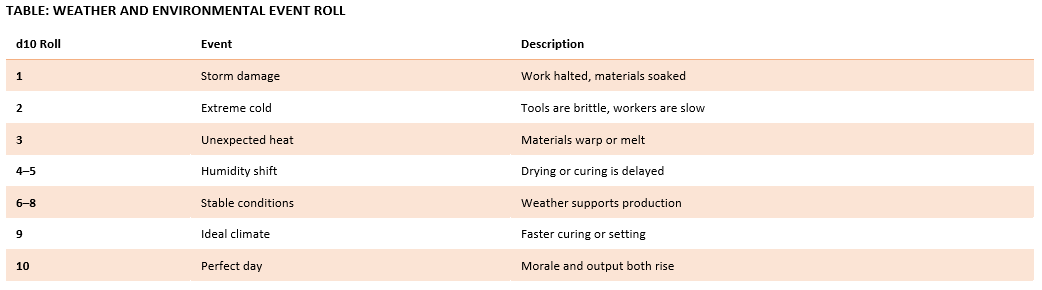
Weather events are common in shipyards, tanneries, dye houses, and potion gardens. A storm on roll 1 may ruin an entire week’s worth of drying hides. Perfect weather on roll 10 accelerates schedules and reduces cost.

Supply Chain Disruption Events

This table represents issues beyond the workshop walls. Roll a d8 when waiting on critical materials, subcontractor deliveries, or guild approvals.
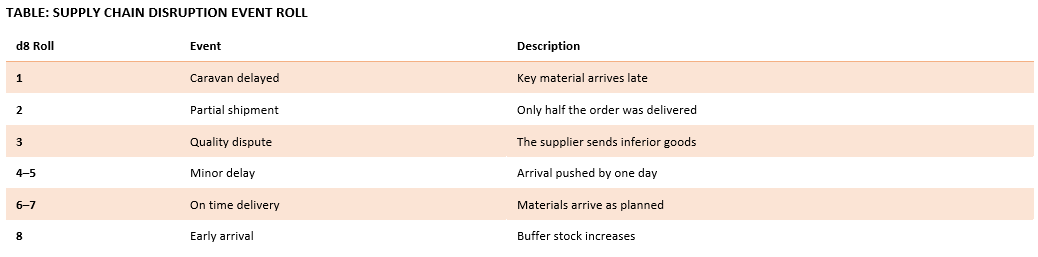
Supply chain events cascade into manufacturing schedules. A delayed caravan on roll 1 may force the workshop to halt or switch to a different product. Early arrival on roll 8 enables work to begin ahead of schedule.

Inspection and Compliance Events

Quality inspectors, guild auditors, and arcane regulators all visit workshops. Roll a d10 when an inspection is scheduled or occurs randomly.
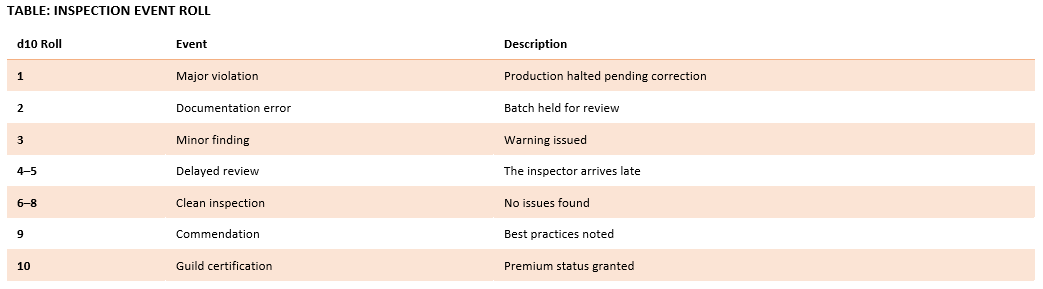
Inspection events affect reputation and market access. A major violation on roll 1 may result in fines and lost sales. Guild certification on roll 10 opens doors to exclusive contracts and higher pricing.

Interpreting Results and Taking Action

When an event is rolled, the production scribe must record the outcome and determine the response. Every roll has financial and operational consequences.

Response Framework by Event Severity

The following table provides guidance on how to respond to different events. Each response type includes suggested documentation and escalation paths.
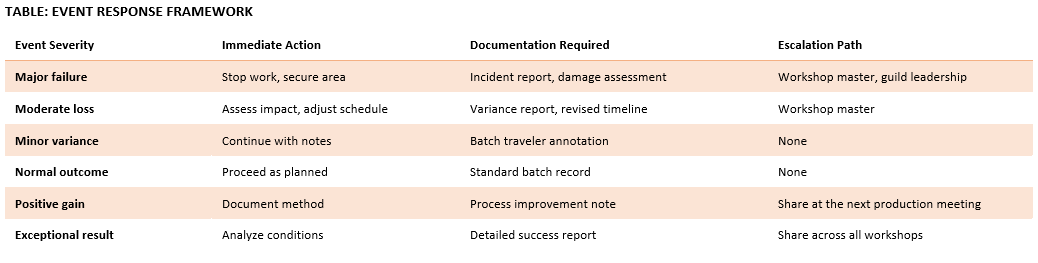
This framework ensures that events are handled consistently and that knowledge is captured for future improvement.

Recording Events: The Production Log

Every event should be logged in the production journal. This creates a historical record that can be analyzed for patterns, trends, and root causes. The log format should include the following fields.
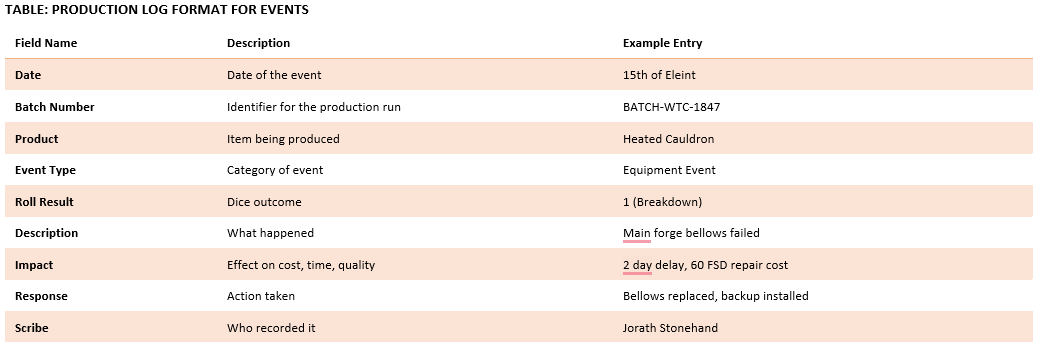
Over time, this log reveals which events are most common, which products are most vulnerable, and which workshops need additional support.

Worked Example: A Heated Cauldron Production Run

To demonstrate how these tables work together, here is a complete production scenario for a batch of five heated cauldrons. The Waterdeep Trading Company produces these in its Dock Ward foundry.

Batch Details

Product: Heated Cauldron
Batch Size: 5 units
Standard Cost per Unit: 285.00 FSD
Expected Total Cost: 1,425.00 FSD
Production Duration: 3 days

Day 1: Batch Start

Core Manufacturing Event Roll: d20 = 7 (Minor defect)
Material Handling Roll: d12 = 9 (Stable supply)

The batch begins with materials issued correctly. However, during the first day of forging, a minor defect was detected in the iron shaping. The rims are slightly uneven. This requires an additional hour of grinding and refinishing.

Cost Impact: +15.00 FSD labor (1 hour at 15 FSD per hour)
Schedule Impact: None (absorbed within shift)

Day 2: Mid Run Inspection

Labor and Skill Roll: d12 = 10 (Skilled intervention)
Equipment Roll: d10 = 8 (Smooth run)

The master smith notices the issue from Day 1 and adjusts the forming technique mid-run. This prevents further defects and slightly reduces cycle time. The forge operates smoothly throughout the shift.

Cost Impact: -10.00 FSD (time saved reduces labor cost)
Schedule Impact: 2 hours ahead of plan

Day 3: Magical Enchantment

Magical Interference Roll: d8 = 3 (Rune instability)

During enchantment, the heating runes show minor instability. The enchanter detects this during testing and re-inscribes two of the five cauldrons. This takes an additional three hours.

Cost Impact: +45.00 FSD arcane labor (3 hours at 15 FSD per hour)
Schedule Impact: 3 hours behind plan (net 1 hour behind overall)

Day 3: Final Output

Final Output Roll: d12 = 9 (Clean audit)

All five cauldrons pass final inspection with records fully aligned. The batch is approved for packaging and shipment.

Cost Impact: None
Schedule Impact: None

Final Batch Cost Summary

The following table shows how the event rolls impacted the total cost for this batch of five heated cauldrons.

The batch finished with a total variance of 50.00 FSD, or 3.5 percent over standard cost. This is within acceptable tolerance and can be absorbed into normal pricing. The production log notes that skilled intervention is the best practice for future runs.

How the Waterdeep Trading Company Uses These Rolls

These tables are not about chance alone. They create repeatable pressure that mirrors real operations. The company uses them in several ways.

Training and Simulation

New production scribes and workshop apprentices roll through simulated batches to learn how variance affects cost, time, and quality. They practice writing incident reports, calculating cost impacts, and deciding when to escalate issues.

Planning and Buffering

Historical event data informs planning assumptions. If Equipment Events show a 15 percent breakdown rate over six months, the company schedules preventive maintenance more frequently and keeps backup tools on hand.

Variance Analysis

Event rolls provide a structured way to explain why actual costs differ from standard costs. Instead of vague entries like “production issues,” the ledger shows “Equipment breakdown on Day 2, repair cost 60 FSD.”

Process Improvement

Positive events, such as skilled interventions or efficiency gains, are studied and replicated. The company documents the conditions that led to success and trains other workers in the technique.

A good company does not avoid events. It prepares for them, learns from them, and becomes stronger because of them.

Event Frequency by Product Type

Not all products face the same level of risk. The following table provides guidance on how often to roll based on product complexity and value.
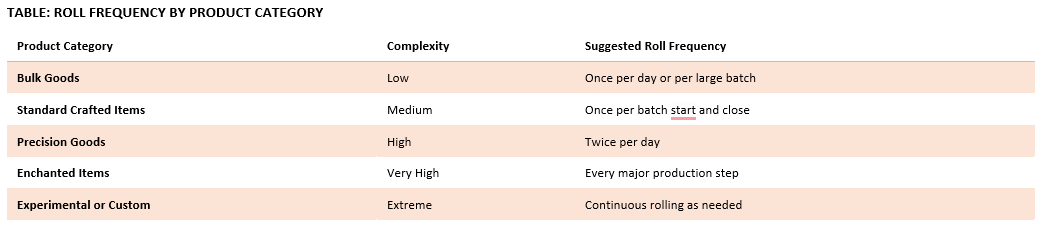
Bulk goods like nails, rope, or simple pottery have fewer variables. Enchanted weapons, alchemical compounds, and magical scrolls demand constant attention and more frequent checks.

Compound Event Scenarios

Sometimes multiple events occur in sequence or concurrently. These compound scenarios test the workshop’s resilience and the production team’s skill.

Example Compound Event: Storm During Enchantment

Scenario: A storm strikes (Weather Event roll = 1) while enchanting cauldrons (Magical Interference roll = 2). The storm disrupts ambient arcane energy, causing spell drift.

Response:

  1. Halt enchantment immediately to prevent arcane surge.
  2. Secure materials and equipment.
  3. Resume enchantment after the storm passes, re-inscribing affected runes.
  4. Log both events with a full impact assessment.

Cost Impact: 80.00 FSD (lost time, rework, materials ruined by moisture)
Schedule Impact: 1 full day delay

Compound events reveal weak points in process design and highlight the need for contingency plans.

Final Thoughts

Manufacturing in Faerûn is shaped by hands, heat, tools, and magic. Dice tables give structure to uncertainty and help explain why strong systems matter even on good days.

These rolls do not replace good management. They enhance it. They teach scribes to expect variance, record it clearly, and respond with skill rather than panic. Over time, a workshop that uses these tables will build a deeper understanding of its own rhythm, strengths, and fragilities.

The Waterdeep Trading Company knows that mastery comes not from avoiding trouble, but from meeting it with prepared hands and clear minds.

Use these tables to teach, to simulate, and to tell better operational stories inside the workshops of Faerûn.

This interplay of principles produces financial statements that outside parties can trust, management can use to make decisions, and auditors can verify. The result is a shared language of commerce understood throughout Faerûn.


Support the AD&D365 Project on Patreon.  To grow this world, we’ve launched an official Patreon page where supporters can access exclusive content, tools, and training labs, and even influence the project’s future. Your support fuels more than just development; it expands the guildhall, forges new scrolls, and empowers the next generation of configuration wizards.  Begin your journey: https://www.patreon.com/adnd365/

A Grateful Salute to Our Patrons.  To all those who stand behind the vision, thank you for helping bring this world to life. Our Benefactors, Andre Breillatt and Eryndor Fiscairn, your boundless generosity fuels the arcane core of this project. Without your magic, the weave would falter. Our Apprentices, the spell engines turn, and the training labs thrive thanks to our current Apprentices: Michael Ramirez and Andreth Bael’Rathyn. Special thanks to our past Apprentices, whose contributions helped us get here: Ralf Weber, Wendy Rijners, Shashi Mahesh, Julia Tejera, Ben Ekokobe, Tiago Xavier, Naveen Boyinapelli, Marcos Tadeu Wolf, Kathryn Greene, Jason Brown, Mark Christy, and Ashish Singh. Our Initiates, Jesper Livbjerg, Peter Lorre, Gregory Brigden, and Martin Grahm, your commitment marks the start of the deeper path, stepping beyond mere observation into the active shaping of this realm. Our Followers, your steady presence along the journey is a beacon of encouragement: Rusty Cavalier, Eric Shuss, Sunil Panchal, Sarah D. Morgan, Nick Ramchandani, Daniel Kjærsgaard, and Tomasz Pałys. And our Voyeurs, Harry Burgh, Abdelrahman Nabil, and Basil Quarrell, ever watching from the shadows, clearly intrigued… but not enough to part with a single gold piece. Your silent curiosity is noted and mildly judged.

Want to design your own economic models in Faerûn?  Get your own AD&D365 Environment and guides at adnd365.com/start, and request access to the public view of the current database at https://public.adnd365.com – Login npc@adnd365.com, Password N0nPl@yC#822!

In Faerûn, the art of crafting is as regional as its cuisine. From the spell-drenched halls of Waterdeep to the labor-rigged forges of Neverwinter, every locale brings with it a unique blend of resources, guild politics, magical infrastructure, and economic volatility. For the Waterdeep Trading Company, understanding these regional cost modifiers is essential to maximizing margin and optimizing the costing sheets that guide production decisions.

Whether you’re crafting alchemical reagents in Calimport, forging plate armor in Baldur’s Gate, or weaving silks in Silverymoon, the cost to produce an item is never static. This article explores the key modifiers that affect production costs across cities, and why your costing sheet must adapt accordingly.

What It Is

A regional cost modifier is a set of economic conditions tied to a specific city or region that influences how much it costs to manufacture a product. These include:

  • Labor Guild Rates: Wages for skilled and unskilled labor, often dictated by local guilds
  • Magical Infrastructure: Availability of enchantment circles, leyline-fed workshops, and arcane utilities
  • Raw Material Scarcity: Local availability or import dependency of key materials
  • Trade Access & Taxes: Tariffs, teleportation fees, and black market presence

These factors combine into a regional multiplier that can dramatically affect the final cost of production.

Why It Matters

For cost sheets to remain accurate, they must factor in where crafting occurs. Producing a potion in Waterdeep is faster and cheaper thanks to arcane infrastructure, but the same potion in Neverwinter may require higher-paid alchemists and extra stabilization materials due to leyline drift.

Ignoring regional modifiers risks:

  • Undercosting in high-expense regions
  • Overpricing in optimized production zones
  • Misallocation of production contracts across the realm

Understanding cost variability allows the Waterdeep Trading Company to assign production tasks to the most cost-effective locations.


Support the AD&D365 Project on Patreon. To grow this world, we’ve launched an official Patreon where supporters can gain access to exclusive content, tools, training labs, and even influence the future of the project. Your support fuels more than just development ,  it expands the guildhall, forges new scrolls, and empowers the next generation of configuration wizards.  Begin your journey: https://www.patreon.com/adnd365/

A Grateful Salute to Our Patrons. To all those who stand behind the vision, thank you for helping bring this world to life. Our Benefactor, Andre Breillatt,  Your boundless generosity fuels the arcane core of this project. Without your magic, the weave would falter. Our Apprentices,  The spell engines turn and the training labs thrive thanks to our current Apprentices: Michael Ramirez and Andreth Bael’Rathyn (Name obfuscated to protect their identity). Special thanks to our past Apprentices, whose contributions helped us get here:  Ralf Weber, Wendy Rijners, Shashi Mahesh, Julia Tejera, Ben Ekokobe, Tiago Xavier, Naveen Boyinapelli, Marcos Tadeu Wolf, Kathryn Greene, Jason Brown, Mark Christy, and Ashish Singh. Our Followers,  Your steady presence along the journey is a beacon of encouragement: Sunil Panchal, Sarah D. Morgan, Nick Ramchandani, Daniel Kjærsgaard, and Tomasz Pałys. Our Voyeurs, Harry Burgh, Abdelrahman Nabil and Basil Quarrell, ever watching from the shadows, clearly intrigued… but not enough to part with a single gold piece. Your silent curiosity is noted, and mildly judged.


Components of Regional Cost Modifiers

Each modifier influences one or more components of the standard costing sheet. These are most often applied as multipliers to base values.

This table gives a clear example of how identical products may have different production costs depending on the crafting location.

Introducing Randomization

To reflect the ever-shifting nature of Faerûn’s economy, the Waterdeep Trading Company augments static modifiers with randomized roll tables. These are applied quarterly or during major campaign shifts.

Worked Example: Alchemical Resistance Salve

Subscribe to get access

Read more of this content when you subscribe today.


Want to design your own manufacturing models in Faerûn? Get your own AD&D365 Environment and guides at adnd365.com/start, and request access to the public view of the current database at https://public.adnd365.com (Login npc@adnd365.com, Password “N0nPl@yC#822!”)

In the trade halls of Waterdeep and the merchant caravans of the Sword Coast, fate and fortune walk hand in hand. It is only natural that guild administrators, supply masters, and finance scribes would embrace a method long familiar to adventurers: the humble dice roll. Whether settling a vendor dispute, simulating market shifts, or adjudicating magical failures, randomness provides realism and energy to even the most rigid ledgers.

This article explores how randomness—delivered through dice rolls—can be introduced into Dynamics 365 Finance and Operations to simulate the unpredictable world of Faerûn. From approval workflows to risk-based inventory adjustments, these dice-driven scenarios breathe life into business systems, making them immersive, dynamic, and fun to train on.

What It Is

Adding randomness means injecting chance into business processes—typically through d20s, d10s, or percentile dice—to determine outcomes that would otherwise be manually chosen or hard-coded. This can be done with real dice at the desk, random number functions in the system, or automated logic in tools like Power Automate.

This concept is particularly useful in the AD&D365 training environment, where simulation, roleplay, and unpredictability add value to onboarding, demonstrations, and business games.

Why It Matters

Randomization makes Dynamics 365:

  • More engaging: Training sessions become unpredictable and interactive
  • More immersive: Reflects the volatile world of Faerûn, where arcane mishaps and political whim can alter trade flows
  • More realistic: Models uncertainty, risk, and variability—key factors in logistics, finance, and customer behavior
  • More flexible: Dice-based logic can branch workflows and simulate outcomes not covered by standard rules

This approach also encourages creative thinking and decision-making among users, especially when playing out consequences from a bad roll or a stroke of luck.


Support the AD&D365 Project on Patreon. To grow this world, we’ve launched an official Patreon where supporters can gain access to exclusive content, tools, training labs, and even influence the future of the project. Your support fuels more than just development ,  it expands the guildhall, forges new scrolls, and empowers the next generation of configuration wizards.  Begin your journey: https://www.patreon.com/adnd365/

A Grateful Salute to Our Patrons. To all those who stand behind the vision—thank you for helping bring this world to life. Our Benefactor, Andre Breillatt — Your boundless generosity fuels the arcane core of this project. Without your magic, the weave would falter. Our Apprentices — The spell engines turn and the training labs thrive thanks to our current Apprentices: Michael Ramirez and Andreth Bael’Rathyn (Name obfuscated to protect their identity). Special thanks to our past Apprentices, whose contributions helped us get here:  Ralf Weber, Wendy Rijners, Shashi Mahesh, Julia Tejera, Ben Ekokobe, Tiago Xavier, Naveen Boyinapelli, Marcos Tadeu Wolf, Kathryn Greene, Jason Brown, Mark Christy, and Ashish Singh. Our Followers — Your steady presence along the journey is a beacon of encouragement: Sunil Panchal, Sarah D. Morgan, Nick Ramchandani, Daniel Kjærsgaard, and Tomasz Pałys. Our VoyeursHarry Burgh and Abdelrahman Nabil, ever watching from the shadows, clearly intrigued… but not enough to part with a single gold piece. Your silent curiosity is noted—and mildly judged.

Want to design your own manufacturing models in Faerûn? Get your own AD&D365 Environment and guides at adnd365.com/start, and request access to the public view of the current database at https://public.adnd365.com (Login npc@adnd365.com, Password “N0nPl@yC#822!”)


Dice-Driven Scenarios for Dynamics 365

Below are five structured examples where dice-based randomness is used to enhance different modules and processes within Dynamics 365. Each scenario includes a detailed table to show the dice mechanics, outcome descriptions, and suggested system actions.

Requisition Approval Simulation

Used during training or when modeling bureaucratic layers in large guild councils or merchant alliances. Dice can determine the fate of a requisition, from golden favor to outright rejection.

Inventory Loss During Transit

Use this scenario to simulate risk during transport across Faerûn—whether by road, portal, or elemental barge.

Supplier Quality Variance

Inconsistent supplier quality is common in both the mundane and magical economies of Faerûn. This roll simulates that variability.

Magical Infusion Risk Factor

When crafting enchanted goods, spellbound scrolls, or alchemical potions, randomness reflects the instability of arcane infusion.

Customer Response to Offer

From grumpy dwarves to eager guildmasters, not every customer reacts the same to your latest sales pitch.

Final Thoughts

Dice-based randomness in Dynamics 365 introduces fun, realism, and strategic complexity to even the most mundane workflows. For trainers, it’s a powerful engagement tool. For guild administrators and finance controllers, it’s a method of simulating Faerûn’s ever-changing tides of commerce, magic, and mischief.

Whether rolled in the boardroom or coded into automation scripts, the die is not just cast—it is integrated. Now, when a vendor’s delivery fails due to a vortex surge, or a potion turns violet instead of healing red, you have a system that responds in kind.

When Faerûnians hear “batch control,” their thoughts often drift to the rich scent of mead barrels aging beneath Baldur’s Gate, or to the tightly tracked crates of vintage wine headed for noble feasts in Waterdeep. But there’s another trade where batch control has become essential, not for taste, but for trust.

The Herbalists Guild of Faerûn (HRBL) has quietly adopted one of the most advanced forms of traceability across the continent. No longer just guardians of ancient remedies and hedge-grown wisdom, the herbalists are becoming stewards of supply chain integrity in a world where reputation can wilt faster than a summer thistle.

The Trouble With Loose Leaves

A few years ago, no one questioned where their feverfew sprigs came from. You bought them from a guild-certified apothecary, assumed they were properly harvested, dried, and dosed, and hoped for the best. But as Faerûn’s trade expanded and demand for rare potions exploded, the risks multiplied:

  • Spoiled wild yarrow from the Chondalwood weakened recovery potions across multiple outposts.
  • A black-market ring in Tethyr swapped skybloom petals with painted leaves from roadside weeds.
  • A corrupted batch of bitter nettle led to hallucinatory side effects in Luskan’s mercenary district.

Without traceability, the blame scattered like dandelion fluff in the wind. With traceability, the HRBL could trace the problem right back to the glade, the gatherer, and the moment of misharvest.

What Does Batch Control Look Like for Herbalists?

Under HRBL regulation, all registered ingredients now include the following details:

Every finished salve, tincture, or potion includes encoded batch marks readable by guild auditors and arcane inspection devices.

From Grove to Vial: How the Guild Tracks Flow

A simplified example:

  1. Frostroot is harvested outside Daggerford by a certified gatherer. It is assigned a batch code, bagged, tagged, and sealed with a guild rune.
  2. It enters a local guild node, where potency is tested and quality is validated. If the results fall below standard, it’s discarded or redirected to minor uses.
  3. A potion brewer in Elturel uses the frostroot batch to craft a batch of Resilience Draught. The potion is labeled with its own production code and linked back to every ingredient used.
  4. A recall alert is issued two weeks later due to a contamination issue upstream. The HRBL issues an order: all Resilience Draughts linked to that frostroot batch must be removed from shelves and adventuring packs by the next full moon.
  5. Compensation and sanctions are processed based on documentation. The brewer is cleared. The gatherer is retrained. The forest site is closed for inspection.

Why the Guild Cares Deeply About This

The HRBL isn’t driven by bureaucracy—they’re driven by the weight of responsibility. Herbalists aren’t just craftspeople; they’re caretakers of health, memory, and survival. When something goes wrong in a potion, people get hurt.

With batch tracking:

  • Safety becomes provable, not just promised.
  • Fraud becomes traceable.
  • Reputation becomes protectable.

And for guild members, it ensures that their skills are never devalued by counterfeiters or careless hands.

Looking Ahead

The Herbalists Guild of Faerûn is now experimenting with layered seals and arcane batch runes that react to climate, time, or tampering. Some regions are piloting seasonal certification marks, allowing rare spring blossoms to be certified separately from late bloomers.

In an age of magical volatility and global trade, traceability isn’t optional, it’s an ingredient in the potion itself.

If you work with ingredients, sell potions, or run an apothecary, now is the time to ask: Do you know where your herbs came from—and where they’ll go next?

To learn more about how the HRBL operates across Faerûn, grab the free public guild records at https://public.adnd365.com

Login: npc@adnd365.com

Password: “N0nPl@yC#822!”

Or start your own trade simulation with the full guides at adnd365.com/start.

In the unpredictable world of Faerûnian commerce, where a snowstorm in Ten-Towns or a goblin raid near the Trade Way can grind trade to a halt, the most successful merchants rely on more than fixed storage. They rely on motion. Enter the Rolling Warehouse. a revolutionary logistics solution blending transportation, storage, and strategic mobility.

More than a wagon and more than a warehouse, a Rolling Warehouse is a self-contained, mobile stockroom on wheels, designed to travel trade routes, supply outposts, and respond to shifting economic winds. They are the unsung heroes of supply chains, silently delivering prosperity from Baldur’s Gate to Bryn Shander.

What Is a Rolling Warehouse?

A Rolling Warehouse is a heavily fortified and often enchanted freight caravan used by trading companies, merchant guilds, and military suppliers. Each is designed to carry both volume and value, everything from winter cloaks and dried meat to enchanted blades and potions of healing. These units serve not only as transport but also as temporary depots, allowing goods to be staged and distributed closer to where they’re needed.

They often travel with their own crew: Loadmasters, Inventory Porters, Beastmasters, and in many cases, a warded security specialist to guard high-value cargo from magical or mundane threats.

Why Faerûn Needs Them

Example: During Deepwinter, Luskan’s frozen port cut it off from southern trade. A pair of Rolling Warehouses diverted from Neverwinter to bring hardtack, salted fish, and oil lamps just in time for the Harbor Festival, saving both the event and the city’s reputation for hospitality.

The Anatomy of a Rolling Warehouse

A Rolling Warehouse is more than a cart with crates. It’s a coordinated, living supply operation that combines enchantment, engineering, and enterprise. Let’s break down each essential component and role in the system:

Stocking and Inventory Assignment

Before departure, inventory is staged and loaded based on a blend of demand forecasts, trade route conditions, and strategic needs. Typical categories include:

  • Staple goods: flour, salt, hardtack, cloth, lamp oil
  • Seasonal items: cloaks in winter, festival gear, fresh herbs
  • Magical wares: low-grade healing potions, enchantment runes, arcane ink
  • Emergency supplies: tents, medical kits, cursed item containment jars

Loadmasters consult with trade coordinators and use encoded scrolls or enchanted manifests to document inventory, with each item sealed in containers labeled by alchemical ink or guild wax.

Route and Dispatch Planning

Rolling Warehouses don’t just go — they’re assigned planned corridors that span guild-supported outposts and waystations. A single trip may involve:

  • Primary Route Scroll: Identifies destination cities, rest points, terrain conditions
  • Fallback Paths: Reroute options in case of natural disasters, road collapse, or raids
  • Mirror Comm Check-ins: Scheduled reports using communication mirrors or relay stones to confirm location, progress, and route condition

Dispatch teams coordinate with local porters’ guilds to ensure paved roads, safe harbors, and posted watch rotations for night travel. Major houses often sponsor a Route Scryer to monitor the caravan via crystal ball or mirror scrying.

Active Storage and Mobile Distribution

Unlike static warehouses, Rolling Warehouses function as live inventory centers, capable of conducting business on the road:

  • Pop-Up Markets: Crews can open side panels and convert into mobile market stalls for roadside sales
  • Camp Drops: In wartime or expedition supply chains, inventory can be issued directly to troops or adventuring guilds from the cart
  • Staggered Deliveries: Deliver only parts of inventory across multiple stops while still in motion

Each Rolling Warehouse carries a Porter Ledger, tracking items moved in or out during the journey. These ledgers are enchanted for heat, water, and tamper resistance, and some sync with merchant guild registries on arrival.

Crew and Roles Aboard the Warehouse

A standard Rolling Warehouse caravan is a self-sufficient crewed operation, including:

Many caravans also employ a Beastmaster, especially if large animals or magical creatures are used for pulling the warehouse or guarding the route.

Security and Defense Enchantments

Given the value of mobile stock, Rolling Warehouses are hardened with both mundane and magical defenses:

  • Ironwood Plating: Fire-resistant and enchanted to resist blunt force
  • Ward Glyphs: Trigger alarms, illusions, or stunning shocks when unauthorized access is attempted
  • Chameleon Cloaks: Optical illusions that make the wagon appear as mundane freight or even a ruined cart
  • Defensive Traps: Tethered glyphstones that activate spikes, glue traps, or blinding light upon breach

In high-risk areas (such as routes through the Mere of Dead Men or past the Fields of the Dead), caravans may travel with hired guards, mercenary scouts, or even arcane-bound sentries perched atop the wagons.

Inspection and Resupply Stations

Rolling Warehouses depend on access to inspection points, which serve as both safety checks and replenishment hubs. These typically include:

  • Resupply Docks: Load up new inventory, swap beasts, refill enchanted refrigeration chambers
  • Magical Checkpoints: Realign route glyphs or stabilize pocket dimension storage
  • Guild Audits: Ensure taxes, fees, and guild tariffs are settled before passing through toll towns or protected zones

These checkpoints are manned by representatives from the Freight Consortium or United Caravaners, and sometimes host local scribes who issue transit seals and approval glyphs.

Magical Enhancements on the Move

Some Rolling Warehouses are little marvels of logistics enchantment. Features may include:

Guild Oversight and Support

These mobile units are often sanctioned by the United Caravaners & Teamsters Guild, with regulatory support from organizations like the Faerûn Dockworkers Federation and the Faerûnian Freight Consortium. Crews are trained and guild-certified, with rotating assignments, insurance scrolls, and emergency messenger birds for route disruptions.

Case Study: A Midwinter Trade Pivot

Origin: Waterdeep Destination: Fireshear (rerouted from Luskan) Cargo: Wool cloaks, dried fruits, firewood bundles Complication: Ice trolls attacking the western coast trade roads Solution: Diverted inland via Mirabar trade road, secured by mercenaries from the Free Adventurers League Outcome: Delivery made only three days late, saving the village festival and landing the company a lucrative snow-elk jerky contract

Conclusion

Rolling Warehouses are not merely logistical tools. They’re a symbol of adaptability, trust, and foresight in an unpredictable world. Whether supplying adventurers in the Spine of the World or provisioning a merchant gala in Athkatla, these mobile marvels prove that sometimes the best warehouse isn’t a building. it’s a moving target.

Looking to roll your inventory into action? Buy the guides at adnd365.com/start and request access to the public Faerûnian trade database at https://public.adnd365.com

Username: npc@adnd365.com

Password: N0nPl@yC#822!

In Faerûn, no successful merchant operates alone. Behind every cartload of enchanted textiles or barrel of trollwine stands a guild – documenting, inspecting, regulating, and, when necessary, demanding compensation. These are not advisory councils or informal collectives. They are the law in most cities when it comes to tradecraft, labor, pricing, and apprenticeships.

At the Waterdeep Trading Company, guilds form the foundation of our entire supply network. From the warehouses of Silverymoon to the docks of Calimport, our ability to do business depends on how well we manage, track, and respect these institutions.

What Is a Guild in Faerûn?

To an outsider, a guild may look like a club of craftsmen. To a merchant, it is a governing body. Guilds in Faerûn:

  • Regulate Pricing: They set base prices and forbid undercutting or overpricing.
  • Enforce Quality Standards: Products bearing the guild seal meet standards of safety, craftsmanship, and purity.
  • Manage Apprenticeships: Only members of a guild can legally train new workers in a trade.
  • Control Certification: From spell-tuned brewing to adamantine shaping, guilds determine who is licensed to work in a craft.
  • Settle Disputes: Guild arbitration often supersedes civil courts in trade matters.
  • Oversee Regional Chapters: Each major city has a chapter following the central charter while adjusting for local needs.

Organizing Guild Information in Your Company

To manage guilds effectively, companies like ours treat each one like a partner, with structured records and established procedures.

Guild Directory Examples

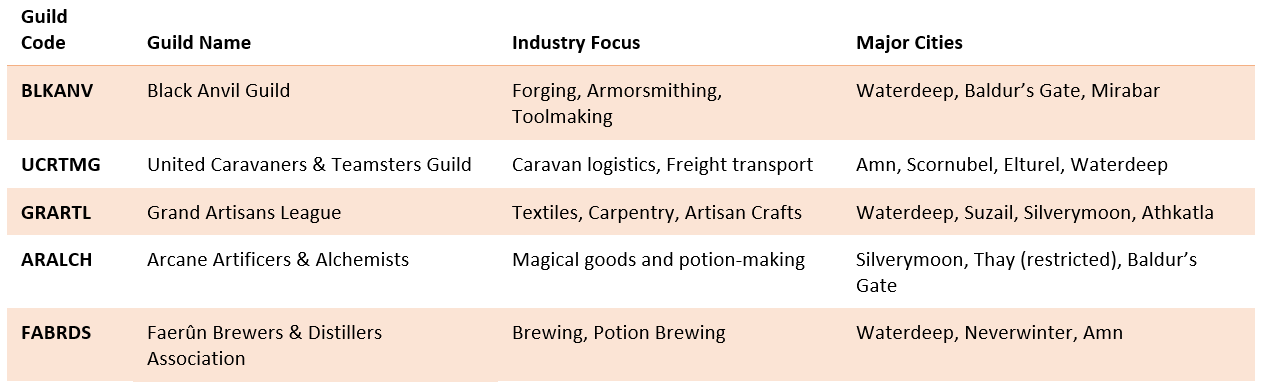
Here are a few of the more prominent guilds the Waterdeep Trading Company works with:

Guilds govern not just trade but talent. If you want to hire a certified loommaster, a leyline-calibrated enchanter, or a crystal alchemist with reliability, guild records are your best friend.

Merchants should track:

  • Certification Validity (including expiration and issuing chapter)
  • Completed Apprenticeship Logs (trainer, craft, rating)
  • Advancement Requests (for promotion to master rank or guild chair)
  • Guild Exams (success rates and focus areas)

By doing this, you can ensure you’re always working with approved craftsmen and that your wares pass muster when they reach port inspectors.

Managing Guild Contracts

Contracts with guilds are not one-size-fits-all. A shipping agreement with the Teamsters may include:

  • Volume quotas
  • Minimum wage requirements
  • Safety and magical seal inspections
  • Contingency routes for high-risk regions
  • A procurement agreement with the Black Anvil Guild might include:
  • Fixed pricing tiers for steel or mithral goods
  • Priority supply in wartime
  • Enchantment inspection clauses

Track these by guild, chapter, and effective date—and always be aware of when a renegotiation period is due.

Dispute Resolution and Compliance

Most cities allow guilds to enforce their own rulings within their domain. When a dispute arises:

  • Arbitration is often mandatory
  • Guild fines may be binding on the merchant
  • Disciplinary actions (such as blacklisting) can affect all affiliated trade

Maintain detailed logs of:

  • Complaints filed
  • Guild responses
  • Resolution terms
  • Any modifications to contracts or certifications following the ruling

This protects your company and helps build a reputation as a guild-respecting trading house.

Guild Reporting and Oversight

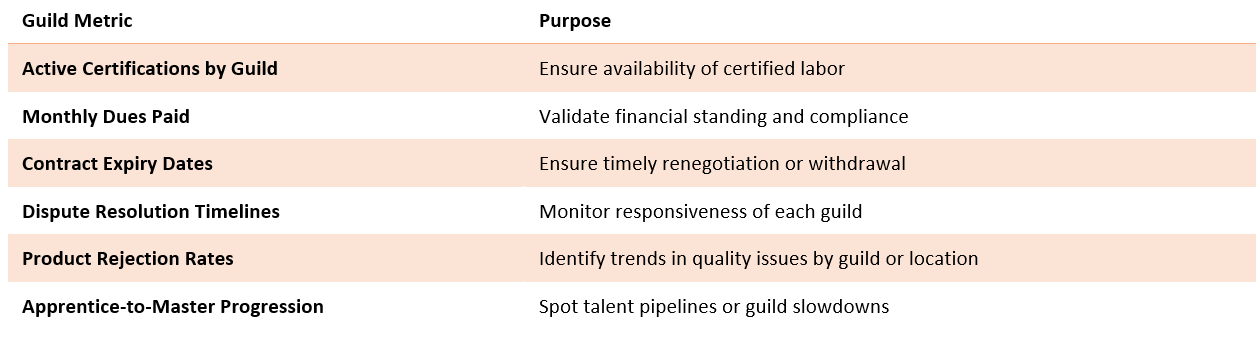
Larger operations should develop guild reporting practices. Here are a few metrics we track:

Final Thoughts: Why Guilds Deserve Respect

Guilds don’t just protect craftsmen—they protect the economy. They ensure that products move fairly, workers are trained properly, and that bad actors can’t flood the market with cursed tankards and half-finished crossbows.

For a trading company, building strong, respectful, well-documented relationships with every guild you work with isn’t just a best practice—it’s the key to staying in business.

Want to start managing your guild partnerships better? Check out the guides at adnd365.com/start and explore the public demo environment at https://public.adnd365.com, using:

Login: npc@adnd365.com

Password: N0nPl@yC#822!