Archive

Tag Archives: writing

Along the Sword Coast, speed often matters more than storage. Ale spoils, grain attracts pests, and caravan space is never free. For the Waterdeep Trading Company, letting goods sit idle is not always wise. In many cases, the safest and most profitable choice is to keep them moving.

Cross-dock replenishment is the practice of receiving goods and forwarding them without placing them in long-term storage. Crates arrive, are checked, sorted, and routed, then leave the same day for shops, inns, or onward caravans. Coin is protected by reducing handling, reducing risk, and reducing time.

This article explains how cross-dock replenishment works in Faerûn, why it matters, which products fit the model, and how the Waterdeep Trading Company applies it across its trade routes.

What Cross-Dock Replenishment Is

Cross-dock replenishment is a logistics method where inbound goods are matched directly to outbound demand. Inventory passes through the warehouse, but does not truly enter it.

At the Waterdeep Trading Company, this means a shipment arriving from Baldur’s Gate in the morning can be split and loaded onto outbound wagons to Daggerford and Neverwinter by nightfall. The dock is a meeting point, not a resting place.

This approach relies on timing, trust in suppliers, and clear commitments from customers.

Why It Matters to the Waterdeep Trading Company

Storage has a cost even when rent is paid in advance. Every extra day a crate sits increases the risk of loss, spoilage, theft, and tied-up coin.

Cross-docking matters because it reduces.

  • Handling labor, fewer touches per crate
  • Inventory value on the books is lower, and working capital
  • Damage and spoilage, especially for food and drink
  • Congestion inside city warehouses

It also improves service. Taverns receive fresher ale, healers receive timely herbs, and merchants can promise delivery dates with confidence.

Products That Fit Cross-Dock Replenishment

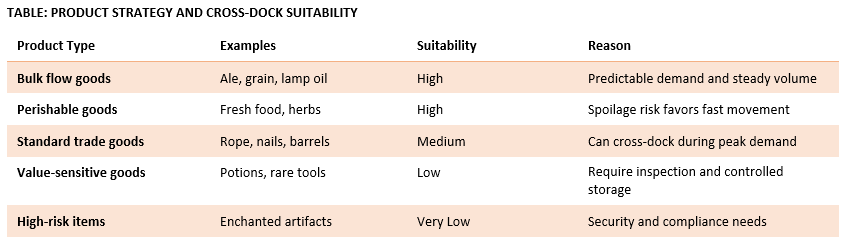
Not every product belongs on a cross-dock. The Waterdeep Trading Company uses product strategy to decide what moves fast and what rests.

Cross-docking is most effective when demand is known before the goods arrive.

How the Cross-Dock Flow Works

Cross-dock replenishment follows a strict rhythm. If timing slips, the benefits vanish.

Inbound caravans arrive during scheduled windows. Goods are checked for quantity and condition only; no detailed inspection is performed. Crates are tagged by destination and staged briefly on the dock floor. Outbound wagons or river barges are already assigned and waiting. Goods are loaded and depart the same day.

The dock behaves more like a crossroads than a warehouse.

Cross-Dock Versus Traditional Warehousing

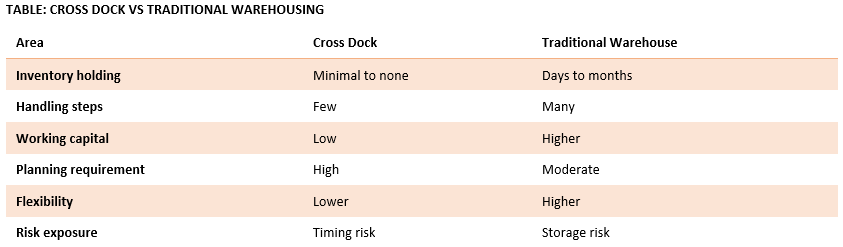
Understanding the difference helps planners choose the right model.

The Waterdeep Trading Company uses both models, often side by side in the same facility.

Worked Example: Ale Replenishment for Sword Coast Taverns

A shipment of 120 crates of ale arrives from the breweries near Baldur’s Gate at dawn.

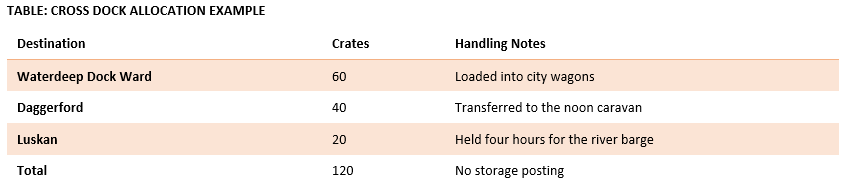
Orders already exist for Waterdeep Dock Ward taverns, Daggerford inns, and a Luskan caravan. Instead of placing the ale into storage, the crates are divided immediately.

By nightfall, the dock is empty, and coin has already been earned from fulfilled orders.

Risks and Controls

Cross-dock replenishment trades storage risk for timing risk. When something goes wrong, the impact is immediate.

Common risks include delayed caravans, missing outbound capacity, and mismatched quantities. To control this, the Waterdeep Trading Company relies on confirmed orders, fixed dock schedules, and clear cut-off times. If an inbound caravan misses its window, goods are diverted to standard storage instead of blocking the dock.

Cross-docking is never forced. It is chosen when conditions are right.

Realms Aware Considerations

Faerûn adds its own flavor to cross-dock operations. The weather can close mountain passes. Guild inspections can delay unloading. Magical interference can spoil timing spells used for coordination.

For this reason, cross-docking is more common near major hubs like Waterdeep and Baldur’s Gate, where routes are dense and backup options exist.

Final Thoughts

Cross-dock replenishment is not about speed alone. It is about intent. Goods that are meant to flow should be allowed to flow.

For the Waterdeep Trading Company, cross-docking protects coin, reduces waste, and supports reliable trade across the Sword Coast. Used wisely, it keeps warehouses clear and customers satisfied.


Support the AD&D365 Project on Patreon.  To grow this world, we’ve launched an official Patreon page where supporters can access exclusive content, tools, and training labs, and even influence the project’s future. Your support fuels more than just development; it expands the guildhall, forges new scrolls, and empowers the next generation of configuration wizards.  Begin your journey: https://www.patreon.com/adnd365/

A Grateful Salute to Our Patrons.  To all those who stand behind the vision, thank you for helping bring this world to life. Our Benefactors, Andre Breillatt and Eryndor Fiscairn, your boundless generosity fuels the arcane core of this project. Without your magic, the weave would falter. Our Apprentices, the spell engines turn, and the training labs thrive thanks to our current Apprentices: Michael Ramirez and Andreth Bael’Rathyn. Special thanks to our past Apprentices, whose contributions helped us get here: Ralf Weber, Wendy Rijners, Shashi Mahesh, Julia Tejera, Ben Ekokobe, Tiago Xavier, Naveen Boyinapelli, Marcos Tadeu Wolf, Kathryn Greene, Jason Brown, Mark Christy, and Ashish Singh. Our Initiates, Jesper Livbjerg, Peter Lorre, Gregory Brigden, and Martin Grahm, your commitment marks the start of the deeper path, stepping beyond mere observation into the active shaping of this realm. Our Followers, your steady presence along the journey is a beacon of encouragement: Rusty Cavalier, Eric Shuss, Sunil Panchal, Sarah D. Morgan, Nick Ramchandani, Daniel Kjærsgaard, and Tomasz Pałys. And our Voyeurs, Harry Burgh, Abdelrahman Nabil, and Basil Quarrell, ever watching from the shadows, clearly intrigued… but not enough to part with a single gold piece. Your silent curiosity is noted and mildly judged.

Want to design your own economic models in Faerûn?  Get your own AD&D365 Environment and guides at adnd365.com/start, and request access to the public view of the current database at https://public.adnd365.com – Login npc@adnd365.com, Password N0nPl@yC#822!
Once an organization decides that a code should be fixed-length, the next question is unavoidable.

How long should it be?

Too short, and the code runs out of room or loses clarity.
Too long; it becomes slow to read, hard to type, and error-prone.

The Waterdeep Trading Company treats code length as a design decision, not a guess. This article explains how to select the appropriate length for fixed codes using practical customer-group examples.

What Fixed Length Is Solving

Fixed-length codes exist to create predictability.

They allow

  • Clean sorting
  • Consistent reports
  • Easy scanning
  • Stable training materials

Length determines how much meaning and growth can be packed into that predictability.

Common Fixed Length Options with Examples

Two Characters

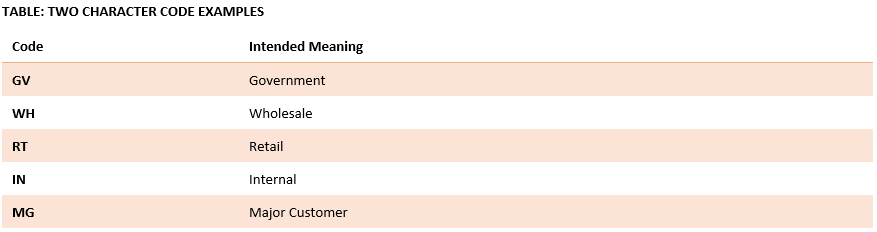
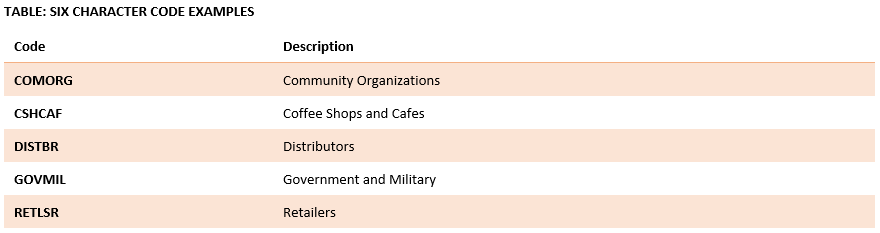
Two character codes are rarely sufficient for business classifications.

They only work when

  • The list is extremely small
  • The values will never grow
  • Meaning is obvious without explanation

For customer groups, this breaks almost immediately.

These become ambiguous as soon as the business needs subcategories.

Four Characters

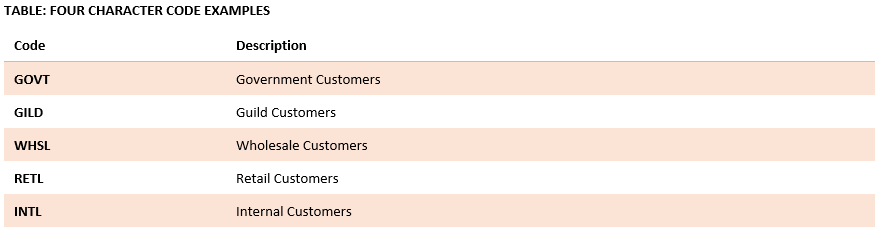
Four-character codes work for small, controlled domains.

They are often used for

  • Region codes
  • Short site identifiers
  • Very limited category lists

Expansion pressure becomes apparent as the list grows.

Six Characters

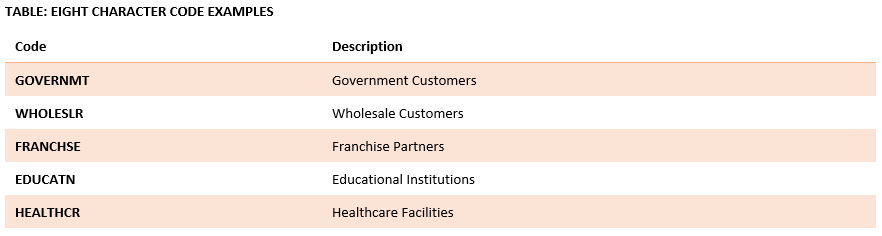
Six characters are the most common reference data balance points.

They allow

  • Clear abbreviations
  • Visual consistency
  • Room for moderate growth

This length supports scalability while remaining readable and easy to train on.

Eight Characters

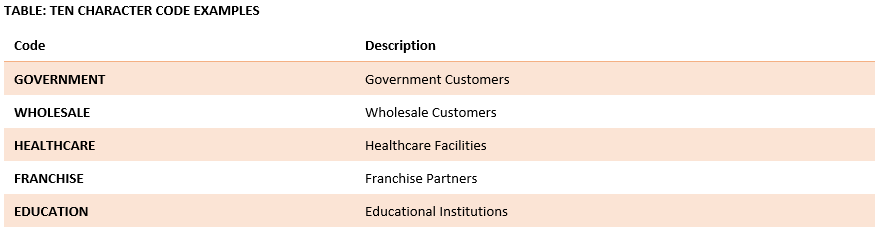
Eight characters favor longevity over speed.

They work well when

  • The domain is large
  • Growth is expected
  • More clarity is required

This reduces abbreviation pressure at the cost of slightly slower scanning.

Ten Characters or More

Ten-character fixed codes should be used cautiously.

They only make sense when

  • The code must be fully readable
  • Structure is minimal
  • The list is stable

At this point, variable-length codes often provide better flexibility.

Human Factors Matter

The Waterdeep Trading Company places a heavy weight on how often people interact with a code.

Key questions are always asked

  • Will this appear in daily work
  • Will clerks type it manually
  • Will it be spoken aloud

The more human interaction involved, the shorter and cleaner the code should be.

Growth Pressure Over Time

A fixed-length code must survive future use, not just current needs.

Short codes fail when

  • New categories appear
  • The business expands into new markets
  • Special cases multiply

Longer codes fail when

  • Users avoid them
  • Entry errors increase
  • People invent unofficial shortcuts

The ideal length balances both pressures.

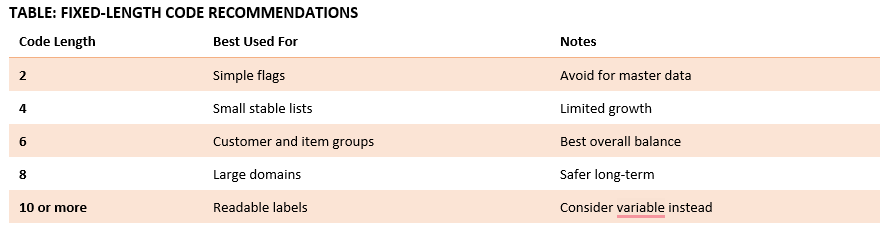
Practical Recommendation

Why Six Characters Often Win

Six characters succeed because they sit in the middle.

They are

  • Short enough to scan
  • Long enough to grow
  • Clear enough to teach
  • Stable enough to trust

This is why many well-run systems standardize on six for customer groups and posting groups.

Final Thoughts

There is no universal correct length. There is only the correct fit.

Fixed-length codes should be

  • Long enough to survive growth
  • Short enough to support people
  • Consistent enough to train

Choosing the length early and documenting the rationale avoids costly redesign later.


Support the AD&D365 Project on Patreon.  To grow this world, we’ve launched an official Patreon page where supporters can access exclusive content, tools, and training labs, and even influence the project’s future. Your support fuels more than just development; it expands the guildhall, forges new scrolls, and empowers the next generation of configuration wizards.  Begin your journey: https://www.patreon.com/adnd365/

A Grateful Salute to Our Patrons.  To all those who stand behind the vision, thank you for helping bring this world to life. Our Benefactors, Andre Breillatt and Eryndor Fiscairn, your boundless generosity fuels the arcane core of this project. Without your magic, the weave would falter. Our Apprentices, the spell engines turn, and the training labs thrive thanks to our current Apprentices: Michael Ramirez and Andreth Bael’Rathyn. Special thanks to our past Apprentices, whose contributions helped us get here: Ralf Weber, Wendy Rijners, Shashi Mahesh, Julia Tejera, Ben Ekokobe, Tiago Xavier, Naveen Boyinapelli, Marcos Tadeu Wolf, Kathryn Greene, Jason Brown, Mark Christy, and Ashish Singh. Our Initiates, Jesper Livbjerg, Peter Lorre, Gregory Brigden, and Martin Grahm, your commitment marks the start of the deeper path, stepping beyond mere observation into the active shaping of this realm. Our Followers, your steady presence along the journey is a beacon of encouragement: Rusty Cavalier, Eric Shuss, Sunil Panchal, Sarah D. Morgan, Nick Ramchandani, Daniel Kjærsgaard, and Tomasz Pałys. And our Voyeurs, Harry Burgh, Abdelrahman Nabil, and Basil Quarrell, ever watching from the shadows, clearly intrigued… but not enough to part with a single gold piece. Your silent curiosity is noted and mildly judged.

Want to design your own economic models in Faerûn?  Get your own AD&D365 Environment and guides at adnd365.com/start, and request access to the public view of the current database at https://public.adnd365.com – Login npc@adnd365.com, Password N0nPl@yC#822!
Across the Sword Coast, trade moves at the pace of hooves and turning wheels. From short runs between Waterdeep wards to long caravan routes toward Baldur’s Gate or Silverymoon, wagons and horses take constant strain. The Waterdeep Trading Company treats wagon wheels and horseshoes as managed assets, not afterthoughts. Poor timing on replacement leads to broken axles, lame horses, lost cargo, and missed contracts. Careful tracking keeps goods moving and costs predictable.

This article explains how the company monitors wear, records inspections, and determines when to replace wheels and shoes before failure.

What This Management Covers

Wagon wheel and horseshoe management is the practice of tracking usage, condition, and service life of the two most-stressed components in overland transport. It applies to company-owned wagons, leased caravans, and draft or riding horses assigned to trade routes.

The goal is simple. Replace parts early enough to avoid breakdowns, but not so early that coin is wasted.

Why It Matters

A failed wheel or a thrown shoe rarely happens near a city forge. Breakdowns delay deliveries, expose cargo to theft, and drive repair costs far above planned maintenance costs.

For the Waterdeep Trading Company, this affects:

  • Route reliability and delivery promises
  • Caravan safety and animal welfare
  • Maintenance budgets and cost control
  • Accurate pricing of long-haul contracts

Tracking Wagon Wheel Wear

Each wagon is assigned a wheel set record. Inspections are logged at defined intervals, typically upon route completion or at set distances traveled.

Wear is judged on rim thickness, spoke cracks, hub looseness, and iron band condition.

Each indicator is marked as Green, Amber, or Red in the maintenance log. Red status blocks the wagon from assignment.

Tracking Horseshoe Wear

Horseshoes are tracked per horse, not per route. Different animals wear shoes at different rates based on weight, gait, and load.

Farriers inspect shoes during rest stops and at stables. Records note nail tightness, shoe thinning, and hoof edge damage.

Any sign of gait change moves the horse to inspection status, even if the shoe looks intact.

Replacement Decision Rules

The company uses clear rules to avoid debate in the field.

Wheels are replaced based on condition, not age. A lightly used city wagon may keep wheels for years, while a mountain route wagon may need them twice a season.

Horseshoes follow shorter cycles and are replaced on a planned schedule unless they show early wear.

These rules allow caravan masters to act without waiting for head office approval.

Worked Example: Luskan Trade Run

A wagon assigned to the Waterdeep to Luskan route returns after 420 miles. Inspection shows rim thinning marked Amber and a minor spoke crack on one wheel.

The wheel is set to Red due to the crack. Replacement is scheduled before the next run. The cost is posted as planned maintenance rather than emergency repair.

At the same time, two draft horses show loose nails but no gait issues. Shoes are reset, not replaced, saving material cost while keeping the animals fit.

Accounting and Records

Maintenance costs are posted to route or fleet cost centers. Planned replacements are budgeted. Emergency repairs are tracked separately to highlight avoidable failures.

This allows Greta Ironfist and the Arcane Treasurers to see which routes cause excess wear and adjust pricing or routing.

Realms Aware Considerations

Road conditions vary sharply across Faerûn. Stone roads near Waterdeep are gentle on wheels but challenging on shoes. Forest tracks damage spokes. Coastal routes rust iron bands faster.

Seasonal weather also matters. Spring mud loosens hubs, winter ice chips hooves. Records always note season and route type.

Final Thoughts

Wagon wheels and horseshoes decide whether trade flows or stalls. By treating them as tracked assets, the Waterdeep Trading Company avoids roadside failures and keeps its promises to customers across the Sword Coast.

Careful inspection, clear rules, and steady records turn simple iron and wood into reliable trade tools.


Support the AD&D365 Project on Patreon.  To grow this world, we’ve launched an official Patreon page where supporters can access exclusive content, tools, and training labs, and even influence the project’s future. Your support fuels more than just development; it expands the guildhall, forges new scrolls, and empowers the next generation of configuration wizards.  Begin your journey: https://www.patreon.com/adnd365/

A Grateful Salute to Our Patrons.  To all those who stand behind the vision, thank you for helping bring this world to life. Our Benefactors, Andre Breillatt and Eryndor Fiscairn, your boundless generosity fuels the arcane core of this project. Without your magic, the weave would falter. Our Apprentices, the spell engines turn, and the training labs thrive thanks to our current Apprentices: Michael Ramirez and Andreth Bael’Rathyn. Special thanks to our past Apprentices, whose contributions helped us get here: Ralf Weber, Wendy Rijners, Shashi Mahesh, Julia Tejera, Ben Ekokobe, Tiago Xavier, Naveen Boyinapelli, Marcos Tadeu Wolf, Kathryn Greene, Jason Brown, Mark Christy, and Ashish Singh. Our Initiates, Jesper Livbjerg, Peter Lorre, Gregory Brigden, and Martin Grahm, your commitment marks the start of the deeper path, stepping beyond mere observation into the active shaping of this realm. Our Followers, your steady presence along the journey is a beacon of encouragement: Rusty Cavalier, Eric Shuss, Sunil Panchal, Sarah D. Morgan, Nick Ramchandani, Daniel Kjærsgaard, and Tomasz Pałys. And our Voyeurs, Harry Burgh, Abdelrahman Nabil, and Basil Quarrell, ever watching from the shadows, clearly intrigued… but not enough to part with a single gold piece. Your silent curiosity is noted and mildly judged.

Want to design your own economic models in Faerûn?  Get your own AD&D365 Environment and guides at adnd365.com/start, and request access to the public view of the current database at https://public.adnd365.com – Login npc@adnd365.com, Password N0nPl@yC#822!
Across Faerûn, merchants and guilds work with goods that rarely behave in uniform ways. Some arrive with uneven cuts, some stretch or shrink when handled, and others flow or coil into shapes that defy standard form. Two tracking methods address these challenges within the Waterdeep Trading Company. These are catchweight and variable measures. The two are often confused, yet each follows a distinct tradition rooted in long-standing trade customs from the Sword Coast to the inland markets.

This expanded article explores how each method works, why they diverge, and how the company applies them to tangible goods.

What Catchweight Is

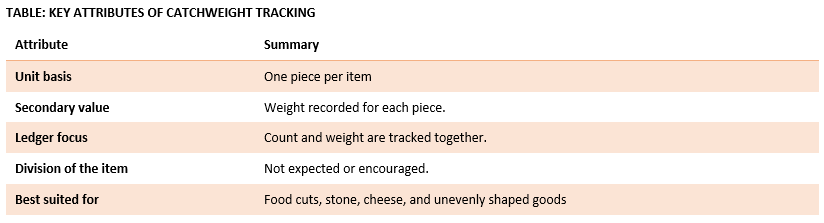
Catchweight is used when an item is traded and inventoried as a single unit, yet its value depends on its actual weight. The piece is counted as one, but no two pieces weigh the same. The ledger must therefore carry both the count and the weight for every item received. This method applies to goods shaped by hand, harvested in uneven portions, or carved from natural materials.

Boar meat from farms near Daggerford offers a clear example. Hunters deliver each haunch as a single piece, but the weight of each cut varies. The company must accept the count as a whole unit and price the cut based on its recorded weight. The same applies to the stone blocks quarried in the Western Heartlands. Each block is counted as a single unit, yet the density of the stone and the irregularity of its cut make the accurate measure of value. Even cheese wheels brought in from Amn follow this rule. Farmers shape them by hand, and each wheel comes out slightly different. Merchants rely on weight to ensure fair payment between buyers and suppliers.

In all these cases, the company treats each item as one object, one unit in stock, yet uses weight as the companion measure for valuation. This duality is central to catchweight.

This table highlights the essential traits of catchweight and why it is applied to certain goods.

What Variable Measure Is

Variable measure is used when an item has no practical piece count at all. Instead, its measure is the only value that matters. These goods are destined to be cut, poured, stretched, or shaped during use. A piece means nothing. Only the remaining measure matters.

Cloth from the Waterdeep Weaver’s Guild is a perfect example. A bolt may arrive with forty-five yards, and tailors may cut ten yards for a robe, two yards for a sash, or a fraction for lining. The bolt does not shrink as a piece. It simply loses length. The ledger tracks the remaining yards until the entire bolt is consumed. Rope coils behave the same way. A sailor may cut a short length for a rig, and the ledger only needs to record how many yards remain in the coil. Timber beams brought from the Western Heartlands also fall under this method. A carpenter trims a beam to fit a frame, yet there is no expectation that the leftover sections be counted as separate pieces—only the remaining length or volume matters.

Variable measure places complete focus on the unit of measure. It assumes goods will change form and size through regular use. No count is required, and no record of pieces is ever created.

This table outlines the essential traits of variable measure and why it differs from catchweight.

Why These Methods Are Not the Same

Catchweight and variable measure appear similar because both acknowledge irregular goods. Yet their rules diverge sharply.

In catchweight, the piece is the item’s core identity. A smoked boar cut is one cut. A cheese wheel is one wheel. A quarry stone is one block. The weight varies, and this variation affects the cost and selling price. The ledger, therefore, carries two values at all times: the count and the weight. Workers know that the item cannot be freely divided without changing its identity. A cheese wheel cut in two is no longer a single wheel, and the tracking method fails. The item must remain whole.

Variable measure takes the opposite approach. The item has no identity as a piece. A bolt of cloth is not one object in the same sense as a cheese wheel. It is simply forty-five yards of fabric. Cutting it into sections does not change its identity. A rope coil does not become two pieces in the ledger when a length is cut. It becomes a smaller total measure. Pieces do not matter because pieces do not exist.

This fundamental difference shapes how the company handles stock, cost, and issue.

Expanded Examples

The Cheese Wheel: When a caravan from Amn arrives with six cheese wheels, the ledger records six units, each with its individual weight. One wheel may weigh twelve pounds, another thirteen, and a third eleven and a half. The workers stack all six wheels together, yet the enchanted scales beneath the receiving table track each weight precisely. Later, when the cheese is sold to taverns in the Dock Ward or noble kitchens in the Sea Ward, the invoice reflects the recorded weight, not a fixed price per wheel. The identity of each wheel remains whole. Cutting the wheel would force it out of its tracking method, so the guild sells wheels intact unless a special arrangement is made.

The Cloth Bolt:  A bolt arriving from the Weaver’s Guild is handled quite differently. A forty-five-yard bolt is logged simply as forty-five yards. When tailors request fabric for company uniforms or mage robes, they draw the exact length required. After cutting, the ledger updates the remaining measure. No one records the number of cuts taken from the bolt. When it is finally used up, there is no history of pieces, only a record of how many yards were issued and to which workshop. The bolt’s design allows division, so the tracking method supports it without penalty.

The Stone Block:  Stone quarried in the Western Heartlands is carried to Waterdeep as single blocks. Each block is heavy and irregular. Workers measure its weight upon receipt, then use that value in both cost and freight calculations. A mason could reshape the block later, yet the original count and weight must be preserved for audit purposes. This reinforces the rule that the block is a single-tracked unit, and the ledger will not follow every future chip removed by masons. It cares only about the original block.

The Rope Coil:  A coil of rope behaves in the exact opposite way. A sailor or warehouse worker needs only a length sufficient to secure a load or repair a harness. Cutting the rope is expected, repeated, and unremarkable. The remaining coil remains unchanged. The ledger reflects only the new measured total. No worker needs to track how many pieces the rope becomes divided into.

Side-by-Side Comparison

This table compares how the ledger treats the two methods and why they are not interchangeable.

Why the Company Keeps Them Separate

Each method influences freight rules, vendor contracts, customer pricing, and internal cost control. Catchweight affects transport fees because heavier items cost more to haul. Variable measures affect workshop planning because cuts must be tracked precisely during production runs.

The Waterdeep Trading Company separates these methods to avoid confusion in mixed cargo shipments, ensure fair valuation when trading with coastal guilds, and maintain clarity when issuing goods across its workshops. The distinction also prevents disputes when merchants, adventurers, or craftsmen question why prices differ even when goods look similar.

Final Thoughts

Understanding the difference between catchweight and variable measure is essential for any merchant working with goods that do not conform to standard forms. In Waterdeep, this knowledge keeps ledgers clean, contracts clear, and trade flowing without delay. Across Faerûn, it marks a merchant as trained, careful, and ready to stand behind every recorded measure.


Support the AD&D365 Project on Patreon.  To grow this world, we’ve launched an official Patreon page where supporters can access exclusive content, tools, and training labs, and even influence the project’s future. Your support fuels more than just development; it expands the guildhall, forges new scrolls, and empowers the next generation of configuration wizards.  Begin your journey: https://www.patreon.com/adnd365/

A Grateful Salute to Our Patrons.  To all those who stand behind the vision, thank you for helping bring this world to life. Our Benefactors, Andre Breillatt and Eryndor Fiscairn, your boundless generosity fuels the arcane core of this project. Without your magic, the weave would falter. Our Apprentices, the spell engines turn, and the training labs thrive thanks to our current Apprentices: Michael Ramirez and Andreth Bael’Rathyn. Special thanks to our past Apprentices, whose contributions helped us get here: Ralf Weber, Wendy Rijners, Shashi Mahesh, Julia Tejera, Ben Ekokobe, Tiago Xavier, Naveen Boyinapelli, Marcos Tadeu Wolf, Kathryn Greene, Jason Brown, Mark Christy, and Ashish Singh. Our Initiates, Jesper Livbjerg, Peter Lorre, Gregory Brigden, and Martin Grahm, your commitment marks the start of the deeper path, stepping beyond mere observation into the active shaping of this realm. Our Followers, your steady presence along the journey is a beacon of encouragement: Rusty Cavalier, Eric Shuss, Sunil Panchal, Sarah D. Morgan, Nick Ramchandani, Daniel Kjærsgaard, and Tomasz Pałys. And our Voyeurs, Harry Burgh, Abdelrahman Nabil, and Basil Quarrell, ever watching from the shadows, clearly intrigued… but not enough to part with a single gold piece. Your silent curiosity is noted and mildly judged.

Want to design your own economic models in Faerûn?  Get your own AD&D365 Environment and guides at adnd365.com/start, and request access to the public view of the current database at https://public.adnd365.com – Login npc@adnd365.com, Password N0nPl@yC#822!
Ownership in Faerûn carries weight in both coin and standing. A share in the Waterdeep Trading Company grants a vote in council meetings, a portion of seasonal surplus, and a clear place within the guild’s long history. Greta Ironfist relies on equity shares to invite investment while keeping the company’s direction firm and stable.

This article explains how shares work within the company, how they support expansion across the Sword Coast, and how equity accounts in the Faerûn Standard Chart of Accounts record every change in ownership.

What Equity Shares Are

An equity share represents a unit of ownership. Common shares grant one vote and a portion of surplus. Preferred shares grant early surplus rights but no vote. Guildmaster shares belong only to Greta Ironfist and carry weighted voting strength.

Shares allow the company to raise funds for new routes, enchanted storage, and protection contracts. They also create a path for dedicated workers to share in long-term success.

Why Equity Shares Matter

Shares determine who guides the company. They allow outside investors to support major plans while keeping authority in the hands of confirmed shareholders. They help fund caravan lines, warehouse expansions, and arcane upgrades without drawing on moneylenders.

The share ledger maintained by the arcane treasurers keeps every transfer clear. The Scriveners’, Scribes’, and Clerks’ Guild verifies each scroll before it enters the official record.

Share Classes Used in the Company

The Waterdeep Trading Company uses three classes of shares.

This table shows how each class participates in votes and surplus.

This structure encourages investment without weakening leadership.

Equity Accounts Used for Share Management

Ownership activity is recorded in a series of equity and liability accounts. These accounts come from the Faerûn Standard Chart of Accounts and include both existing accounts and new ones created to support preferred shares, guildmaster shares, surplus tracking, and treasury share activity.

This combined table brings all share-related accounts together, making the overall structure clear.

This structure supports transparent reporting in both regular seasons and expansion periods.

Worked Example: Preferred Share Issue

The council votes to open a new trade route to Calimport. To fund the enchanted crates, caravan guards, and advance payments to Rashemi traders, the company issues 500 preferred shares at 100.00 FSD each. The nominal value is 80.00 FSD, and the remaining 20.00 FSD per share becomes share premium.

This strengthens the company’s position without altering council control.

Worked Example: Surplus Declaration

At season’s end, the council declares a surplus distribution of 12,000.00 FSD.

Payment later clears the liability.

Realms Aware Notes

Share values may rise or fall with supply routes, arcane costs, seasonal demand, or shifting regional tariffs. Trade lines in Luskan or the North may require preferred share structures to attract outside backing.

The Scriveners’, Scribes’, and Clerks’ Guild must seal every transfer scroll before it becomes valid. This keeps the ledger clean and reduces disputes in high-value share exchanges.

Final Thoughts

A strong share structure supports the Waterdeep Trading Company as it grows. These accounts keep every change in ownership clear, protect decision-making rights, and ensure that surplus is shared fairly. With a unified ledger and well-defined share classes, the company stands ready to expand across Faerûn with confidence.


Support the AD&D365 Project on Patreon.  To grow this world, we’ve launched an official Patreon page where supporters can access exclusive content, tools, and training labs, and even influence the project’s future. Your support fuels more than just development; it expands the guildhall, forges new scrolls, and empowers the next generation of configuration wizards.  Begin your journey: https://www.patreon.com/adnd365/

A Grateful Salute to Our Patrons.  To all those who stand behind the vision, thank you for helping bring this world to life. Our Benefactors, Andre Breillatt and Eryndor Fiscairn, your boundless generosity fuels the arcane core of this project. Without your magic, the weave would falter. Our Apprentices, the spell engines turn, and the training labs thrive thanks to our current Apprentices: Michael Ramirez and Andreth Bael’Rathyn. Special thanks to our past Apprentices, whose contributions helped us get here: Ralf Weber, Wendy Rijners, Shashi Mahesh, Julia Tejera, Ben Ekokobe, Tiago Xavier, Naveen Boyinapelli, Marcos Tadeu Wolf, Kathryn Greene, Jason Brown, Mark Christy, and Ashish Singh. Our Initiates, Jesper Livbjerg, Peter Lorre, Gregory Brigden, and Martin Grahm, your commitment marks the start of the deeper path, stepping beyond mere observation into the active shaping of this realm. Our Followers, your steady presence along the journey is a beacon of encouragement: Rusty Cavalier, Eric Shuss, Sunil Panchal, Sarah D. Morgan, Nick Ramchandani, Daniel Kjærsgaard, and Tomasz Pałys. And our Voyeurs, Harry Burgh, Abdelrahman Nabil, and Basil Quarrell, ever watching from the shadows, clearly intrigued… but not enough to part with a single gold piece. Your silent curiosity is noted and mildly judged.

Want to design your own economic models in Faerûn?  Get your own AD&D365 Environment and guides at adnd365.com/start, and request access to the public view of the current database at https://public.adnd365.com – Login npc@adnd365.com, Password N0nPl@yC#822!
In a realm where caravans share the roads with wyverns and trade ships brave seas patrolled by sahuagin, commerce must be guarded as fiercely as it is managed. The Waterdeep Trading Company, ever watchful of both profit and peril, has expanded its reach through the Complete Merchant Stall Program, a fully managed retail partnership combining supply, training, branding, enchanted marketing, and now, comprehensive protection for both merchants and their goods.

This initiative turns local traders into empowered partners, equipped with training, logistical support, and the trusted crest of Waterdeep’s premier trading guild, all while operating under the protective watch of Company-hired guards and warding specialists.

What It Is

The Complete Merchant Stall Program is a turnkey merchant partnership that provides everything needed to operate an official Waterdeep Trading Company retail stall. Each stall is outfitted with preselected goods, standardized signage, and embedded magical safeguards, all supported by advanced accounting and replenishment systems built within Dynamics 365 Faerûn Edition.

Participants receive shipment coordination through the Company’s caravan, sea, or portal networks and gain access to financial integration, profit-sharing, and now, professional-grade Protection and Security Services that safeguard goods in transit and merchants at the stallfront.

Every partnership is backed by the Waterdeep Trading Company’s honor and defense guarantees, making it one of the safest and most profitable ventures available in Faerûnian commerce today.

Why It Matters

Trade across the Realms is not without danger. Bandits, magical mischief, and rival guild interference have long plagued independent merchants. The Waterdeep Trading Company understands that a profitable partnership is only as strong as its security.

The Complete Merchant Stall Program ensures that every stall operates with the same logistical precision, brand power, and now, defensive infrastructure, enjoyed by the Company’s headquarters on the Sword Coast.

Merchants receive the stability of centralized operations, the prestige of the Waterdeep name, and the peace of mind that comes with knowing their livelihood is protected by trained guards, warding glyphs, and contracted escort companies.

Components of the Program

Stall Vendor Training

The Waterdeep Trading Company believes that a skilled merchant is as vital as a stocked shelf. Each partner undergoes the Stall Vendor Training Series, designed to combine commerce, magic, and safety.

All graduates earn the Waterdeep Merchant Seal, authorizing the operation of branded stalls across Faerûn.

Stall Marketing and Signage

Marketing within Faerûn blends craftsmanship, artistry, and subtle magic. Every partner stall includes a complete branding and signage kit:

  • Crest Banner of Waterdeep, woven in enchanted thread that resists fire, water, and illusory tampering.
  • Illuminated Pricing Plaques displaying exchange rates in local tender.
  • Soundstone Announcers broadcasting promotions or bardic jingles.
  • Holo-Banners that shimmer with current seasonal campaigns.
  • Rune-Marked Loyalty Tokens, trackable across all partner stalls via the shared ledger.

Each region receives localized aesthetic adjustments, for instance, copper and teal tones for Baldur’s Gate or silvered frostwood panels for Icewind Dale stalls. These variations respect local culture while maintaining brand recognition across the Realms.

Social Media and Bardic Partnerships

The Company has partnered with bardic guilds and illusionist messengers to maintain presence through BardLink, Faerûn’s premier network of enchanted media and public broadcasts.

Merchants may promote their stalls through:

  • BardLink Feeds: Performers singing product highlights or enchantment demos.
  • IllusionPost Walls: Visual advertisements displayed in taverns and marketplaces.
  • GuildTag Promotions: Sigil-linked broadcasts connecting all Waterdeep-branded merchants.

Each stall gains a monthly media budget to commission bards or illusionists for promotional performances, ensuring continuous engagement with local patrons and adventuring parties.

Protection and Security Services

The Waterdeep Trading Company now extends its influence into protection and logistics security through the Guild Guard Partnership, administered by Korrek Ironhand, Chief of Security and decorated veteran of the Baldur’s Gate campaigns.

Each merchant stall and delivery caravan receives tiered security coverage based on product value and location risk:

Deliveries are safeguarded through a dedicated Secure Freight Network, operating enchanted chests sealed with sigils traceable via the Company’s Logistics Ledger. Lost or damaged goods trigger automatic insurance reimbursement through the Arcane Treasury Office, ensuring merchants are never left vulnerable to misfortune or malice.

Example:
A Silver-tier merchant in Silverymoon receives bi-weekly shipments of enchanted lanterns. Each crate is warded with a tracing glyph, and guards accompany it through Evermoor Way. In the rare event of ambush, a scry-linked orb alerts nearby Company watchposts to dispatch aid.

Worked Example: The Alchemist of Athkatla

Marwen, an aspiring alchemist, joined the program and received her Alchemy & Curiosities Stall. Her stock, potion bases, herbal extracts, and focus crystals, was shipped via Company caravan escorted by a Silver-tier protection detail.

Her stall’s luminous signage displayed her products beneath an enchanted glass canopy. BardLink promotions featuring the jingle “Marwen’s Mixtures Make Magic Manageable” echoed through Athkatla’s promenade.

One night, thieves attempted to breach her supply chest. The warding glyph triggered an auditory illusion, a phantom guard patrol, and dispatched a warning via her scry orb to the local Company guard post. Within minutes, the culprits were apprehended, and her inventory remained untouched.

Her monthly report, automatically posted to her Faerûn D365 ledger, confirmed a profit increase of 32 percent with no losses.

Realms-Aware Considerations

Security services adhere to the Guild Code of Defense, ensuring lawful, proportional protection within city jurisdictions. Magical warding follows the Mage Guild Arcane Trade Accord, guaranteeing that deterrence enchantments cause no harm to customers or non-aggressors.

All security operatives are members of the Mercenary’s Charter of the Sword Coast, trained in nonlethal subdual and cargo escort. No stall is left undefended, and all shipments are traceable from warehouse to storefront.

Additionally, all alchemical and organic components, such as Troll Fat Extracts and serpent oils, are ethically sourced, honoring the Trollkind Preservation Compact and Venomcrafting Charter of Chult.

Final Thoughts

The Complete Merchant Stall Program is a fusion of commerce, enchantment, and security, an entire ecosystem of prosperity and protection. By combining merchant training, bardic marketing, and robust defensive support, the Waterdeep Trading Company ensures that every stall operates as a beacon of reliability and safety across Faerûn.

From Waterdeep’s glittering wards to Icewind Dale’s frozen markets, merchants can now trade with confidence, knowing that their livelihood, their customers, and their goods are protected under the crest of Waterdeep.


Support the AD&D365 Project on Patreon.  To grow this world, we’ve launched an official Patreon where supporters can gain access to exclusive content, tools, training labs, and even influence the future of the project. Your support fuels more than just development ,  it expands the guildhall, forges new scrolls, and empowers the next generation of configuration wizards.  Begin your journey: https://www.patreon.com/adnd365/

A Grateful Salute to Our Patrons.  To all those who stand behind the vision, thank you for helping bring this world to life. Our Benefactors, Andre Breillatt, and Eryndor Fiscairn, your boundless generosity fuels the arcane core of this project. Without your magic, the weave would falter. Our Apprentices, the spell engines turn, and the training labs thrive thanks to our current Apprentices: Michael Ramirez and Andreth Bael’Rathyn. Special thanks to our past Apprentices, whose contributions helped us get here: Ralf Weber, Wendy Rijners, Shashi Mahesh, Julia Tejera, Ben Ekokobe, Tiago Xavier, Naveen Boyinapelli, Marcos Tadeu Wolf, Kathryn Greene, Jason Brown, Mark Christy, and Ashish Singh. Our Initiates, Jesper Livbjerg, Peter Lorre, Gregory Brigden, and Martin Grahm, your commitment marks the start of the deeper path, stepping beyond mere observation into the active shaping of this realm. Our Followers, your steady presence along the journey is a beacon of encouragement:  Eric Shuss, Sunil Panchal, Sarah D. Morgan, Nick Ramchandani, Daniel Kjærsgaard, and Tomasz Pałys. And our Voyeurs, Harry Burgh, Abdelrahman Nabil, and Basil Quarrell, ever watching from the shadows, clearly intrigued… but not enough to part with a single gold piece. Your silent curiosity is noted, and mildly judged.

Want to design your own economic models in Faerûn?  Get your own AD&D365 Environment and guides at adnd365.com/start, and request access to the public view of the current database at https://public.adnd365.com – Login npc@adnd365.com, Password N0nPl@yC#822!
In the mystic halls of the Waterdeep Trading Company’s Department of Arcane Inscription, a new craft has emerged that bridges art, magic, and structured design: GlyphForge.
GlyphForge serves as both a philosophy and a system, a structured language of symbols that can describe, evoke, and empower. Much like accountants use ledgers and artificers use schematics, glyphwrights use glyphs to bind meaning and magic into form.

This guide provides the full codified structure of the Glyphic Arcanum, a system that standardizes the creation, fusion, and interpretation of glyphs across the known realms.

What Is GlyphForge

GlyphForge is a structured design system for creating, explaining, and visualizing ancient magical symbols. It defines every glyph as a fusion of runic logic, elemental association, and symbolic intent. Each glyph, whether carved into sandstone or inscribed upon parchment, represents a self-contained enchantment.

These symbols are carved into the ledgers of the Arcane Treasury, drawn by cartographers upon planar maps, and even etched upon cooking stones by culinary mages who seek to perfect their art.

The Structure of a Glyph

Every glyph follows a three-layered hierarchy, balancing core meaning with elemental and directional intent.

When multiple meanings overlap, glyphs are nested within a Containment Ring (⚲), ensuring magical stability.

The Logic of Symbolism

Each element follows a specific visual motif, grounded in the ancient design languages of the Arcane Guilds.

Design Standards

Glyphs must be centered in perfect geometry. They glow faintly when active and often appear etched upon stone, metal, or parchment. Each element determines the hue of its glow.

Constructing Glyphs

To create a glyph, select one symbol from each layer:

  1. Core Rune: What action is being performed?
  2. Aspect Mark: What element or essence powers it?
  3. Focus Stroke:  Who or what is affected?

Then fuse them together in sequence.
Example: ⌘ + 🔺 + ∩ = Flame Ward, a shield of protective fire surrounding an area.

For complex symbols, enclose the fusion in ⚲ to stabilize it.

Example Glyphs

Below are the most recognized glyphs of the Glyphic Arcanum.

Ingredient Glyphs

The Guild of Culinary Mages frequently inscribes ingredient glyphs into cauldrons, allowing meals to sustain magical potency.

Glyph Syntax Rules

Just as merchants rely on standardized ledgers to ensure their accounts align, so too must glyphwrights follow precise structure when combining symbols. The Glyph Syntax Rules serve as the grammatical foundation of the Glyphic Arcanum, ensuring that each rune, aspect, and focus interacts correctly within an inscription.

Without proper syntax, a glyph’s meaning can shift, unravel, or even invert, turning a ward into a snare or a blessing into a curse. These rules govern how layers are ordered, nested, or stabilized, defining whether energy flows harmoniously or collapses upon itself.

By following these conventions, artisans can craft complex and stable glyphs that remain consistent across spellbooks, scrolls, and arcane seals. This syntax is the unspoken language of magic itself, the logic that binds artistry to precision.

Every glyph name carries more than identity, it conveys purpose. The naming suffixes of the Glyphic Arcanum act as linguistic markers that reveal a glyph’s function or nature. Whether denoting creation, protection, transformation, or containment, these endings help scholars and artisans understand a symbol’s intent at a glance.

Worked Examples

Healing Flame
Fusion: ⚚ + 🔺 + ∧
Meaning: Healing fire directed toward a living being.
Visual: Central flame motif wrapped in soft, circular lines of light.

Stone Memory
Fusion: ⚷ + ⬛ + ,
Meaning: Knowledge engraved in earth, remembrance through matter.
Visual: Rectangular foundation with an inward spiral of awareness.

Bread Sigil (Moltar)
Fusion: ⚲(⚒ + ⚚ + ⌖ + ☉)
Meaning: Creation of life through craft, nurture, and fire.
Visual: A ring of grain and droplet motifs surrounding a central rising flame.

Image Prompt Guidelines

When rendering glyphs as images:

  • Use centered, circular designs.
  • Show glowing etchings on aged material.
  • Maintain symmetry and reverence.
  • Avoid modern or religious symbols.

Why GlyphForge Matters

For the Waterdeep Trading Company, GlyphForge is more than artistry, it is a business tool. Recipes, enchantments, and protection seals are all standardized using this system, ensuring that magical formulas can be transferred between workshops without misinterpretation or fraud.
Each symbol’s precise layering deters tampering, as even the smallest alteration changes its meaning or nullifies its magic entirely. Thus, the placement of a single rune safeguards both art and commerce across Faerûn.

Final Thoughts

GlyphForge unites the visual and the arcane into one structured discipline. Whether used for potion design, artifact sealing, or enchanted trade documentation, it brings clarity and consistency to the mystical craft of inscription.

As the scribes of Waterdeep often say: “A word may lie, but a glyph remembers truth.”


Support the AD&D365 Project on Patreon.  To grow this world, we’ve launched an official Patreon where supporters can gain access to exclusive content, tools, training labs, and even influence the future of the project. Your support fuels more than just development ,  it expands the guildhall, forges new scrolls, and empowers the next generation of configuration wizards.  Begin your journey: https://www.patreon.com/adnd365/

A Grateful Salute to Our Patrons.  To all those who stand behind the vision, thank you for helping bring this world to life. Our Benefactors, Andre Breillatt, and Eryndor Fiscairn, your boundless generosity fuels the arcane core of this project. Without your magic, the weave would falter. Our Apprentices, the spell engines turn and the training labs thrive thanks to our current Apprentices: Michael Ramirez and Andreth Bael’Rathyn. Special thanks to our past Apprentices, whose contributions helped us get here:  Ralf Weber, Wendy Rijners, Shashi Mahesh, Julia Tejera, Ben Ekokobe, Tiago Xavier, Naveen Boyinapelli, Marcos Tadeu Wolf, Kathryn Greene, Jason Brown, Mark Christy, and Ashish Singh. Our Initiates, Gregory Brigden, and Martin Grahm, your commitment marks the start of the deeper path, stepping beyond mere observation into the active shaping of this realm. Our Followers, your steady presence along the journey is a beacon of encouragement:  Eric Shuss, Sunil Panchal, Sarah D. Morgan, Nick Ramchandani, Daniel Kjærsgaard, and Tomasz Pałys. And our Voyeurs, Harry Burgh, Abdelrahman Nabil, and Basil Quarrell, ever watching from the shadows, clearly intrigued… but not enough to part with a single gold piece. Your silent curiosity is noted, and mildly judged.Want to design your own economic models in Faerûn?  Get your own AD&D365 Environment and guides at adnd365.com/start, and request access to the public view of the current database at https://public.adnd365.com – Login npc@adnd365.com, Password N0nPl@yC#822!
In Faerûn, where caravans cross nations and portals link planes, trade is a living, breathing force. Yet even the best-run merchants of Waterdeep, Baldur’s Gate, and Calimport know that not every deal goes as planned. A cracked wand, a spoiled crate of moonwine, or an amulet that misfires its enchantment, all must be handled with discipline.

The Waterdeep Trading Company has built a structured framework for such cases known as Returns and Dispositions. This process ensures that every returned good, mundane or magical, is properly inspected, valued, and resolved, preserving both customer trust and the Company’s ledgers.

What It Is

A Return records the reversal of a completed sale or shipment. A Disposition defines the next step in that item’s story: whether it is resold, repaired, scrapped, or replaced.

When a customer or partner initiates a return, clerks record the reason, identify the source of issue, and assign a disposition code. Returned items are routed through specialized review zones, warehouses, vaults, or workshops, based on product type and region.

Why It Matters

Returns and dispositions maintain the Company’s reputation and prevent financial distortion. Without them, inventory counts could drift, profit margins would blur, and customers could lose confidence in trade fairness.

They also allow analysts to study trade patterns: identifying failing suppliers, error-prone regions, or recurring mishaps in teleportation routes. This is vital in Faerûn, where magical instability, regional tariffs, or planar interference can turn a simple exchange into a costly problem.

Standard Disposition Actions

The Waterdeep Trading Company uses a set of standardized Disposition Codes across its trade houses in Faerûn. Each determines how a returned good is handled once it re-enters inventory or quarantine.

Each disposition is logged against both physical and arcane inventories. When magic is involved, treasurers consult with the Mage Guild Arcane Mark Office to verify containment before processing.

Faerûn-Specific Disposition Codes

Because Faerûn is a realm of enchantment, divine law, and shifting trade alliances, standard merchant practices alone cannot manage its complexities. The Waterdeep Trading Company therefore maintains a second, deeper layer of Faerûn-Specific Disposition Codes, adapted for magical instability, divine purification, barter settlements, and regional compliance.

Return Reason Codes

To understand the causes behind returns, the Company employs a library of standardized Reason Codes. These codes are reviewed quarterly by the Sage Archivists and shared with the Scriveners’, Scribes’, & Clerks’ Guild for industry benchmarking.

These records allow the Company to trace whether returns arise from supplier error, warehouse mishandling, or arcane instability, critical insight for improving both craftsmanship and trade routes.

Worked Example: Return from the Sword Coast

A trader from Baldur’s Gate (01-BDG-LWC) returns an enchanted cooking pot that failed to sustain its warming spell. The return is classified as:

  • Reason Code: DEFECTIVE
  • Disposition Code: CREDREP (Credit, Repair, and Return)
  • Value: 𝔉285.00 FSD

Upon arrival, the pot is routed to the Arcane Containment Ward in the Waterdeep warehouse for rune re-inscription. After a successful enchantment check by the Lorewright Cartographers, it is returned to sellable stock and a credit is issued to the trader’s ledger.

Example: Arcane Containment Return

A Moonshae Isles customer returns a scrying mirror that shows inverted images of alternate timelines, a clear case of magical corruption.

  • Reason Code: DEFECTIVE
  • Disposition: CREDARC (Credit and Arcane Rework)
  • Route: Teleported to Waterdeep Arcane Vault under Mage Guild seal
  • Resolution: Mirror cleansed using distilled moonlight and re-enchanted before resale

Example: Divine Disposal

A Suzail temple sends back a relic that began emanating necrotic whispers after consecration.

  • Reason Code: CURSED
  • Disposition: SCRPDIS (Scrap under Divine Supervision)
  • Action: Disassembled by clerics of Lathander, base silver repurposed into purified chalices

Regional and Arcane Considerations

Faerûn’s vast geography requires local handling rules.

These localized differences ensure that returns comply with trade law and arcane safety ordinances while maintaining consistent internal records.

Realms-Aware Examples of Quarantine Dispositions

These examples highlight how physical, magical, and bureaucratic layers intertwine in Faerûn’s approach to reverse logistics.

Realms-Aware Benefits

Faerûn-specific disposition codes achieve far more than simple inventory control. They:

  • Protect clerks from exposure to cursed materials.
  • Comply with temple and guild purification mandates.
  • Prevent cross-contamination of planar energies.
  • Maintain detailed provenance for both mundane and enchanted goods.

Final Thoughts

In the Waterdeep Trading Company, every return tells a story. Whether it is a defective blade from Suzail, a spoiled elixir from Rashemen, or a misfired charm from Silverymoon, each item follows a trail of accountability.

The Returns and Dispositions system transforms what could be loss into learning, protecting profit, preserving reputation, and strengthening trust across the Realms. Through Faerûn-specific disposition codes, the Company honors every return with care suited to its nature, be it forged, brewed, or bound by ancient spell. This approach turns even failure into order, sustaining trust between guild, merchant, and the magic that binds Faerûn’s economy together.


Support the AD&D365 Project on Patreon.  To grow this world, we’ve launched an official Patreon where supporters can gain access to exclusive content, tools, training labs, and even influence the future of the project. Your support fuels more than just development ,  it expands the guildhall, forges new scrolls, and empowers the next generation of configuration wizards.  Begin your journey: https://www.patreon.com/adnd365/

A Grateful Salute to Our Patrons.  To all those who stand behind the vision, thank you for helping bring this world to life. Our Benefactors, Andre Breillatt, and Eryndor Fiscairn, your boundless generosity fuels the arcane core of this project. Without your magic, the weave would falter. Our Apprentices, the spell engines turn and the training labs thrive thanks to our current Apprentices: Michael Ramirez and Andreth Bael’Rathyn. Special thanks to our past Apprentices, whose contributions helped us get here:  Ralf Weber, Wendy Rijners, Shashi Mahesh, Julia Tejera, Ben Ekokobe, Tiago Xavier, Naveen Boyinapelli, Marcos Tadeu Wolf, Kathryn Greene, Jason Brown, Mark Christy, and Ashish Singh. Our Initiates, Gregory Brigden, and Martin Grahm, your commitment marks the start of the deeper path, stepping beyond mere observation into the active shaping of this realm. Our Followers, your steady presence along the journey is a beacon of encouragement:  Eric Shuss, Sunil Panchal, Sarah D. Morgan, Nick Ramchandani, Daniel Kjærsgaard, and Tomasz Pałys. And our Voyeurs, Harry Burgh, Abdelrahman Nabil, and Basil Quarrell, ever watching from the shadows, clearly intrigued… but not enough to part with a single gold piece. Your silent curiosity is noted, and mildly judged.

Want to design your own economic models in Faerûn?  Get your own AD&D365 Environment and guides at adnd365.com/start, and request access to the public view of the current database at https://public.adnd365.com – Login npc@adnd365.com, Password N0nPl@yC#822!
In Faerûn, storage is more than a matter of shelf space, it is a balance between mundane logistics and arcane ingenuity. The Waterdeep Trading Company must manage everything from crates of grain and barrels of ale to relics humming with latent enchantments. Whether items are placed in physical bins, Bags of Holding, or secured within vault cells, the principles of organization and accountability remain the same, though the methods differ greatly.

What It Is

A warehouse bin is a physical location within a storage facility where items are placed for tracking and retrieval. In mundane warehouses, bins are organized by item type, serial, or lot number. In arcane operations, however, magical containers introduce entirely new dimensions, literally.

Magical containers such as Bags of Holding, Portable Holes, and Vault Cells of Holding expand space through extra-dimensional means. These containers allow a trader to store vast quantities of goods in a fraction of the space required in the physical world. Yet, their use introduces challenges in accounting, safety, and traceability.

Why It Matters

Without precise tracking, items may vanish into extra-dimensional limbo or become subject to spatial interference. The Waterdeep Trading Company uses specialized inventory controls within its enchanted warehouse system to balance efficiency and risk.

Proper bin and container management ensures:

  • Accurate stock visibility between planar and physical spaces.
  • Prevention of duplication, misplacement, or loss in dimensional folds.
  • Compliance with guild regulations for enchanted goods.
  • Efficient use of vault space for high-value or volatile items.

Components or Breakdown

Each storage method serves a distinct purpose and should be recorded differently in the company’s inventory ledger.

Worked Example: Storing Enchanted Blades

When the Waterdeep Trading Company receives a shipment of enchanted blades from the Baldur’s Gate Blacksmiths Guild, the items are classified by storage requirement:

Each entry includes a traceable ID, whether physical or magical. Items in Bags of Holding are logged using the Container Ledger, linking to the owner’s sigil for accountability.

Realms-Aware Considerations

  1. Dimensional Safety: Mixing two Bags of Holding or inserting one into a Portable Hole tears the planar fabric, releasing contents, and sometimes handlers, into the Astral Plane. Always log magical container interactions in the Arcane Safety Register.
  2. Audit Visibility: Magical inventories require synchronization spells, often performed by Sage Archivists. Each synchronization event should be tied to the general ledger’s Inventory Reconciliation journal.
  3. Teleportation Freight: Items in magical containers are subject to extra tariffs under the Guild of Transplanar Commerce. Ensure cost allocation includes dimensional fees.

Final Thoughts

Balancing physical and magical warehousing requires both discipline and enchantment. Whether managing a mundane barrel of flour or a vault-bound crown jewel, the guiding principle is the same: every item must have a home, and that home must be known to the ledger.

By uniting warehouse bin management with arcane storage tracking, the Waterdeep Trading Company maintains not only control of its stock but also mastery of the unseen spaces between planes.


Support the AD&D365 Project on Patreon.  To grow this world, we’ve launched an official Patreon where supporters can gain access to exclusive content, tools, training labs, and even influence the future of the project. Your support fuels more than just development ,  it expands the guildhall, forges new scrolls, and empowers the next generation of configuration wizards.  Begin your journey: https://www.patreon.com/adnd365/

A Grateful Salute to Our Patrons.  To all those who stand behind the vision, thank you for helping bring this world to life. Our Benefactors, Andre Breillatt, and Eryndor Fiscairn, your boundless generosity fuels the arcane core of this project. Without your magic, the weave would falter. Our Apprentices, the spell engines turn and the training labs thrive thanks to our current Apprentices: Michael Ramirez and Andreth Bael’Rathyn. Special thanks to our past Apprentices, whose contributions helped us get here:  Ralf Weber, Wendy Rijners, Shashi Mahesh, Julia Tejera, Ben Ekokobe, Tiago Xavier, Naveen Boyinapelli, Marcos Tadeu Wolf, Kathryn Greene, Jason Brown, Mark Christy, and Ashish Singh. Our Initiates, Gregory Brigden, and Martin Grahm, your commitment marks the start of the deeper path, stepping beyond mere observation into the active shaping of this realm. Our Followers, your steady presence along the journey is a beacon of encouragement:  Eric Shuss, Sunil Panchal, Sarah D. Morgan, Nick Ramchandani, Daniel Kjærsgaard, and Tomasz Pałys. And our Voyeurs, Harry Burgh, Abdelrahman Nabil, and Basil Quarrell, ever watching from the shadows, clearly intrigued… but not enough to part with a single gold piece. Your silent curiosity is noted, and mildly judged.

Want to design your own economic models in Faerûn?  Get your own AD&D365 Environment and guides at adnd365.com/start, and request access to the public view of the current database at https://public.adnd365.com – Login npc@adnd365.com, Password N0nPl@yC#822!

In the trade halls of Faerûn, no contract is sealed and no coin disbursed without the watchful eyes of those entrusted with authority. The Waterdeep Trading Company, like many guilds and merchant houses, relies upon structured approval workflows. These enchanted procedures ensure that all orders, invoices, and financial records are scrutinized by the right parties before action is taken. Just as no caravan leaves without a caravan master’s nod, no ledger entry or purchase order advances without its arcane sign-off.

What Approval Workflows Are

An approval workflow is the structured process by which documents—be they purchase orders, vendor invoices, or journal entries—must pass through designated approvers. Each approver represents a layer of oversight, much like guild seals affixed in turn to scrolls of binding. Within the system, these workflows are configured using templates and rules, ensuring no transaction moves forward without magical or managerial consent.

Types of Approvals in the Realms

Approval workflows in Faerûn fall into distinct categories, each designed for different kinds of trade, governance, or magical oversight.

Workflows by Document Type

Different business records require different kinds of approval.

Approvals via the Guild Whisper Network

While parchment and wax seals remain the backbone of commerce, the Waterdeep Trading Company has harnessed the Guild Whisper Network—an arcane lattice of sending stones, crystal orbs, and whisper-scrolls—to extend approval workflows beyond the guildhall.

Through this system:

  • Approvers can receive tasks instantly, no matter if they are in Suzail, Silverymoon, or aboard a caravan.
  • Magical missives replicate the approval request, displaying the document details as an illusion.
  • With a spoken word of assent, refusal, or escalation, the approval is recorded in the company’s enchanted ledger.
  • Complex approvals—such as majority votes—can be tallied in real time, with results displayed as glowing seals visible to all council members.

Worked Example: Vendor Invoice with Whisper Approval

Suppose a vendor from the Baldur’s Gate Blacksmiths Guild submits an invoice for steel shipment. Instead of requiring Borin Stonehand to travel back to Waterdeep:

  1. Invoice entered by Darrik Ambermantle.
  2. Approval workflow routes to Borin’s sending stone through the Guild Whisper Network.
  3. Borin inspects the illusionary invoice and speaks “Approved.”
  4. Rune-seal is affixed instantly in the ledger.
  5. Payment is authorized without delay.

This system combines the rigor of guild law with the reach of arcane communication.

Realms-Aware Considerations

Unlike the modern realms, Faerûn’s approval workflows must account for arcane and guild-specific factors:

  • Magical Validation: Contracts may require rune-seals to prove authenticity.
  • Guild Hierarchies: Some workflows demand votes from majority councils.
  • Regional Factors: A purchase order raised in Calimport might need both the local Silk Quarter guildmaster’s approval and Waterdeep headquarters’ seal.
  • Emergency Overrides: During dragon attack or famine, workflows may allow bypass by high council decree, with retroactive sealing.
  • Distributed Approvals: With the Guild Whisper Network, even adventurers in the field may approve a trade in real time.

Final Thoughts

Approval workflows are the lifeblood of disciplined trade. They replace uncertainty with order, allowing the Waterdeep Trading Company to conduct business with confidence, from the Sword Coast to the sands of Calimshan. Much like spells that protect a city, these processes shield the company’s coffers and reputation. With the Guild Whisper Network, approvals are no longer bound to parchment—they travel across Faerûn as swiftly as thought itself.


Support the AD&D365 Project on Patreon.  To grow this world, we’ve launched an official Patreon where supporters can gain access to exclusive content, tools, training labs, and even influence the future of the project. Your support fuels more than just development ,  it expands the guildhall, forges new scrolls, and empowers the next generation of configuration wizards.  Begin your journey: https://www.patreon.com/adnd365/

A Grateful Salute to Our Patrons.  To all those who stand behind the vision, thank you for helping bring this world to life. Our Benefactors, Andre Breillatt, and Eryndor Fiscairn, your boundless generosity fuels the arcane core of this project. Without your magic, the weave would falter. Our Apprentices, the spell engines turn and the training labs thrive thanks to our current Apprentices: Michael Ramirez and Andreth Bael’Rathyn. Special thanks to our past Apprentices, whose contributions helped us get here:  Ralf Weber, Wendy Rijners, Shashi Mahesh, Julia Tejera, Ben Ekokobe, Tiago Xavier, Naveen Boyinapelli, Marcos Tadeu Wolf, Kathryn Greene, Jason Brown, Mark Christy, and Ashish Singh. Our Initiates, Gregory Brigden, and Martin Grahm, your commitment marks the start of the deeper path, stepping beyond mere observation into the active shaping of this realm. Our Followers, your steady presence along the journey is a beacon of encouragement:  Eric Shuss, Sunil Panchal, Sarah D. Morgan, Nick Ramchandani, Daniel Kjærsgaard, and Tomasz Pałys. And our Voyeurs, Harry Burgh, Abdelrahman Nabil, and Basil Quarrell, ever watching from the shadows, clearly intrigued… but not enough to part with a single gold piece. Your silent curiosity is noted, and mildly judged.

Want to design your own economic models in Faerûn?  Get your own AD&D365 Environment and guides at adnd365.com/start, and request access to the public view of the current database at https://public.adnd365.com – Login npc@adnd365.com, Password N0nPl@yC#822!