In the trade halls of Faerûn, no contract is sealed and no coin disbursed without the watchful eyes of those entrusted with authority. The Waterdeep Trading Company, like many guilds and merchant houses, relies upon structured approval workflows. These enchanted procedures ensure that all orders, invoices, and financial records are scrutinized by the right parties before action is taken. Just as no caravan leaves without a caravan master’s nod, no ledger entry or purchase order advances without its arcane sign-off.
What Approval Workflows Are
An approval workflow is the structured process by which documents—be they purchase orders, vendor invoices, or journal entries—must pass through designated approvers. Each approver represents a layer of oversight, much like guild seals affixed in turn to scrolls of binding. Within the system, these workflows are configured using templates and rules, ensuring no transaction moves forward without magical or managerial consent.
Types of Approvals in the Realms
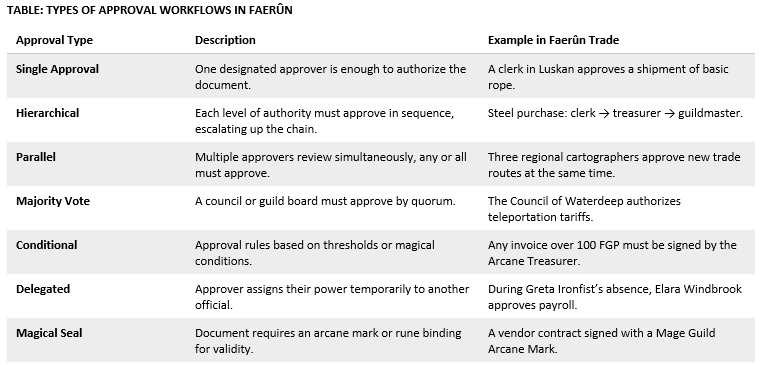
Approval workflows in Faerûn fall into distinct categories, each designed for different kinds of trade, governance, or magical oversight.
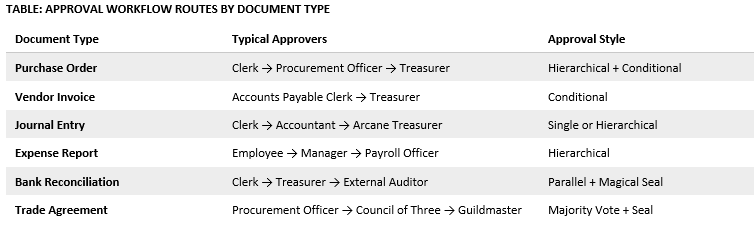
Workflows by Document Type
Different business records require different kinds of approval.
Approvals via the Guild Whisper Network
While parchment and wax seals remain the backbone of commerce, the Waterdeep Trading Company has harnessed the Guild Whisper Network—an arcane lattice of sending stones, crystal orbs, and whisper-scrolls—to extend approval workflows beyond the guildhall.
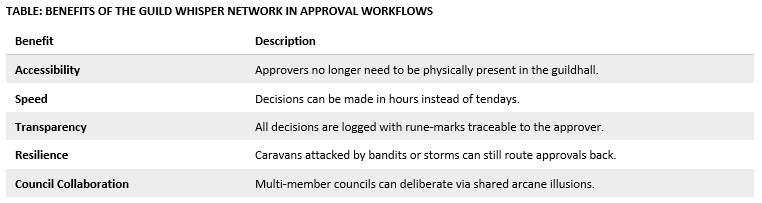
Through this system:
Approvers can receive tasks instantly, no matter if they are in Suzail, Silverymoon, or aboard a caravan.
Magical missives replicate the approval request, displaying the document details as an illusion.
With a spoken word of assent, refusal, or escalation, the approval is recorded in the company’s enchanted ledger.
Complex approvals—such as majority votes—can be tallied in real time, with results displayed as glowing seals visible to all council members.
Worked Example: Vendor Invoice with Whisper Approval
Suppose a vendor from the Baldur’s Gate Blacksmiths Guild submits an invoice for steel shipment. Instead of requiring Borin Stonehand to travel back to Waterdeep:
Invoice entered by Darrik Ambermantle.
Approval workflow routes to Borin’s sending stone through the Guild Whisper Network.
Borin inspects the illusionary invoice and speaks “Approved.”
Rune-seal is affixed instantly in the ledger.
Payment is authorized without delay.
This system combines the rigor of guild law with the reach of arcane communication.
Realms-Aware Considerations
Unlike the modern realms, Faerûn’s approval workflows must account for arcane and guild-specific factors:
Magical Validation: Contracts may require rune-seals to prove authenticity.
Guild Hierarchies: Some workflows demand votes from majority councils.
Regional Factors: A purchase order raised in Calimport might need both the local Silk Quarter guildmaster’s approval and Waterdeep headquarters’ seal.
Emergency Overrides: During dragon attack or famine, workflows may allow bypass by high council decree, with retroactive sealing.
Distributed Approvals: With the Guild Whisper Network, even adventurers in the field may approve a trade in real time.
Final Thoughts
Approval workflows are the lifeblood of disciplined trade. They replace uncertainty with order, allowing the Waterdeep Trading Company to conduct business with confidence, from the Sword Coast to the sands of Calimshan. Much like spells that protect a city, these processes shield the company’s coffers and reputation. With the Guild Whisper Network, approvals are no longer bound to parchment—they travel across Faerûn as swiftly as thought itself.
Support the AD&D365 Project on Patreon. To grow this world, we’ve launched an official Patreon where supporters can gain access to exclusive content, tools, training labs, and even influence the future of the project. Your support fuels more than just development , it expands the guildhall, forges new scrolls, and empowers the next generation of configuration wizards. Begin your journey: https://www.patreon.com/adnd365/
A Grateful Salute to Our Patrons. To all those who stand behind the vision, thank you for helping bring this world to life. Our Benefactors, Andre Breillatt, and Eryndor Fiscairn‡, your boundless generosity fuels the arcane core of this project. Without your magic, the weave would falter. Our Apprentices, the spell engines turn and the training labs thrive thanks to our current Apprentices: Michael Ramirez and Andreth Bael’Rathyn‡. Special thanks to our past Apprentices, whose contributions helped us get here: Ralf Weber, Wendy Rijners, Shashi Mahesh, Julia Tejera, Ben Ekokobe, Tiago Xavier, Naveen Boyinapelli, Marcos Tadeu Wolf, Kathryn Greene, Jason Brown, Mark Christy, and Ashish Singh.Our Initiates, Gregory Brigden, and Martin Grahm, your commitment marks the start of the deeper path, stepping beyond mere observation into the active shaping of this realm. Our Followers, your steady presence along the journey is a beacon of encouragement: Eric Shuss, Sunil Panchal, Sarah D. Morgan, Nick Ramchandani, Daniel Kjærsgaard, and Tomasz Pałys. And our Voyeurs, Harry Burgh, Abdelrahman Nabil, and Basil Quarrell, ever watching from the shadows, clearly intrigued… but not enough to part with a single gold piece. Your silent curiosity is noted, and mildly judged.
Want to design your own economic models in Faerûn? Get your own AD&D365 Environment and guides at adnd365.com/start, and request access to the public view of the current database at https://public.adnd365.com – Login npc@adnd365.com, Password N0nPl@yC#822!
In the bustling workshops and enchanted forges of Faerûn, the reputation of the Waterdeep Trading Company rests on the quality of its goods. From rune-etched cauldrons to barrels of ale, consistency is key. To maintain that standard, the company employs structured methods of inline and continuous item sampling during production. These practices ensure that defects are caught early, magical anomalies are corrected, and customers across the Sword Coast receive only the finest merchandise.
What It Is
Production is not simply the act of crafting an item—it is the weaving together of material, labor, and enchantment into something worthy of trade. At every step, flaws may appear: impurities in ore, unstable runes, mismeasured herbs, or even disruption from ambient magic. Inline sampling and continuous sampling are the two chief practices for safeguarding against such failures. Inline sampling takes precise snapshots of quality at chosen points in the line, while continuous sampling acts as an ever-vigilant sentinel, monitoring the flow without pause. Together, they form a shield against defects and unreliability in the production halls of Faerûn.
Inline sampling refers to taking quality samples at defined checkpoints within the production line. This could be after the shaping of a steel blade, midway through a potion distillation, or upon the weaving of an enchanted fabric.
Continuous sampling involves monitoring product quality throughout the entire production flow. Instead of relying on static checkpoints, it constantly draws information—through inspection, testing, or even arcane sensors—to flag issues as soon as they arise.
Both methods are integral parts of a quality control system within Faerûn’s manufacturing houses and are supported by enchanted ledgers that track results automatically.
Why It Matters
Every caravan that departs Waterdeep bears the reputation of the Company with it. A cracked cauldron in Baldur’s Gate or a spoiled potion in Calimport can tarnish not just a shipment but the very trust of an entire guild or city. By embedding sampling practices into production, the Company ensures that goods arriving in far-off markets meet the highest standards. More than a technical necessity, these practices fulfill guild contracts, appease inspectors, and honor the confidence of customers who expect perfection from every crate, cask, and casting.
Inline and continuous sampling matter because they:
Reduce waste by catching defects before they reach final assembly
Protect brand reputation by ensuring goods are consistent
Meet guild regulations, such as those set by the Brewers & Distillers or Arcane Artificers’ Union
Provide traceability for compliance with magical safety standards
Support continuous improvement of both mundane and arcane production processes
Components of Inline Sampling
Inline sampling is deliberate and structured, demanding that checkpoints be chosen wisely. A single overlooked step can allow imperfections to slip downstream. By establishing these checkpoints—whether at the forge, the loom, or the distillery—workers carve moments of certainty out of an otherwise complex flow. Each checkpoint becomes a watchtower along the supply route, guarding the line against creeping errors. The Company records not just results, but the very methods of inspection, so that apprentices learn, guilds are reassured, and auditors find confidence in the paper and rune trails alike.
Inline sampling typically includes:
Checkpoint Definition: Identifying critical stages in the production route where a sample must be taken.
Sample Size: Deciding how many items to test from each batch or flow.
Inspection Method: Visual, mechanical, or magical checks depending on the item.
Documentation: Recording results in production journals, often supported by enchanted runes or Dynamics 365 ledgers.
Components of Continuous Sampling
Continuous sampling carries this watchfulness further, embedding quality vigilance into the very heartbeat of production. Instead of stopping to examine at intervals, it uses enchanted crystals, mechanical gauges, or even bound elementals to watch every item as it moves. No forge can produce endlessly flawless goods, but continuous monitoring ensures that the moment cracks form, or magical energy fluctuates, the line is alerted. This constant oversight is akin to a cleric’s ward, shielding not through occasional ritual but through ceaseless guardianship.
Continuous sampling builds on these by:
Using real-time detection tools, such as crystal sensors for potion stability or weight-runes for milling consistency.
Applying statistical or arcane process control to spot trends.
Ensuring ongoing compliance, with alerts that automatically halt a production line if thresholds are breached.
Worked Example: Enchanted Steel Cauldron
The enchanted steel cauldron is one of the Waterdeep Trading Company’s most popular items, sold to merchants, alchemists, and inns across the Sword Coast. Its strength lies not only in its steel but in the delicate balance of enchantments that allow it to withstand flame, frost, and magical reactions. To maintain this reputation, both inline and continuous sampling are employed throughout its production cycle.
Step 1: Smelting and Pouring
As dwarven smelters pour molten steel into molds, inline sampling occurs every twentieth ladle. A portion of the steel is cooled, tested for purity, and checked for proper alloy balance. If traces of brittle slag are found, the entire melt is flagged for rework. At the same stage, continuous sampling is achieved by placing rune-marked weights at the base of the molds. These weights glow red if the density shifts outside acceptable limits, alerting workers instantly.
Step 2: Shaping and Hammering
When the cauldron halves are hammered into form, inline sampling involves removing one cauldron per shift and testing rim thickness with enchanted calipers. Results are logged into the quality ledger for guild review. Continuous sampling here is subtler: rune-etched anvils hum and glow whenever force distribution strays, catching uneven strikes that could cause long-term weakness.
Step 3: Enchanting
Perhaps the most critical stage, enchantments must bind evenly across the steel. Inline sampling includes channeling a simple flame spell into every fiftieth cauldron, verifying that the enchantment disperses heat without distortion. Meanwhile, continuous sampling is carried out by crystals embedded above the enchanting circle. These crystals pulse whenever magical resonance falters, allowing enchanters to halt the ritual before an unstable cauldron is finalized.
Step 4: Cooling and Finishing
During cooling, inline sampling involves pulling random cauldrons and filling them with boiling water to test for sudden cracks. The tests are witnessed by both smiths and guild auditors. Continuous sampling comes through rune-bands laid along the cooling racks, which hum in harmony when the cauldrons contract evenly. A discordant note warns of hidden fractures invisible to the naked eye.
Step 5: Packing and Dispatch
Before the cauldrons are crated and sealed for caravan, the sampling process continues. Inline checks inspect branding marks and serial runes on selected cauldrons to ensure traceability. Continuous oversight comes from arcane sigils painted on the storage pallets that glow if any item deviates from the recorded sample standard.
By employing both sampling methods, the Waterdeep Trading Company ensures that not a single enchanted cauldron leaves the forge untested. Customers in Calimport can set them over dragon-fire stoves, alchemists in Baldur’s Gate can brew volatile mixtures within them, and nobles in Silverymoon can serve feasts with pride—all without fear of failure.
Realms-Aware Considerations
Unlike purely mundane factories, Faerûn’s production halls contend with shifting magical fields, guild regulations, and planar oddities. Inline and continuous sampling must be adapted for each region and product. A brewer in Silverymoon might emphasize sensory sampling to detect subtleties of taste enchanted by moonlight, while a smith in Luskan must focus on structural checks to prevent flaws in steel. When trade stretches across planes, additional layers of stability and safety are imposed, ensuring that what survives a planar forge remains safe once carried back to Waterdeep. In the Realms, quality control is as much an art of adaptation as it is of procedure.
In Faerûn, these methods must adapt to local conditions:
Arcane Influence: Magical surges may distort results; continuous wards are often required.
Regional Guild Standards: Brewers in Silverymoon use stricter taste tests than smiths in Baldur’s Gate.
Inline and continuous item sampling are more than mundane quality tools—they are safeguards of trust in a realm where goods may carry both physical and magical consequences. For the Waterdeep Trading Company, they ensure that every cauldron, potion, and enchanted saddle leaving its gates strengthens its reputation as the Sword Coast’s most reliable trading house.
Support the AD&D365 Project on Patreon.
To grow this world, we’ve launched an official Patreon where supporters can gain access to exclusive content, tools, training labs, and even influence the future of the project. Your support fuels more than just development , it expands the guildhall, forges new scrolls, and empowers the next generation of configuration wizards. Begin your journey: https://www.patreon.com/adnd365/
A Grateful Salute to Our Patrons
To all those who stand behind the vision, thank you for helping bring this world to life. Our Benefactors, Andre Breillatt, and Eryndor Fiscairn‡, your boundless generosity fuels the arcane core of this project. Without your magic, the weave would falter. Our Apprentices, the spell engines turn and the training labs thrive thanks to our current Apprentices: Michael Ramirez and Andreth Bael’Rathyn‡. Special thanks to our past Apprentices, whose contributions helped us get here: Ralf Weber, Wendy Rijners, Shashi Mahesh, Julia Tejera, Ben Ekokobe, Tiago Xavier, Naveen Boyinapelli, Marcos Tadeu Wolf, Kathryn Greene, Jason Brown, Mark Christy, and Ashish Singh.Our Initiates, Gregory Brigden, and Martin Grahm, your commitment marks the start of the deeperFpath, stepping beyond mere observation into the active shaping of this realm. Our Followers, your steady presence along the journey is a beacon of encouragement: Eric Shuss, Sunil Panchal, Sarah D. Morgan, Nick Ramchandani, Daniel Kjærsgaard, and Tomasz Pałys. And our Voyeurs, Harry Burgh, Abdelrahman Nabil, and Basil Quarrell, ever watching from the shadows, clearly intrigued… but not enough to part with a single gold piece. Your silent curiosity is noted, and mildly judged.
Want to design your own economic models in Faerûn?
Get your own AD&D365 Environment and guides at adnd365.com/start, and request access to the public view of the current database at https://public.adnd365.com – Login npc@adnd365.com, Password N0nPl@yC#822!
In the wards of Waterdeep, work begins before dawn and ends when the last cart clears the gate. Foremen count crates, baristas tune grindstones, and clerks balance ledgers by lantern light. The Waterdeep Trading Company thrives when each role is measured with clarity and coached with purpose. This article gathers the company rating models, anchors, and prompts into one reusable guide. It turns scattered checklists into a single practice that is fair, fast, and ready for audit in every city of the Sword Coast.
What It Is
This is a complete evaluation framework for crews and stewards across shops, warehouses, caravans, and labs. It defines rating scales with pass rules, gives behavior anchors for everyday tasks, and packages a clean question set for reviews. It also includes targeted follow-ups for training exceptions and a worked example that shows the scoring pattern.
Why It Matters
Consistent ratings reduce disputes and speed coaching. Anchors cut guesswork between shifts and locations. Pass rules support auditors and guild inspectors. Together, these practices improve service, limit rework, and raise throughput without risking safety or compliance.
Rating Models at a Glance
This section introduces the scales used across the company. Each model has a factor used in scoring, a pass rule, and a plain description. Use this overview to pick the right model before you rate a task.
The following table summarizes every model the Waterdeep Trading Company uses for performance and compliance. Keep this close at hand when preparing reviews or building dashboards. It doubles as a quick reference so stewards can choose the correct scale without searching through scrolls.
BARS5, Behavior Anchors for Common Roles
This section explains the behavior scale with concrete anchors for three common duties. Use these anchors to keep ratings consistent between wards and shifts, especially when crews rotate between lanes.
The next table turns the BARS5 scale into specific, observable behaviors across three role families. These anchors reduce rater drift, help new stewards calibrate quickly, and give employees clear targets for advancement.
Training Status and Follow Through
This section covers training completion states and the actions that keep the roster compliant. Use the status table for scoring and the follow up table to close gaps without delay.
The next table shows every completion state along with factor and pass rule. It is the single source of truth for auditors and guild inspectors. Pair it with the follow up table that follows to convert exceptions into dated action.
Use the next table whenever a training item is failed or exempt. These prompts create a corrective path with ownership and due dates. This prevents repeat exceptions and keeps the ledger of learning clean.
Skill Proficiency
This section records how strong a skill is in daily work. Use the five level table for detailed roles, and the three level table for quick snapshots during ladder reviews.
The table below defines five proficiency levels with factors and pass rules. Use it for hands on roles like brewing, picking, and station work. It is also helpful when proposing cross training or merit increases.
Use the next table when a quick snapshot is needed for role mapping. It supports talent reviews, crew assignments, and leadership identification with minimal overhead.
Compliance and Observation
This section captures policy status and live task checks. Use it to certify safe practice on the floor and to keep inspection scrolls in order.
The following compliance table aligns policy status to clear outcomes. It is designed for quick sign off during monthly reviews and for guild inspections. It ensures that remediation steps are tracked when gaps appear.
Use the observation table that follows to document what was seen at the station. It is the evidence trail for sign off and prevents disputes about readiness.
Frequency, Security, License, and Audit
This section covers measures that guide training plans and risk posture, including frequency of use, security drills, credentials, and audits.
The next table is informational. It captures how often a skill is used. This helps planners time refreshers and rotate crews to maintain muscle memory without wasting tuition.
Security incidents in Faerûn include trapped parchments and false sending stones. The table below records the latest outcome for drills or real events. It pairs well with refresher coaching notes.
Credentials keep dangerous work safe, from forklifts to alchemical vessels. Use the next table to track standing, schedule renewals, and satisfy inspectors.
Audits keep shops and warehouses honest. The next table provides a simple four level record for findings. Use it with CAPA logs to close issues before the next inspection.
Attendance matters for classroom and on the job sessions. Use the table below to record presence and to trigger make up training when needed.
Short UI Tooltips
This section gives single line hints for forms and dashboards. Use them as hover text or small print under field labels when building review scrolls or crystals.
The table below condenses each model into a one line helper. It improves speed during entry and reduces confusion for new stewards.
The Question Set, Ready to Use
This section presents the evaluation prompts in a single checklist. Use the right model beside each prompt, and add notes when the prompt calls for narrative detail.
The next table maps every prompt to the correct model. Take it onto the floor for mid-period checks, and keep a copy in the steward’s office for end-of-period reviews. It allows one pass from behavior through growth planning.
When a completion exception appears, use the prompts below without delay. This keeps the training ledger current and prevents repeat findings at the next inspection.
Worked Example, Mid-Period Snapshot
This section shows a filled example for a picker barista in the Dock Ward. Use it as a model for scoring and notes during mid period coaching.
The next table presents a complete snapshot with selections, factors, pass results, and short notes. It demonstrates how to convert observations into clear scores and actions that carry into the next moon.
Quick Capture Sheet for Field Use
This section gives a one-page capture layout for clipboards and tablets in loud stations. Copy it into a form and keep it near the time board so stewards can complete reviews between rushes.
The next table lists the capture fields in the order a steward will encounter them during a review. It keeps the process fast, traceable, and consistent with the scales above.
Realms Aware Considerations
Travel time varies by ward and season, so judge behaviors first and adjust expectations only when evidence shows outside forces at play. Arcane devices require extra care, so apply compliance with attention to sanitation charms and containment runes. Security awareness includes trapped parchments and false sending stones, treat them like suspicious links, report, isolate, purge. For roaming caravans, pin observations to the city and day to keep context clear for audits.
Final Thoughts
Post the scales in steward stations, add the tooltips to forms, and keep the capture sheet close at hand. Rate the behavior you see most, write brief notes, and close every exception with an owner and a date. End each review with two strengths, one development area, and two or three goals that can be verified on the floor. In this way the Waterdeep Trading Company keeps its promise to crews and clients across Faerûn.
Support the AD&D365 Project on Patreon.
To grow this world, we’ve launched an official Patreon where supporters can gain access to exclusive content, tools, training labs, and even influence the future of the project. Your support fuels more than just development, it expands the guildhall, forges new scrolls, and empowers the next generation of configuration wizards. Begin your journey: https://www.patreon.com/adnd365/
A Grateful Salute to Our Patrons
To all those who stand behind the vision, thank you for helping bring this world to life. Our Benefactors, Andre Breillatt, and Eryndor Fiscairn‡, your boundless generosity fuels the arcane core of this project. Without your magic, the weave would falter. Our Apprentices, the spell engines turn and the training labs thrive thanks to our current Apprentices: Michael Ramirez and Andreth Bael’Rathyn‡. Special thanks to our past Apprentices, whose contributions helped us get here: Ralf Weber, Wendy Rijners, Shashi Mahesh, Julia Tejera, Ben Ekokobe, Tiago Xavier, Naveen Boyinapelli, Marcos Tadeu Wolf, Kathryn Greene, Jason Brown, Mark Christy, and Ashish Singh.Our Initiates, Gregory Brigden, and Martin Grahm, your commitment marks the start of the deeper path, stepping beyond mere observation into the active shaping of this realm. Our Followers, your steady presence along the journey is a beacon of encouragement: Eric Shuss, Sunil Panchal, Sarah D. Morgan, Nick Ramchandani, Daniel Kjærsgaard, and Tomasz Pałys. And our Voyeurs, Harry Burgh, Abdelrahman Nabil, and Basil Quarrell, ever watching from the shadows, clearly intrigued… but not enough to part with a single gold piece. Your silent curiosity is noted, and mildly judged.
Want to design your own economic models in Faerûn?
Get your own AD&D365 Environment and guides at adnd365.com/start, and request access to the public view of the current database at https://public.adnd365.com – Login npc@adnd365.com, Password N0nPl@yC#822!
In the streets and halls of Waterdeep, learning is a living contract. The Waterdeep Trading Company binds its craft to standards that outlast seasons, caravans, and councils. A clear academy structure ensures that every stallkeeper, caravaner, artificer, and ledger scribe gains the right knowledge at the right time. This article sets out the learning management model used by the company, the types of classes, and the master course catalog adapted for the Realms. It also marks which trainings are required for all hands and which are required by role.
What It Is
Learning management is the guild function that designs, delivers, and verifies training across the company. It sets pathways by role, issues certificates and badges, and records completions in the company ledger. It aligns skills to duties using clear curricula and repeatable assessments.
Why It Matters
Training keeps patrons safe, keeps workers confident, and keeps the company in good standing with guild charters and the Lords of Waterdeep. It reduces loss, improves margins, and shortens time to proficiency. It also supports promotions and apprenticeships across guild chapters.
Class Types and Delivery Modes
Below are the formats the company uses to teach and verify skill. Each format has a place in the journey from novice to master.
This table explains each class type so managers can build balanced learning paths.
Company-Wide Required Trainings
All workers complete these within the first tenday, then refresh as scheduled.
This table lists the mandatory courses for every employee, regardless of role.
Role based mandatory courses are listed in the catalog overview below.
Catalog Overview by Guild Path
The full catalog has been realm tuned. Codes remain short for easy ledger entry, titles reflect Faerûn practices, and required audiences are noted.
This table helps leaders see which groups own which requirements.
Worked Example, A Path for a New Market Stall Attendant
A novice begins with Orientation, Conduct, Anti Harassment, CX Basics, Data Privacy, and Timekeeping. In the first tenday they complete Countinghouse and Chit Payments, Cash Handling, Cleaning by Watch, and De escalation. In the second tenday they take Brewcraft 101 and Equipment Care, then pass an On The Job checklist under a senior. Their Mastery Trial is a service simulation using role play and a short ledger reconciliation.
Realms Aware Considerations
Festivals in the city drive seasonality for staffing and refreshers, guild inspections require records on demand, cross city transfers must honor chapter specific rules and seals, caravaners need watch rotation training when routes cross dangerous roads, and arcane workshops require special emergency procedures for vapors and unstable brews.
Final Thoughts
A guild grows only as fast as it teaches. With a clear academy, the Waterdeep Trading Company trains faster, safer, and smarter, and keeps its sigil bright in every ward and on every road.
Support the AD&D365 Project on Patreon.
To grow this world, we’ve launched an official Patreon where supporters can gain access to exclusive content, tools, training labs, and even influence the future of the project. Your support fuels more than just development , it expands the guildhall, forges new scrolls, and empowers the next generation of configuration wizards. Begin your journey: https://www.patreon.com/adnd365/
A Grateful Salute to Our Patrons
To all those who stand behind the vision, thank you for helping bring this world to life. Our Benefactors, Andre Breillatt, and Eryndor Fiscairn‡, your boundless generosity fuels the arcane core of this project. Without your magic, the weave would falter. Our Apprentices, the spell engines turn and the training labs thrive thanks to our current Apprentices: Michael Ramirez and Andreth Bael’Rathyn‡. Special thanks to our past Apprentices, whose contributions helped us get here: Ralf Weber, Wendy Rijners, Shashi Mahesh, Julia Tejera, Ben Ekokobe, Tiago Xavier, Naveen Boyinapelli, Marcos Tadeu Wolf, Kathryn Greene, Jason Brown, Mark Christy, and Ashish Singh.Our Initiates, Gregory Brigden, and Martin Grahm, your commitment marks the start of the deeperFpath, stepping beyond mere observation into the active shaping of this realm. Our Followers, your steady presence along the journey is a beacon of encouragement: Eric Shuss, Sunil Panchal, Sarah D. Morgan, Nick Ramchandani, Daniel Kjærsgaard, and Tomasz Pałys. And our Voyeurs, Harry Burgh, Abdelrahman Nabil, and Basil Quarrell, ever watching from the shadows, clearly intrigued… but not enough to part with a single gold piece. Your silent curiosity is noted, and mildly judged.
Want to design your own economic models in Faerûn?
Get your own AD&D365 Environment and guides at adnd365.com/start, and request access to the public view of the current database at https://public.adnd365.com – Login npc@adnd365.com, Password N0nPl@yC#822!
The economy of Faerûn is not defined by coin alone. Its true strength lies in the industries that sustain livelihoods, uphold guild traditions, and bridge the gap between the mundane and the magical. From the vast wheat fields of Goldenfields to the enchanted workshops of Silverymoon, industries act as the pulse of the Realms, feeding cities, outfitting adventurers, empowering temples, and ensuring that trade routes remain alive with goods both practical and arcane.
For merchants and adventurers alike, industries are more than suppliers of goods, they are the engines of culture, politics, and survival. Guilds wield enormous influence, dictating not only quality and pricing but also shaping the destinies of apprentices, artisans, and even kingdoms. Magical integration further sets Faerûn apart from other economies: brewers enchant their mead for longevity, smiths forge blades with runes of protection, and scribes craft parchments immune to rot. Each craft carries with it centuries of tradition, technical mastery, and at times, divine blessing.
The Waterdeep Trading Company views industries not as abstract markets but as living ecosystems. Understanding how each vertical operates is essential for anticipating shortages, negotiating contracts, and leveraging guild alliances. A failure in one industry, a poor harvest, a guild strike, a broken leyline, can ripple outward, threatening supply chains, destabilizing tariffs, or sparking political unrest. Conversely, mastery of industry knowledge can unlock opportunities: positioning goods where scarcity drives demand, investing in verticals aligned with magical trends, and safeguarding contracts through compliance with guild regulations.
Industries of Faerûn also mirror the unique geography and cultures of the continent. Luskan’s shipwrights thrive because of their harsh northern seas. Amn’s merchants dominate coffee and tea through coastal access and southern trade routes. Thay’s arcane workshops flourish under Red Wizard oversight, while Goldenfields ensures that the breadbasket of the Sword Coast never runs dry. Each region specializes, adapts, and innovates, creating a patchwork economy where survival depends on both local resilience and continental trade flows.
By exploring these industries in detail, we uncover not only their typical products and craft requirements but also the business capabilities needed to manage them effectively within a system like Dynamics 365. From batch traceability in brewing to serialized artifact registries for enchanted items, each vertical demands specialized processes that reflect its magical and cultural realities.
The following sections will examine the major industries of Faerûn, their guild structures, and their operational needs. Together, they form a blueprint for understanding the engines of commerce and craft, industries that do not simply sustain the Realms but define them.
Why Faerûnian Industries Matter
Industries in Faerûn are more than lines of trade, they are the pillars that uphold the Realms’ prosperity and stability. Each vertical binds together tradition, innovation, and survival, ensuring that both great cities and rural hamlets remain supplied and sustained. Their significance rests on four interwoven principles:
Guild Regulation: Powerful guilds safeguard every craft, enforcing standards of quality, setting fair wages, and guiding apprenticeships. Their oversight prevents chaos in the marketplace and ensures continuity of skill across generations.
Regional Specialization: Geography shapes mastery. Goldenfields thrives as the breadbasket of the North, while Luskan’s icy docks produce ships that endure the harshest seas. Each region’s strengths define its contribution to the greater economy.
Magical Integration: Arcane practice and mundane craft are inseparable. Brewers weave enchantments into mead for longevity, smiths etch protective runes into armor, and scribes enchant parchment against decay. Magic amplifies what craftsmanship alone could not achieve.
Economic Stability: Industries are the lifeblood of tariffs, taxes, and trade flows. They generate wealth for cities, sustenance for villages, and resilience for kingdoms, anchoring both everyday survival and grand commerce.
Together, these principles explain why industries are not merely sectors of labor, they are the engines that drive Faerûn’s culture, politics, and prosperity.
Key Industries of Faerûn and Their Unique Requirements
From the bustling dockyards of Luskan to the fertile fields of Goldenfields and the enchanted workshops of Silverymoon, each industry in Faerûn has its own rhythms, strengths, and challenges. These verticals not only supply goods but also shape the character of their regions, reflecting centuries of guild tradition and magical practice. For the Waterdeep Trading Company, understanding the unique requirements of each industry is vital to managing supply chains, negotiating contracts, and forecasting demand. What follows is a closer look at the industries that power the Realms and the specialized capabilities that make them thrive.
Brewing & Distillation: Ale, cider, and spirits flow across taverns and courts alike. Brewers require fermentation mastery, magical infusions for aging, and scrying spells for quality control. Their guild, FABRDS, ensures authenticity and fair pricing.
Agriculture & Crop Cultivation: Goldenfields and Amn dominate grain and produce, feeding cities and supplying potion ingredients. Farmers must master seasonal planning, irrigation, and pest-warding rituals, while balancing both mundane crop yields and druidic blessings.
Cattle & Livestock Trade: From Daggerford pastures to Calimport markets, livestock fuels diets and barter economies. Herdsmen must focus on breeding management, disease prevention, and caravan protection, especially in regions where a cow may be worth 30 gold or more.
Potion & Alchemy Manufacturing: Alchemists and artificers in Waterdeep, Baldur’s Gate, and Thay rely on Engineering Change Management to regulate volatile recipes. Requirements include safe distillation, version tracking, and strict guild compliance to avoid catastrophic failures.
Textile & Storage Crafting: The Grand Artisans League oversees fabrics, satchels, and planar bags. Craftsfolk require loom mastery, dye enchantment, and planar weave sealing, ensuring robes resist flames and bags hold more than their size would suggest.
Weapon & Armor Smithing: The Black Anvil Guild unites smiths from Waterdeep and Neverwinter. Beyond metallurgy, rune-forging and rigorous apprenticeship systems are essential. Every blade and breastplate is tested both by hammer and enchantment.
Enchanted Item Production: Concentrated in Silverymoon and Thay, enchanted item production requires leyline attunement, artifact registries, and enchantment safety practices. Wands, rings, and arcane tools must be carefully catalogued to prevent misuse.
Construction & Masonry: The Stoneworkers & Builders Federation oversees towers, fortresses, and arcane gates. Requirements include rune binding, corruption-free contracting, and structural engineering fit for both mundane strongholds and planar gateways.
Herbalism & Botanical Goods: Herbalists in Candlekeep and Silverymoon must balance cultivation, drying techniques, and ritual knowledge. Their trade supplies both healers and alchemists, with guilds ensuring rare herbs are protected from exploitation.
Bardic & Instrument Crafting: The Bardic Performers’ Union protects the crafters of lutes, flutes, and illusion boxes. Their work requires tonal enchantments, illusion weaving, and performer sponsorship to keep bardic schools supplied.
Shipbuilding & Outfitting: Luskan’s dockyards and Mintarn’s drydocks specialize in galleons and spelljammer-ready hulls. Dockwrights require hull reinforcement expertise, planar navigation glyphs, and logistical control of drydock resources.
Glassblowing & Crystalworks: Glasswrights shape vials, mirrors, and scrying lenses in Amn and Silverymoon. Precision crystal alignment and enchantment compatibility are paramount to prevent flaws in alchemical or divinatory tools.
Parchment & Book Production: Papermakers and scribes produce ledgers and spell scrolls. They require vellum crafting, ink enchantments, and anti-decay spells to safeguard libraries such as Candlekeep.
Gemcutting & Stonebinding: The Gemcutters’ Consortium ensures stability in jewelry and soul stones. Skills include faceting, soul-binding rituals, and gemstone stabilization, work that often balances commerce with spiritual trust.
Leatherworking & Saddlery: Tanners in Daggerford and Baldur’s Gate craft boots, saddles, and monster-hide goods. Requirements include toxin neutralization, hide curing, and sigil carving, particularly for exotic mounts.
Candle, Oil & Incense Making: Temples rely heavily on WIXCOL guild-certified products. Craftsfolk refine wax, infuse scents, and maintain ritual purity, ensuring candles and incense meet religious standards.
Jewelry & Amulet Forging: Artificers of Ornament specialize in protective amulets and noble house sigils. They must blend heraldic design with enchantment bonding, ensuring both prestige and function.
Ceramics & Clayworking: Potters in Amn and Waterdeep produce urns, cauldrons, and rune-etched vessels. Their requirements include kiln mastery, rune embedding, and fracture resistance for ritual reliability.
Furniture & Fixtures: Carpenters craft chests, beds, and warded doors. Joinery, planar anchoring, and compartment warding are required to create fixtures that protect against scrying or intrusion.
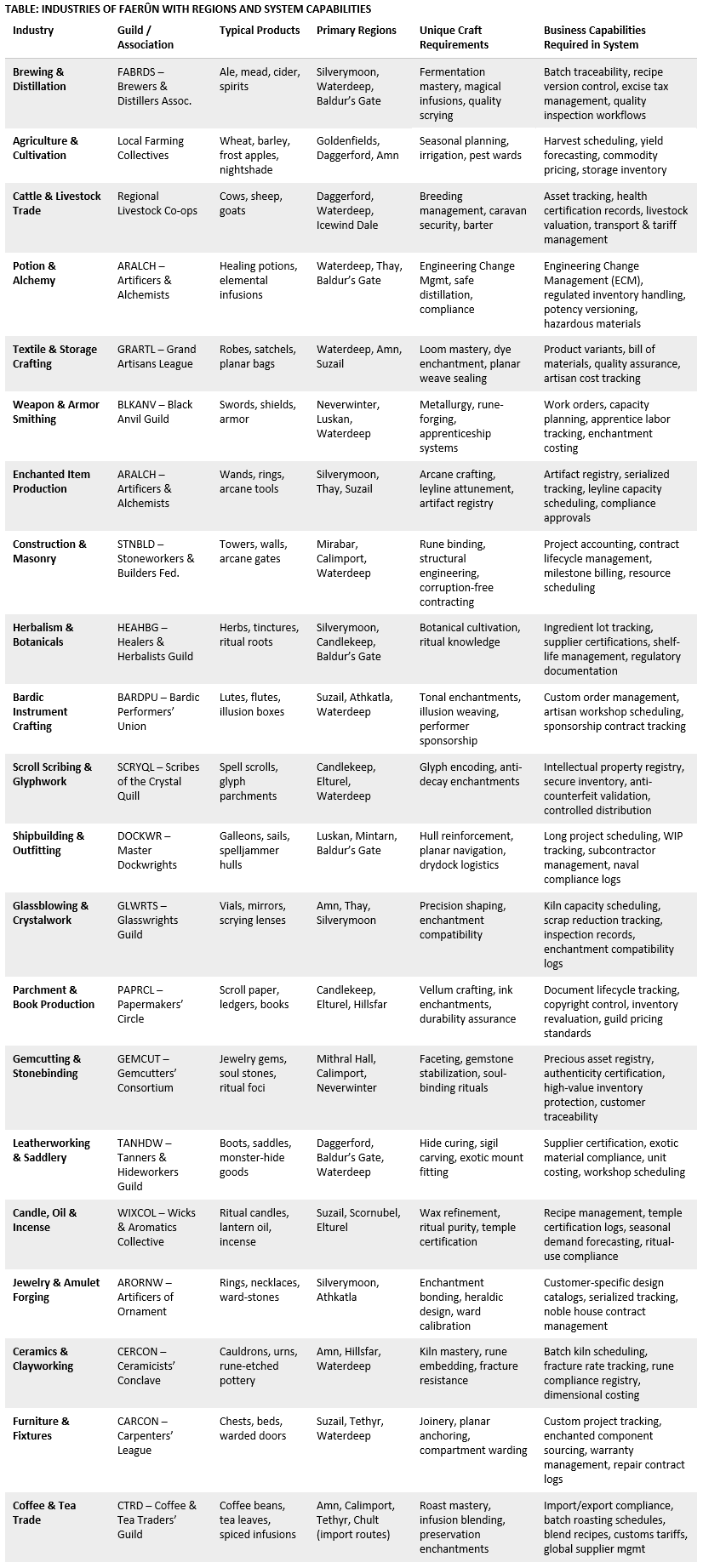
The following table highlights all the industries of Faerûn, their guilds, typical goods, craft requirements, business system needs, and the regions where they are most active. A new row has been added for the Coffee & Tea trade, a growing vertical in southern Faerûn.
Realms-Aware Considerations
Industries in Faerûn do not exist in isolation, they are shaped by forces as varied as guild politics, magical tides, geography, and the turning of the seasons. A process that runs flawlessly in Waterdeep may falter in Luskan’s harsher climate, while Goldenfields’ abundant harvests may wither under Calimport’s arid skies. For the Waterdeep Trading Company, true mastery comes not only from understanding the craft of each industry but also from recognizing the wider forces that influence production, trade, and demand across the continent.
Seasonality – Many trades, particularly agriculture, brewing, and candle-making, are bound to ritual calendars and harvest cycles, creating periods of abundance and scarcity that drive pricing and supply.
Magic vs. Mundane Balance – Some industries, such as alchemy and potion-making, operate under strict arcane regulation, while others, like blacksmithing, face shifting pressures from tariffs, wartime requisitions, or local politics.
Guild Oversight – Apprenticeships, certifications, and price controls are enforced through powerful guild networks, ensuring consistency but also limiting flexibility for independent traders.
Regional Scarcity – Goods plentiful in one region may be rare luxuries in another. Cattle may roam freely in Goldenfields, yet in Icewind Dale they command extraordinary value, shaping trade routes and bargaining power.
Taken together, these considerations remind us that Faerûn’s industries are never static. They are living systems, influenced by culture, magic, and environment. For traders and guilds alike, success lies in adapting to these shifting currents while maintaining trust, quality, and resilience.
Final Thoughts
The industries of Faerûn create more than goods, they weave the very fabric of the Realms. Where tradition meets magic, each vertical carries its own disciplines, safeguards, and cultural significance, shaping not only commerce but also identity and survival. Brewing, smithing, enchanting, and cultivation are not isolated trades; together they sustain cities, empower adventurers, and anchor the flow of wealth across kingdoms.
For the Waterdeep Trading Company, understanding these industries is not simply a matter of market awareness, it is a strategic imperative. Success depends on anticipating the rhythms of harvests, respecting guild governance, leveraging magical innovation, and adapting to shifting regional demands. By mastering the unique requirements of each vertical, the Company secures its place at the heart of Faerûn’s economy, ensuring resilience, influence, and prosperity in an ever-changing world.
Support the AD&D365 Project on Patreon.
To grow this world, we’ve launched an official Patreon where supporters can gain access to exclusive content, tools, training labs, and even influence the future of the project. Your support fuels more than just development , it expands the guildhall, forges new scrolls, and empowers the next generation of configuration wizards. Begin your journey: https://www.patreon.com/adnd365/
A Grateful Salute to Our Patrons
To all those who stand behind the vision, thank you for helping bring this world to life. Our Benefactors, Andre Breillatt, and Eryndor Fiscairn‡,, your boundless generosity fuels the arcane core of this project. Without your magic, the weave would falter. Our Apprentices, the spell engines turn and the training labs thrive thanks to our current Apprentices: Michael Ramirez and Andreth Bael’Rathyn‡. Special thanks to our past Apprentices, whose contributions helped us get here: Ralf Weber, Wendy Rijners, Shashi Mahesh, Julia Tejera, Ben Ekokobe, Tiago Xavier, Naveen Boyinapelli, Marcos Tadeu Wolf, Kathryn Greene, Jason Brown, Mark Christy, and Ashish Singh.Our Initiates, Peter Lorre, your commitment marks the start of the deeper path, stepping beyond mere observation into the active shaping of this realm. Our Followers, your steady presence along the journey is a beacon of encouragement: Eric Shuss, Sunil Panchal, Sarah D. Morgan, Nick Ramchandani, Daniel Kjærsgaard, and Tomasz Pałys. And our Voyeurs, Harry Burgh, Abdelrahman Nabil, and Basil Quarrell, ever watching from the shadows, clearly intrigued… but not enough to part with a single gold piece. Your silent curiosity is noted, and mildly judged.
Want to design your own economic models in Faerûn?
Get your own AD&D365 Environment and guides at adnd365.com/start, and request access to the public view of the current database at https://public.adnd365.com – Login npc@adnd365.com, Password N0nPl@yC#822!
From the anvil halls of the Black Anvil Guild to the silk-threaded studios of the Grand Artisans League, apprenticeships are the lifeblood of skilled labor across Faerûn. For the Waterdeep Trading Company and affiliated guilds, integrating apprentices into active production environments ensures not only continuity of craft but also operational resilience. However, such integration requires careful structuring, balancing training, certification, and workplace safety.
This article outlines how Faerûnian guilds manage apprentice participation on the production floor, detailing learning outcomes, certification paths, and the governance necessary to mitigate risk and uphold standards.
What It Is
Apprenticeship Integration is the structured onboarding of novice guild members into real-world production activities. Unlike classroom instruction or simulation-based learning, this model places apprentices directly on workshop floors, caravan logistics teams, or alchemical lines, under the guidance of journeymen and masters.
Why It Matters
For the Waterdeep Trading Company and its guild partners, apprentices are not mere students, they are future masters, capable of carrying on the art and trade. Integration allows:
Accelerated skill acquisition through practical experience
Early detection of talent and specialization pathways
Reduced training costs through in-situ instruction
Strengthening of guild labor pipelines during peak demand
Components of the Integration Framework
The successful inclusion of apprentices on live workstations or production environments requires structure. The table below outlines the key components:
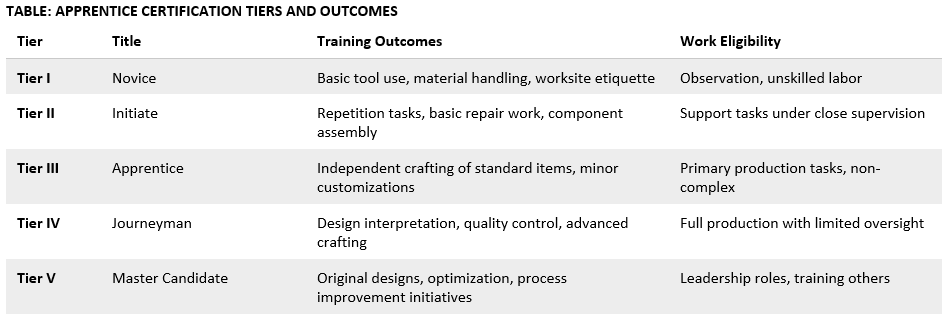
Training Outcomes by Certification Tier
Each certification level within a guild defines the scope of permissible work and the expected outcomes. Below is a model used by the Grand Artisans League:
Risk Mitigation When Working with Apprentices
Letting apprentices on the shop floor is not without risk. The Waterdeep Trading Company applies the following strategies to minimize disruptions and dangers:
Task Gating: Each task is linked to a minimum certification tier, preventing unqualified access
Shadow Assignments: New apprentices must shadow a senior member for a defined period before solo work
Rotational Learning: Apprentices rotate across stations to prevent overuse injuries and broaden exposure
Incident Review Panels: Any apprentice-caused incident triggers a panel review and learning cycle
Worked Example: Integration at the Elturel Leatherworks Guild
At the Elturel chapter of the Grand Artisans League, apprentices from Tier II onward are placed on the production floor during peak order seasons. A sample schedule might look like:
Morning: Tool sharpening, leather cutting under journeyman review
Midday: Stitching standard satchels on the apprentice line
Afternoon: Supervisory feedback, skill assessments, and lore studies
Every completed product is logged against the apprentice’s guild ledger. Errors beyond tolerance lead to either rework drills or temporary reassignment to basic tasks.
Realms-Aware Considerations
Different cities and guilds apply unique filters:
Baldur’s Gate Blacksmiths Guild mandates all apprentices pass a Magical Resistance Fitness check due to high enchanted forge use
Arcane Artificers Union forbids planar material handling until Tier IV due to safety and containment risks
Faerûn Dockworkers Federation trains apprentices on dummy loads before allowing real cargo interaction
Final Thoughts
Apprenticeship integration in Faerûn is more than filling labor gaps, it is an investment in continuity, quality, and craft preservation. For the Waterdeep Trading Company, ensuring apprentices are nurtured, certified, and safeguarded is key to a sustainable workforce and to the legacies each guild seeks to build.
Support the AD&D365 Project on Patreon.
To grow this world, we’ve launched an official Patreon where supporters can gain access to exclusive content, tools, training labs, and even influence the future of the project. Your support fuels more than just development , it expands the guildhall, forges new scrolls, and empowers the next generation of configuration wizards. Begin your journey: https://www.patreon.com/adnd365/
A Grateful Salute to Our Patrons
To all those who stand behind the vision, thank you for helping bring this world to life. Our Benefactors, Andre Breillatt, and Eryndor Fiscairn‡,, your boundless generosity fuels the arcane core of this project. Without your magic, the weave would falter. Our Apprentices, the spell engines turn and the training labs thrive thanks to our current Apprentices: Michael Ramirez and Andreth Bael’Rathyn‡. Special thanks to our past Apprentices, whose contributions helped us get here: Ralf Weber, Wendy Rijners, Shashi Mahesh, Julia Tejera, Ben Ekokobe, Tiago Xavier, Naveen Boyinapelli, Marcos Tadeu Wolf, Kathryn Greene, Jason Brown, Mark Christy, and Ashish Singh.Our Initiates, Peter Lorre, your commitment marks the start of the deeper path, stepping beyond mere observation into the active shaping of this realm. Our Followers, your steady presence along the journey is a beacon of encouragement: Eric Shuss, Sunil Panchal, Sarah D. Morgan, Nick Ramchandani, Daniel Kjærsgaard, and Tomasz Pałys. And our Voyeurs, Harry Burgh, Abdelrahman Nabil, and Basil Quarrell, ever watching from the shadows, clearly intrigued… but not enough to part with a single gold piece. Your silent curiosity is noted, and mildly judged.
Want to design your own economic models in Faerûn?
Get your own AD&D365 Environment and guides at adnd365.com/start, and request access to the public view of the current database at https://public.adnd365.com – Login npc@adnd365.com, Password N0nPl@yC#822!
In the industrious world of Faerûn, spellcasting is more than art or warfare, it is labor. From enchanting blades to illuminating hearths, arcane effort underpins much of the continent’s production economy. At the Waterdeep Trading Company, understanding when and how to treat spellcasting as a cost of production versus a service expense is essential for accurate costing, fair guild compensation, and sound decision-making.
This article explores the accounting treatment of spellcasting within the production cycle, with a special focus on cases like Continual Flame, where the same spell might be used either as a production input or an after-market service.
What It Is
Spellcasting as labor refers to the classification and costing of magical efforts performed by qualified casters, whether wizards, clerics, artificers, or sorcerers, within the production of goods. This includes:
Enchantments during manufacturing
Temporary transmutations
Alchemical infusions
Ritual augmentations or bindings
Permanent magical installations
Why It Matters
Accounting for spellcasting properly ensures that products reflect their true cost. Misclassifying spellcasting labor can lead to underpriced goods, incorrect margin calculations, or regulatory infractions with the Arcane Artificers & Alchemists Union (ARALCH).
Moreover, some spells blur the line between a production input and a service. For instance, Continual Flame might be cast:
During manufacturing to produce a lightstone sold as part of a lamp (production cost)
Afterward, upon installation at a client’s location (service expense)
Getting this distinction right is essential for inventory valuation, tax treatment, and guild compliance.
Components of Spellcasting Labor
Not all spells are cast alike, nor should they be costed alike. Within the production cycle of the Waterdeep Trading Company, spellcasting manifests in a variety of forms: some spells permanently bind enchantments to goods, while others are temporary enhancements used during bottling, inspection, or safety control. Understanding the types of spellcasting involved allows the company to apply the correct cost category, assign the right account behavior, and uphold transparency across its enchanted operations.
The following table breaks down the most common types of spellcasting labor observed in Faerûnian production and how each should be classified within the accounting framework. This ensures every flick of a wand or uttered incantation finds its rightful place in the ledger.
Worked Example: Continual Flame Use in Production vs. Service
Consider a series of enchanted lanterns sold by the Waterdeep Trading Company.
Scenario A: Production Phase
Continual Flame is cast at the forge.
The lantern is shipped with the light already embedded.
The labor cost of the spell is added to the production BOM.
Scenario B: Post-Sale Service
A lantern is sold empty.
A licensed enchanter is dispatched to cast Continual Flame on-site.
This is treated as a service expense, not capitalized into the product’s inventory value.
Realms-Aware Considerations
Across Faerûn, the cost and treatment of spellcasting labor can vary widely based on local laws, guild regulations, and magical resource availability. What applies in Waterdeep may not hold in Calimport or Silverymoon. The following considerations help ensure compliance and accurate costing in every region where the Waterdeep Trading Company operates.
Guild Approval: Only certified ARALCH members may perform production-stage enchantments.
Spell Component Costing: Some spells require expensive components (e.g., rubies for Continual Flame). These should be tracked as separate material lines.
Location Matters: In Silverymoon, arcane labor is cheaper and more common. In Calimport, magical licenses inflate costs by 15 to 30 percent.
Final Thoughts
Spellcasting is labor, and labor has value. Whether burned into steel or summoned into the sky, each casting must be measured, valued, and attributed with precision. For the Waterdeep Trading Company, this clarity ensures not only financial control but compliance with realmwide trade guild expectations.
Support the AD&D365 Project on Patreon.
To grow this world, we’ve launched an official Patreon where supporters can gain access to exclusive content, tools, training labs, and even influence the future of the project. Your support fuels more than just development , it expands the guildhall, forges new scrolls, and empowers the next generation of configuration wizards. Begin your journey: https://www.patreon.com/adnd365/
A Grateful Salute to Our Patrons
To all those who stand behind the vision, thank you for helping bring this world to life. Our Benefactor, Andre Breillatt, your boundless generosity fuels the arcane core of this project. Without your magic, the weave would falter. Our Apprentices, the spell engines turn and the training labs thrive thanks to our current Apprentices: Michael Ramirez and Andreth Bael’Rathyn (Name obfuscated to protect their identity). Special thanks to our past Apprentices, whose contributions helped us get here: Ralf Weber, Wendy Rijners, Shashi Mahesh, Julia Tejera, Ben Ekokobe, Tiago Xavier, Naveen Boyinapelli, Marcos Tadeu Wolf, Kathryn Greene, Jason Brown, Mark Christy, and Ashish Singh.Our Initiates, Peter Lorre, your commitment marks the start of the deeper path, stepping beyond mere observation into the active shaping of this realm. Our Followers, your steady presence along the journey is a beacon of encouragement: Eric Shuss, Sunil Panchal, Sarah D. Morgan, Nick Ramchandani, Daniel Kjærsgaard, and Tomasz Pałys. And our Voyeurs, Harry Burgh, Abdelrahman Nabil, and Basil Quarrell, ever watching from the shadows, clearly intrigued… but not enough to part with a single gold piece. Your silent curiosity is noted, and mildly judged.
Want to design your own economic models in Faerûn?
Get your own AD&D365 Environment and guides at adnd365.com/start, and request access to the public view of the current database at https://public.adnd365.com – Login npc@adnd365.com, Password N0nPl@yC#822!
From the ember-lit forges of Neverwinter to the mist-cloaked alchemy halls of Thay, the production facilities of Faerûn hum with magical activity. But when spells misfire, potions backfire, or extraplanar residue leaks into the material plane, the consequences can be dire. For the Waterdeep Trading Company and other guild-operated workshops, such events demand swift, structured action, lest a single miscast alter a year’s worth of inventory or spawn something best left undescribed.
This article outlines the key protocols used by responsible enterprises to isolate production lines following arcane incidents. Whether managing potion bottling lines or enchanted fabric looms, understanding and deploying magical contamination control procedures is essential to safeguarding workers, goods, and realms.
What It Is
Magical contamination control refers to the standardized set of responses enacted when production environments are compromised due to:
Alchemical Failures: Unstable mixtures or expired ingredients causing explosive or mutagenic reactions.
Arcane Feedback: Resonant energy loops from misaligned enchantment channels.
Planar Anomalies: Unexpected breaches to or influences from elemental, fey, or infernal planes.
Why It Matters
Unchecked contamination does more than damage product. It risks:
Cross-contamination of inventory
Arcane drift corrupting enchantment runes
Worker injury or polymorphic exposure
Violations of guild regulatory standards
Reputation loss due to cursed or unstable shipments
For guilds operating under the Arcane Artificers & Alchemists Union or exporting under planar trade compacts, containment compliance is legally and ethically mandated.
Components of a Magical Contamination Protocol
The Waterdeep Trading Company employs a tiered response system known as the Aetherlock Sequence. This model scales with severity and includes personnel, magical wards, and procedural safeguards.
Isolation and Neutralization Techniques
When contamination occurs, the first principle is always containment before cure. Methods vary by trade but commonly include:
Arcane Lock and Ward Circles: Prevent spread of animated objects or malicious enchantments
Material Sequestration Fields: Isolate ingredients or products suspected of instability
Spellflame Purge: A controlled cleansing fire that neutralizes enchantments (used only in Tier III or IV events)
Planar Anchors: Restore equilibrium when foreign energy leaks are detected
Worked Example: Fabric Infusion Collapse
At Lara’s Fine Fabrics and More, a batch of invisibility-thread cloaks became unstable after a moonstone filament from the Feywild proved incompatible with standard weave matrices. Within moments, the visibility of workers and materials began fluctuating wildly.
Response Summary:
Tier II initiated
Loom Room sealed with a triple-layer ward
Cloaks marked with non-visual sigils and relocated
All affected workers underwent charm reversal and planar detox
Contamination protocols differ by location and infrastructure:
Final Thoughts
Magical contamination is not a matter of “if” but “when” for any serious producer in Faerûn. By embedding strong protocols, both mundane and magical, into daily operations, guilds like the Waterdeep Trading Company not only protect their profit but honor their oath to the safety of the Realms.
The arcane may be volatile, but through discipline and ritual, even the most unstable magic can be managed.
In the bustling trade heart of Faerûn, the Waterdeep Trading Company has built its reputation on reliability. From enchanted cauldrons sold in Candlekeep to barrels of Twilight Wheat Ale bound for Baldur’s Gate, adventurers and nobles alike trust the Company to deliver safe, dependable, and high-quality goods. Yet, not every shipment is flawless. Potions may destabilize, enchantments may fade, or items may cause unintended magical surges. When these issues occur, the guild cannot rely on coin refunds alone, it must ensure that the problem never happens again.
This is where Corrective and Preventive Actions (CAPA) take root. CAPA is the discipline that ensures magical and mundane products alike meet standards of safety, quality, and trust. In a land where a faulty potion can mean life or death in a dungeon, CAPA is more than process, it is survival.
What Is CAPA?
Corrective and Preventive Actions (CAPA) is a structured process used to resolve product defects, investigate causes, and prevent recurrence. In the context of magical commerce, CAPA is not only about repairing goods but also about safeguarding reputation, protecting customers, and complying with guild regulations.
In Faerûn, a single failed batch of healing potions could tarnish the reputation of a trading company for seasons. CAPA provides the framework to identify the issue, correct the defect, and design safeguards against future failure. It is an arcane-tempered system of accountability that ensures consistency, safety, and trust across the entire supply chain.
Why CAPA Matters for Magical Products
Magical items are far more volatile than their mundane counterparts. Where a cracked leather satchel may inconvenience an adventurer, a mis-brewed potion can burn flesh, explode in transit, or cause unintended enchantments. A sword with a fading rune might break mid-battle. An amulet mis-scribed with unstable sigils might corrupt its wearer.
For the Waterdeep Trading Company, the risks of such failures include:
Loss of trust among adventurers, nobles, and guilds.
Financial penalties from regulatory guilds such as the Arcane Artificers & Alchemists Union.
Legal repercussions from nobles, merchants, or mercenaries harmed by defective items.
Operational disruption, as caravans must be recalled and goods remade.
CAPA ensures that these risks are mitigated. It is a defensive shield protecting both the Company’s coin and its honor.
The CAPA Components in Faerûn
Every CAPA process in the Waterdeep Trading Company follows four main stages.
Detection: Issues are identified through customer complaints, guild inspections, or magical monitoring runes embedded in goods.
Root Cause Analysis: Investigations determine the cause. Methods may include mundane inspection or divination spells to retrace the enchantment sequence.
Corrective Action: Immediate steps taken to address defective stock, such as recalls, refunds, or re-enchantments.
Preventive Action: Long-term measures to ensure the issue does not recur, such as changing suppliers, adjusting workshop wards, or updating process instructions.
CAPA Workflow in Dynamics 365 for Magical Goods
The Waterdeep Trading Company manages CAPA cases directly in its enchanted ledgers, structured within Dynamics 365. A CAPA case links directly to returns, inventory adjustments, or quality incidents, ensuring traceability.
Initiate CAPA Case: A clerk opens a CAPA case when a non-conformance is reported.
Assign Responsibilities: Arcane Treasurers manage cost analysis, Sage Archivists record root cause findings, and Lorewright Cartographers adjust routing and storage data.
Investigate and Document: Records include customer accounts, supplier contracts, magical readings, and inspection reports.
Implement Actions: Corrective steps (replacements, recalls) and preventive measures (new suppliers, modified enchantments) are executed.
Close and Archive: The case is closed only once the Guild Council confirms resolution and preventive safeguards are embedded.
Worked Example: Faulty Potion Batch CAPA
In 1382 DR, the Waterdeep Trading Company faced a crisis. A full caravan of Elixirs of Flame Resistance was returned after adventurers in Calimport reported that the potions had evaporated before use.
Step 1: Detection
The issue was reported by the Faerûn Brewers & Distillers Association after several adventuring parties returned the faulty potions. Enchanted tracking runes confirmed product evaporation during transit.
Step 2: Root Cause Analysis
Investigation revealed that the potion vials had been sourced from a Rashemi supplier.
The glass was mundane and lacked the arcane reinforcement required to contain volatile essences.
Divination spells confirmed leyline interference during distillation had further weakened vial integrity.
Step 3: Corrective Action
All distributed vials were recalled from Calimshan and the Sword Coast.
Customers were refunded in Faerûn Standard Dollars (FSD).
A new batch was brewed, this time infused into reinforced glass vials supplied by the Baldur’s Gate Blacksmiths Guild.
Step 4: Preventive Action
The Rashemi supplier was blacklisted.
Procurement contracts were updated to specify “arcane-reinforced containment required.”
New QA wards were installed in the Alchemical Distillery to monitor vial resilience before shipment.
The case was closed only after the preventive measures were verified across three new production runs.
Realms-Aware Considerations
While the principles of CAPA are universal, applying them across Faerûn requires sensitivity to the unique conditions of the Realms. Each city, guild, and arcane market brings its own challenges, from strict regulations in Waterdeep to the unpredictable flows of leyline magic in Rashemen. A potion brewed under one moon may behave differently under another, and a sword enchanted in Baldur’s Gate may be subject to entirely different guild standards in Calimport.
For the Waterdeep Trading Company, this means that CAPA cannot exist as a static system—it must flex and adapt to regional, magical, and political realities. Regulatory compliance, ingredient variability, guild collaboration, and the protection of reputation are all crucial considerations when designing preventive safeguards for magical products.
Regulatory Compliance: Cities like Waterdeep impose stricter guild regulations, while Luskan offers more leniency. CAPA must adapt accordingly.
Magical Variability: Ingredients fluctuate with moon cycles and leyline strength, demanding flexible but reliable safeguards.
Multi-Guild Oversight: Alchemists, Artificers, and Brewers all influence CAPA, requiring careful coordination.
Reputation Management: A single defective magical batch can ripple across markets, doubling the importance of preventive measures.
Final Thoughts
Corrective and Preventive Actions in Faerûn are more than clerical processes, they are protective wards for commerce. For the Waterdeep Trading Company, CAPA ensures that a single failure does not cascade into systemic collapse. By blending arcane oversight with disciplined process, the Company safeguards both adventurers’ lives and its own long-standing reputation across Faerûn.
Support the AD&D365 Project on Patreon.
To grow this world, we’ve launched an official Patreon where supporters can gain access to exclusive content, tools, training labs, and even influence the future of the project. Your support fuels more than just development , it expands the guildhall, forges new scrolls, and empowers the next generation of configuration wizards. Begin your journey: https://www.patreon.com/adnd365/
A Grateful Salute to Our Patrons
To all those who stand behind the vision, thank you for helping bring this world to life. Our Benefactor, Andre Breillatt, your boundless generosity fuels the arcane core of this project. Without your magic, the weave would falter. Our Apprentices, the spell engines turn and the training labs thrive thanks to our current Apprentices: Michael Ramirez and Andreth Bael’Rathyn (Name obfuscated to protect their identity). Special thanks to our past Apprentices, whose contributions helped us get here: Ralf Weber, Wendy Rijners, Shashi Mahesh, Julia Tejera, Ben Ekokobe, Tiago Xavier, Naveen Boyinapelli, Marcos Tadeu Wolf, Kathryn Greene, Jason Brown, Mark Christy, and Ashish Singh.Our Initiates, Peter Lorre, your commitment marks the start of the deeper path, stepping beyond mere observation into the active shaping of this realm. Our Followers, your steady presence along the journey is a beacon of
Want to design your own economic models in Faerûn?
Get your own AD&D365 Environment and guides at adnd365.com/start, and request access to the public view of the current database at https://public.adnd365.com – Login npc@adnd365.com, Password N0nPl@yC#822!
Artificer’s Consortium, Tinkerers’ League, Foundry of Gond
Work Tier
Level 1 to 10 (Apprentice Inventor to Master Artifice-Savant)
Primary Role
Designs, builds, and maintains magical-mechanical constructs, tools, and production devices across Faerûn
Typical Worksite
Workshops, guild foundries, arcane laboratories, shipyards, and battlefield forges.
The Artificer is the backbone of technological-magic integration in Faerûn. Equal parts inventor, mage, and craftsman, they merge arcane runes with gears, pulleys, and cogs to produce devices that extend beyond mere magic or engineering. In urban centers like Waterdeep, Baldur’s Gate, and Lantan, Artificers are essential to sustaining trade automation, security wards, and war-time engineering.
Their work bridges multiple guilds and industries, providing enchanted constructs, defensive turrets, automated supply networks, and even living golems. With each level of mastery, Artificers climb from simple tinkerers to planar engineers, influencing everything from the postal systems of cities to the engines of skyships and war machines.
As Artificers progress, their proficiency bonus reflects not only technical skill but also guild-granted authority to construct increasingly dangerous or valuable devices. At lower levels, proficiency ensures accurate rune-work and stable mechanisms. At higher levels, it signifies the ability to handle planar alloys, volatile reagents, and enchanted blueprints too complex for ordinary guildsmen.
Their growing proficiency also governs licensing rights within the Artificer’s Consortium. A Guildwright at level 4 might be licensed to build mechanical mounts, while a Forge-Savant at level 7 could oversee entire shipyard automation projects. By level 10, the Artificer wields unmatched authority, shaping devices that alter economies, warfronts, and even planar barriers.
Skill Set Summary
The Artificer’s skill set merges arcane theory with industrial craftsmanship. Their talents are vital to guild economies, diplomacy, and warfare. A Master Artificer is not merely a tinkerer but a strategic resource capable of shifting entire economies or battles. Their skillset shapes city defenses, accelerates production pipelines, and ensures standardization across mechanical and magical systems.
In political spheres, Artificers hold sway as advisors on infrastructure and war-councils. Within trade networks, their constructs support logistics, transportation, and security. Their artistry represents the intersection of craft, arcane power, and state control.
Core Skills
Tinkering & Repair – Building and maintaining minor devices.
Runic Integration – Applying glyphs to machinery for magical augmentation.
Construct Animation – Crafting golems, familiars, and mechanical guardians.
Magical Metallurgy – Forging alloys resistant to enchantments and planar forces.
Arcane Blueprinting – Designing enchanted schematics and prototypes.
Industrial Automation – Scaling devices for guild-wide production.
Defensive Engineering – Creating turrets, wards, and siege devices.
Planar Material Handling – Working with exotic reagents and otherworldly metals.
Reality Anchoring – Building devices that stabilize planar rifts.
Guild Codex Maintenance – Cataloguing inventions for guild archives.
Transport Enchantment – Designing magical propulsion and logistics devices.
Efficiency Metrics
Artificers are measured by output stability, device reliability, and construct resilience. Efficiency grows with each level, marked not just by how much they can produce, but by how long their inventions last and how safe they are for guild deployment.
Class Role in Guild and Economy
Artificers are tracked in guild systems such as Dynamics 365 for Faerûn under innovation registries and construct certification logs. They align magical-industrial processes with master data governance, ensuring their inventions are standardized, recorded, and properly licensed.
System Responsibilities:
Maintain device registries for constructs and prototypes.
Standardize enchantment metadata across inventions.
Track patents and certifications via guild registries.
Integrate with supply chain modules for construct upkeep.
Align construct performance metrics with financial reporting.
Visual representation conveys both the aesthetic of invention and the hierarchy of expertise. Lower-level Artificers appear as soot-covered tinkerers, while high-level ones manifest as near-arcane industrialists whose creations reshape reality.
General Prompt:
An artificer in Faerûn, surrounded by gears, glowing runes, and half-finished constructs. Their attire blends leather aprons with arcane glyphwork, goggles, and enchanted tools. Their workspace is a chaotic mix of glowing crystals, steam engines, and magical blueprints.
Support the AD&D365 Project on Patreon.
To grow this world, we’ve launched an official Patreon where supporters can gain access to exclusive content, tools, training labs, and even influence the future of the project. Your support fuels more than just development , it expands the guildhall, forges new scrolls, and empowers the next generation of configuration wizards. Begin your journey: https://www.patreon.com/adnd365/
A Grateful Salute to Our Patrons
To all those who stand behind the vision, thank you for helping bring this world to life. Our Benefactor, Andre Breillatt, your boundless generosity fuels the arcane core of this project. Without your magic, the weave would falter. Our Apprentices, the spell engines turn and the training labs thrive thanks to our current Apprentices: Michael Ramirez and Andreth Bael’Rathyn (Name obfuscated to protect their identity). Special thanks to our past Apprentices, whose contributions helped us get here: Ralf Weber, Wendy Rijners, Shashi Mahesh, Julia Tejera, Ben Ekokobe, Tiago Xavier, Naveen Boyinapelli, Marcos Tadeu Wolf, Kathryn Greene, Jason Brown, Mark Christy, and Ashish Singh.Our Initiates, Peter Lorre, your commitment marks the start of the deeper path, stepping beyond mere observation into the active shaping of this realm. Our Followers, your steady presence along the journey is a beacon of
Want to design your own economic models in Faerûn?
Get your own AD&D365 Environment and guides at adnd365.com/start, and request access to the public view of the current database at https://public.adnd365.com – Login npc@adnd365.com, Password N0nPl@yC#822!





 A Tinkerers Notebook