Archive

Tag Archives: writing

In Faerûn, no successful merchant operates alone. Behind every cartload of enchanted textiles or barrel of trollwine stands a guild – documenting, inspecting, regulating, and, when necessary, demanding compensation. These are not advisory councils or informal collectives. They are the law in most cities when it comes to tradecraft, labor, pricing, and apprenticeships.

At the Waterdeep Trading Company, guilds form the foundation of our entire supply network. From the warehouses of Silverymoon to the docks of Calimport, our ability to do business depends on how well we manage, track, and respect these institutions.

What Is a Guild in Faerûn?

To an outsider, a guild may look like a club of craftsmen. To a merchant, it is a governing body. Guilds in Faerûn:

  • Regulate Pricing: They set base prices and forbid undercutting or overpricing.
  • Enforce Quality Standards: Products bearing the guild seal meet standards of safety, craftsmanship, and purity.
  • Manage Apprenticeships: Only members of a guild can legally train new workers in a trade.
  • Control Certification: From spell-tuned brewing to adamantine shaping, guilds determine who is licensed to work in a craft.
  • Settle Disputes: Guild arbitration often supersedes civil courts in trade matters.
  • Oversee Regional Chapters: Each major city has a chapter following the central charter while adjusting for local needs.

Organizing Guild Information in Your Company

To manage guilds effectively, companies like ours treat each one like a partner, with structured records and established procedures.

Guild Directory Examples

Here are a few of the more prominent guilds the Waterdeep Trading Company works with:
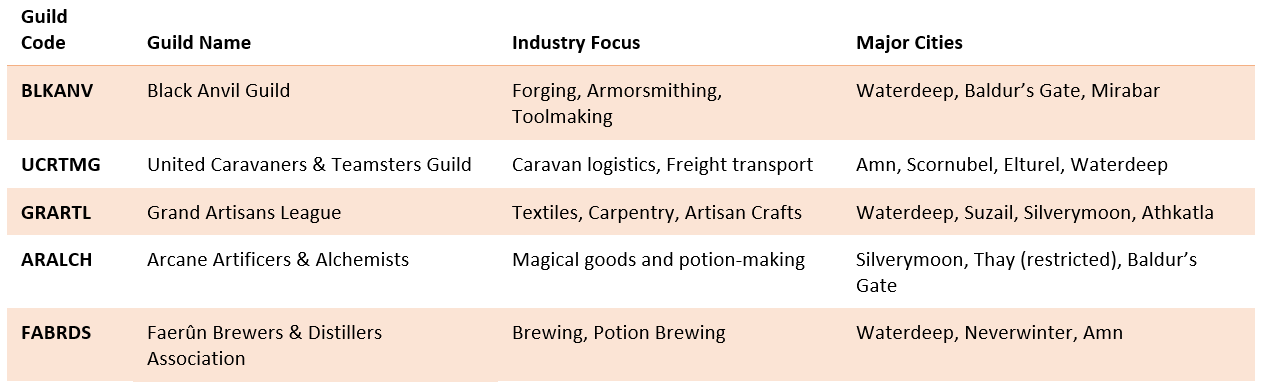
Guilds govern not just trade but talent. If you want to hire a certified loommaster, a leyline-calibrated enchanter, or a crystal alchemist with reliability, guild records are your best friend.

Merchants should track:

  • Certification Validity (including expiration and issuing chapter)
  • Completed Apprenticeship Logs (trainer, craft, rating)
  • Advancement Requests (for promotion to master rank or guild chair)
  • Guild Exams (success rates and focus areas)

By doing this, you can ensure you’re always working with approved craftsmen and that your wares pass muster when they reach port inspectors.

Managing Guild Contracts

Contracts with guilds are not one-size-fits-all. A shipping agreement with the Teamsters may include:

  • Volume quotas
  • Minimum wage requirements
  • Safety and magical seal inspections
  • Contingency routes for high-risk regions
  • A procurement agreement with the Black Anvil Guild might include:
  • Fixed pricing tiers for steel or mithral goods
  • Priority supply in wartime
  • Enchantment inspection clauses

Track these by guild, chapter, and effective date—and always be aware of when a renegotiation period is due.

Dispute Resolution and Compliance

Most cities allow guilds to enforce their own rulings within their domain. When a dispute arises:

  • Arbitration is often mandatory
  • Guild fines may be binding on the merchant
  • Disciplinary actions (such as blacklisting) can affect all affiliated trade

Maintain detailed logs of:

  • Complaints filed
  • Guild responses
  • Resolution terms
  • Any modifications to contracts or certifications following the ruling

This protects your company and helps build a reputation as a guild-respecting trading house.

Guild Reporting and Oversight

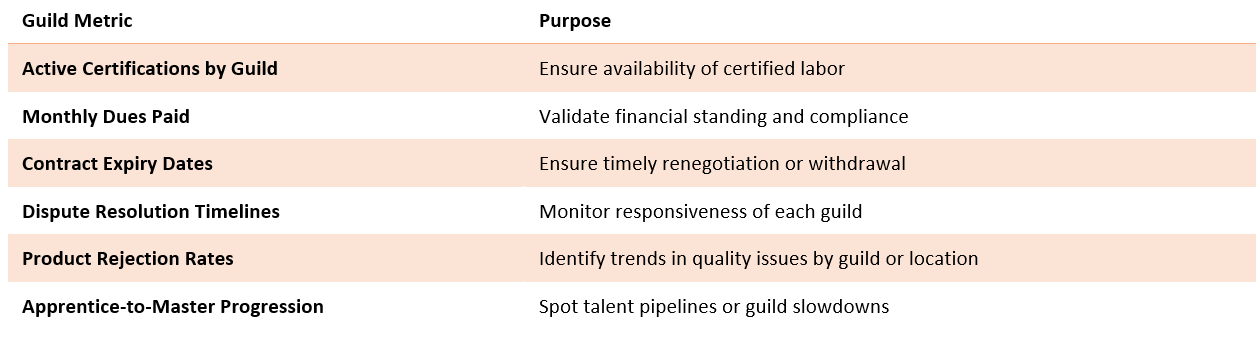
Larger operations should develop guild reporting practices. Here are a few metrics we track:
Final Thoughts: Why Guilds Deserve Respect

Guilds don’t just protect craftsmen—they protect the economy. They ensure that products move fairly, workers are trained properly, and that bad actors can’t flood the market with cursed tankards and half-finished crossbows.

For a trading company, building strong, respectful, well-documented relationships with every guild you work with isn’t just a best practice—it’s the key to staying in business.

Want to start managing your guild partnerships better? Check out the guides at adnd365.com/start and explore the public demo environment at https://public.adnd365.com, using:

Login: npc@adnd365.com

Password: N0nPl@yC#822!

In the cities and strongholds of Faerûn, coin doesn’t just flow through markets and mead halls, it flows through payroll ledgers. Whether you’re an apprentice scribe in Candlekeep or a battle-hardened inventory porter in Waterdeep’s lower docks, your pay is determined by a system that’s as structured as a dwarven fortress: step-based compensation.

This isn’t just a civilized form of gold distribution. It’s how guilds and trading companies standardize pay, encourage career growth, and keep labor disputes from devolving into fireball-flinging protests.

What Is Step-Based Compensation?

Step-based compensation is a tiered wage system where workers earn more as they progress through defined roles. Most guilds structure this into five steps, with each level tied to experience, certifications, or sometimes just surviving long enough to tell the tale.

These ranges aren’t static. In cities like Luskan, where danger clings to every crate, hazard pay bonuses may boost compensation by up to 50%. Some occupations also carry premiums depending on magical risk, rarity of skill, or guild scarcity.

Why the Steps Matter

In a continent bound together by trade routes and teleportation circles, consistency in compensation helps prevent chaos. Guilds enforce minimums, reward growth, and create expectations across the Sword Coast and beyond.

Step-based models also:

  • Support career progression that’s visible and motivating.
  • Enable structured training programs and certifications.
  • Allow for easy workforce budgeting in tools like Dynamics 365.
  • Prevent the “random NPC wage” effect from breaking immersion.

Common Faerûnian Pay Ranges

Here’s a sample from across guilds and corker classes:

These roles often reflect local conditions. A Potion Sampler in Amn may fetch higher rates due to alchemical guild demand, while an Inventory Porter in Mirabar might earn less thanks to automation by enchanted pulley systems.

Moving Up the Ranks

Progressing through compensation steps usually involves:

  • Time served in a guild or under contract
  • Performance evaluations from senior corkers
  • Certifications and formal skill tests
  • Survival, especially in hazardous roles like wild magic waste disposal

Guilds like the Grand Artisans League and the Arcane Artificers Union publish detailed advancement criteria, while others—like the Free Mercenaries League—prefer the “prove it or perish” method.

Standardizing Pay in Dynamics 365

For trading companies like the Waterdeep Trading Company, these steps are modeled directly in Dynamics 365 Human Resources:

  • Job levels and skill requirements mapped to compensation bands
  • Automated progression workflows tied to review periods
  • Reports and dashboards showing wage distribution across sites
  • Integration with guild dues and hazard premiums

This ensures your compensation structure reflects both fantasy logic and enterprise accountability.

Final Thoughts

Whether you’re enchanting potion bottles in Baldur’s Gate or hauling siege ballistae in Scornubel, step-based pay ensures that work in Faerûn is as structured as it is storied. It builds morale, supports retention, and ensures that even the lowliest apprentice has a path forward—ideally, one with fewer explosions.

Looking to implement your step-based compensation strategy (with or without beholder hazard pay)? Start your journey at adnd365.com/start and request access to the public demo of our Faerûn Dynamics 365 setup at https://public.adnd365.com, logging in with

Username: npc@adnd365.com

Password: N0nPl@yC#822!

The realm pays well—if you level up right.

The Waterdeep Trading Company employs a wide range of talent—from guild-trained accountants in Baldur’s Gate to teleportation-circle custodians in Elturel. With such a diverse and magically-inclined workforce, offering the right benefits isn’t just important—it’s essential for survival, morale, and long-term productivity (especially in a realm where “occupational hazard” may include basilisk encounters).

But how do we track benefits, manage eligibility periods, and enable self-enrollment in a setting where both arcane scrolls and labor contracts exist side-by-side?

The answer lies in our adoption of Advanced Dungeons & Dynamics 365.

What Counts as a Benefit in Faerûn?

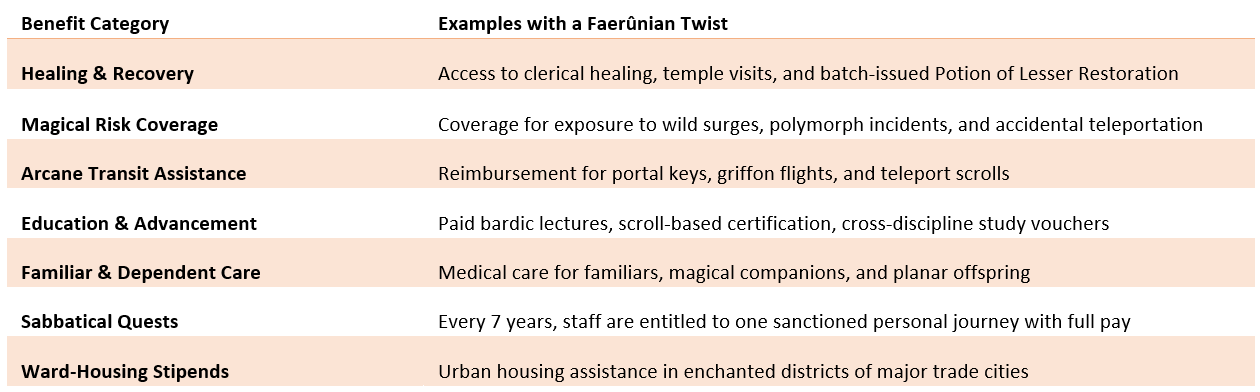
Employee benefits in Faerûn go well beyond the mundane. Here’s a breakdown of what we manage at WDTC:

Let the Adventurers Choose: Self-Service Enrollment

In the spirit of decentralization (and to avoid overworking our HR scribes), employee self-enrollment is a cornerstone of our benefit tracking system. Whether you’re a dwarven accountant working nights in Mithral Hall or a half-elf procurement officer stationed in Thay, you can manage your own benefits via the Employee Self-Service Portal in Dynamics 365 Human Resources.

Here’s how it works:

  1. Eligibility Flags: When a new employee is added, their race, class, guild affiliation, and role type automatically configure their base eligibility.
  2. Enrollment Periods: Two major periods are open annually — Greengrass (early spring) and Highharvestide (autumn harvest). A third “emergency re-enrollment” is available during Time of Troubles declarations.
  3. Benefit Elections: Employees can opt into available plans through an intuitive, portal-based interface. Each option includes a description, value in GP, duration, and special magical considerations.
  4. Familiar Enrollment: Employees with bonded companions can select add-on options for Familiar Healthcare, Companion Shadow Training, or Planar Travel Liability Coverage.

“I signed up for the Arcane Accidents Protection plan just in time—our wizard sneezed during inventory and turned me into a stool. That’s at least a Tier 2 incident,” — Nharra Feldspar, Junior Enchanter, Skullport Branch

Controlling Enrollment with Periods and Rules

Just like any good system of laws in Waterdeep, benefits come with timelines and compliance windows. Dynamics 365 allows us to define benefit periods, event-based eligibility, and waiting periods for risk-heavy roles.

Standard Enrollment Periods

Eligibility Conditions

  • Waiting Periods: Employees classified as “Adventurer Class II or higher” must wait 30 days before Magical Risk plans are active.
  • Guild Membership Dependencies: Benefits for potion-makers, for instance, require active status in the Healers & Herbalists Guild.
  • Location-Based Restrictions: Some plans (like “Underdark Relocation Stipends”) are only available to employees based in subterranean postings.

Automation with a Magical Touch

Here’s what makes the WDTC system so efficient:

  • Automated Alerts for enrollment deadlines sent via Sending Stones or enchanted scrollmail
  • Approval Workflows using customizable rules (e.g., benefits for a druid require Druid Circle co-signature)
  • Reporting and Audit Trails to track who enrolled, when, and how the benefits align with compensation benchmarks
  • Benefit Forecasting with Power BI to estimate potions consumed per department, scroll usage by guild, and familiars vaccinated

Final Thoughts

Managing benefits across Faerûn isn’t just about compliance—it’s about culture. By empowering our employees to enroll themselves, timing those decisions with meaningful in-world events, and tracking magical and mundane needs alike, the Waterdeep Trading Company sets a new standard in workforce support.

Whether you run a guild, a keep, or a kraken-hunting charter, there’s a lesson here: Magic might make anything possible—but good HR practices make it sustainable.

 Want to build your own portal for Faerûnian benefits management? Download the full implementation guides at adnd365.com/start and explore our working demo at https://public.adnd365.com

Login: npc@adnd365.com

Password: N0nPl@yC#822!
Your next sabbatical quest awaits—track it properly.

The Waterdeep Trading Company (WDTC) doesn’t just traffic in grain sacks and crossbow bolts. From spell-scrolls to silks, it handles a sprawling catalog of goods that straddle two very different economic planes: the mundane and the magical. And if there’s one thing Greta Ironfist has learned over the years, it’s this: you cannot value a crate of pickles the same way you value a Potion of Invisibility.

In this post, we explore how WDTC uses multi-ledger inventory valuation in Microsoft Dynamics 365 to accurately represent the true cost and value of its wildly diverse product lines.

The Problem: Two Economies, One Ledger?

Most trading companies operate within a single economic model. Standard costing methods like FIFO or Weighted Average are enough when you’re just shipping barrels of oil or bundles of lumber.

But for WDTC, the reality is more complex:

  • Mundane goods like iron nails or flour operate on predictable market logic.
  • Magical goods fluctuate based on arcane scarcity, planar trade politics, or adventuring trends.

Using a single valuation method across both types would either overstate the value of cheap goods or understate the risk in magical inventory.

The Solution: Valuation by Product Class in Dynamics 365

Using item model groups and inventory valuation methods, WDTC configured Dynamics 365 to assign different costing logic based on product category:

Example: Cloak vs Crate

Let’s break down two sales scenarios:

Cloak of the Emberward (Magical Item)

  • Purchase Cost (initial): 250 gp
  • Market spike after a regional fire elemental outbreak
  • Revaluation: 300 gp
  • Selling Price: 450 gp
  • Costing Method: Moving Average
  • Margin: 150 gp

Crate of Iron Nails (Mundane Item)

  • Purchase Cost: 10 gp
  • Stable demand across regions
  • Selling Price: 15 gp
  • Costing Method: FIFO
  • Margin: 5 gp

This separation ensures that magical price volatility does not distort the margin reports of common products, and vice versa.

Why It Matters to WDTC

  • Accurate financial reporting by product class
  • Better guild compliance when reporting to trade unions and arcane oversight bodies
  • Risk visibility for magical goods with erratic supply chains
  • Profit segmentation that separates stable trade income from speculative arcane revenue

Regional Valuation Adjustments

Faerûn isn’t one economy. It’s dozens. Prices vary by city, faction, and even by time of year.

For instance, Elixir of Haste sells at:

  • 200 gp in Waterdeep
  • 300 gp in Icewind Dale
  • 150 gp in Calimport

WDTC uses financial dimensions tied to region to track where margins are highest. This allows Greta to reroute magical inventory dynamically and ensure magical surplus in saturated markets is reallocated before losses hit the books.

Final Thoughts

Managing two economies under one roof is no easy task. But with the right inventory valuation configuration in Dynamics 365, the Waterdeep Trading Company turns complexity into clarity.

So next time you’re weighing whether to ship a box of rope or a case of scrolls, ask yourself: do you know what it’s really worth, and how it affects your ledger?


For more Faerûn-based business wisdom, get your copy of the guides at adnd365.com/start. You can also request access to our current demo database and see how it’s all set up. Just log in to https://public.adnd365.com using:

Email: npc@adnd365.com

Password: N0nPl@yC#822!

Running a business like the Waterdeep Trading Company involves more than sword sales and enchanted lockboxes. Every tenday, some things stay the same: rent needs paying, guild dues are owed, and inventory costs need logging.

If you find yourself retyping the same entries month after month, it’s time to bring in a little structure. That’s where Periodic Journals come in.

What Are Periodic Journals?

Periodic journals are used for recurring transactions — those repeating entries that don’t change often. Think monthly expenses, regular allocations, or standard entries for fees, salaries, or provisions. Once you’ve defined them, you can post the entries on a regular schedule without building them from scratch every time.

It’s like having a pre-written scroll that auto-fills your accounting spellbook.

Why the Waterdeep Trading Company Uses Them

Each month, the Waterdeep Trading Company pays maintenance fees to several local guilds for use of shared crafting halls and inspection services. Here’s how we structure one of those entries:

This journal can be reused every month with minimal adjustment, making it easy to keep the guilds happy and the books balanced.

Great Use Cases for Periodic Journals

When Not to Use Them

Not everything should be a periodic journal. They work best for entries that are consistent and scheduled. If the amounts vary significantly or require approvals, other journal types might be more appropriate.

Final Thoughts

If you’re repeating the same ledger entry more than once, it’s probably time to automate it. Periodic journals won’t solve every financial challenge, but they will make life easier and free up time for more important work, like negotiating with dwarves over mithral prices.

Want to see periodic journals in a real system?

Check out the walkthroughs in the Advanced Dungeons & Dynamics 365 guides at adnd365.com/start, or log into our public environment at https://public.adnd365.com

Login: npc@adnd365.com

Password: N0nPl@yC#822!

“One wand, five charges. One careless wizard, zero left.” — Greta Ironfist, COO, Waterdeep Trading Company

In the bustling arcane economy of Faerûn, inventory isn’t just about counting barrels of ale or bolts of cloth — it’s about precision tracking of the power inside the product. At the Waterdeep Trading Company (WDTC), that includes magical items like wands, staves, and devices that are finite in function, possessing a specific number of charges.

This is where Catchweight Inventory Management within Dynamics 365 Supply Chain Management comes into play — blending the tangible and the magical to enable better control, traceability, and profitability in the sales and management of charge-limited magical goods.

What Is Catchweight Inventory?

Catchweight inventory allows a product to be managed using two different units of measure simultaneously. It’s commonly used in food and beverage industries (like meat sold by the piece and weight), but at WDTC, we use it for something more… spellbinding:

  • Inventory Unit: 1 Wand of Fireballs
  • Catchweight Unit: 5 Castings

This means we can stock, ship, and invoice the wand by the piece, but track its actual usable magical value — its remaining charges — through a catchweight unit of measure: castings.

Why Use Catchweight for Magic Items?

Magical devices are powerful and pricey. But what happens when a wand is only half full? Or a device has just one charge left?

Using Catchweight, WDTC can:

Implementation Example: Wand of Magic Missiles

Here’s how WDTC configures the Wand of Magic Missiles in Dynamics 365:

When a wand is sold with only 3 of its original 7 charges remaining, Dynamics 365 recognizes both:

  • 1 wand shipped
  • 3 castings recorded for invoicing, pricing, or valuation

Integration with Inventory Dimensions

To further improve management, WDTC associates batch and serial numbers with each magical item. The serial number tracks:

  • Enchantment origin
  • Recharge history
  • Usage logs (via integration with spellcasting records)

This lets us prevent “wand fraud” — shady vendors selling depleted items with illusory packaging.

Reporting and Finance Magic

Using Power BI and native D365 reporting, managers can view:

  • Remaining casting capacity per warehouse
  • Average cost per casting
  • Most depleted items in circulation
  • Projected restock dates based on usage rates

This ensures Greta Ironfist and her enchanters make wise procurement decisions before the next dragon-slaying boom wipes out wand inventory.

Final Thoughts

In a world where a wand’s worth is measured not just by what it is, but how much it can do, Catchweight Inventory Management in Dynamics 365 gives WDTC the tools to balance commerce and chaos. From enchanted bolts to spell-laced scrolls, it’s the key to spellbook-accurate inventory and adventurer-grade profitability.

Want help configuring your own magical inventory system in D365? The arcane consultants at Waterdeep Trading Company are only a sending spell away.

Ready to level up your D365 implementation with a little magic?

Download the full Advanced Dungeons & Dynamics 365 guides and start your quest today at adnd365.com/start.Whether you’re managing inventory in Waterdeep or configuring workflows in Cormyr, these step-by-step tomes will equip you for legendary ERP success.

In the complex and often perilous world of Faerûn, overland trade remains one of the lifelines of regional commerce. Understanding the costs, risks, and logistics of transporting goods between cities is crucial for trading companies, merchant guilds, and caravan operators alike. This article examines the full cost breakdown of transporting goods via horse-drawn caravan from Waterdeep to Dagger Falls, following the more direct and strategic route through Secomber, Loudwater, Llorkh, and the Black Road through the Empire of Shadows.

Overview: Route Summary

The total journey from Waterdeep to Dagger Falls covers 155 leagues, approximately 465 miles, and takes about 15.5 days under average conditions. The route chosen offers a faster but riskier alternative to the northern passage through Silverymoon.

Route Segments

Daily Operational Costs

To estimate full journey expenses, we begin by calculating the daily baseline costs for one standard merchant wagon. These include wages, lodging, maintenance, and overhead.

Basic Daily Costs per Wagon

Hazard Pay and Risk Premiums

Traveling through the Empire of Shadows and the Black Road requires additional security and preparation. Shadowspawn, undead, and political hostilities can add risk-based costs.

Additional Risk-Based Costs

Total Transportation Cost Estimate

With both daily operational costs and risk premiums calculated, we can summarize the full cost for one wagon making the 15.5-day journey.

Final Journey Cost Summary (Per Wagon)

This cost is for one standard wagon. Larger caravans, or those transporting magical goods, should expect higher totals due to increased security needs.

Considerations for Merchants and Caravaneers

  • Insurance: Some merchant guilds offer limited insurance or replacement value for losses due to attack or theft.
  • Teleportation Circles: Licensed teleportation may be available from Silverymoon or Hillsfar, but costs begin at 500 gp one-way, plus registration fees.
  • Cargo Valuation: Goods like dwarven steel, moonshae wine, or spell components may justify the cost and risk of direct overland shipment.

Conclusion

Whether you are a small-scale trader or a major trading company like the Waterdeep Trading Company, understanding the cost structures of overland routes is vital for planning logistics and maximizing profit margins. The Waterdeep to Dagger Falls route via Secomber and the Black Road offers speed, but also risk—and cost. Proper planning, appropriate guard contingents, and clear expectations on tolls and bribes are essential.

To explore how you can set up full logistics operations, merchant trade networks, or configure route-based cost tracking inside Dynamics 365, get the Advanced Dungeons & Dynamics 365 Bare Bones Configuration Guides at:

adnd365.com/start

These guides provide the foundation for modeling travel, trade, inventory, and cost management within your fantasy economy—whether for business or adventuring campaigns.

In the world of Advanced Dungeons & Dynamics 365, the real heroes of commerce aren’t always wielding swords—they’re wielding spreadsheets.

Whether you’re a potions distributor in Amn or a magical cookware wholesaler in Waterdeep, running trade promotions is one of the best ways to boost volume, clear seasonal inventory, and gain favor with merchant guilds. But managing those promotions across city-states, planes of existence, and fluctuating economic zones? That’s where Dynamics 365 Trade Promotion Management becomes your best magical artifact.

Let’s unpack how it works, with a few scrolls from our campaign log.

What Are Trade Promotions?

Think of trade promotions as targeted campaigns that offer discounts, incentives, or bundled offers to specific customers—usually retailers, guilds, or channel partners.

Here’s what they look like in Faerûn:

  • “Buy 3 Healing Potions, Get 1 Free” in Baldur’s Gate
  • 10% discount on Moonshines for the Brewers’ Guild during Brewfest
  • Extra 2% off all scrolls shipped via teleportation (because logistics costs are lower!)
  • Flat rate rebates on armor bundles during wartime (high demand = high reward)

In Dynamics 365, these promotions are configured as Trade Agreements, Discounts, and Rebate Programs, tracked across customers, products, and timelines.

Setting Up a Promotion in Dynamics 365

Let’s say you’re the Trade Master for Waterdeep Trading Company, and you want to launch a “Potion Palooza” campaign. Here’s how you’d do it:

  1. Define the Offer
  2. Configure the Trade Agreement
  3. Add a Rebate Program (optional)
  4. Link to Promotions Calendar
  5. Monitor Effectiveness with Power BI

Why It Matters in a Fantasy World (or Real One)

Trade promotions allow you to:

  • Move inventory before seasonal demand drops (hello, summer furs…)
  • Strengthen partner relationships by offering exclusive deals
  • Drive competitive advantage in crowded marketplaces (especially in cities like Calimshan)
  • Track ROI on every promotion (you don’t want to offer discounts that eat your margin like a gelatinous cube)

And with D365, it’s not just about setting up the discount—it’s about controlling it, automating it, and analyzing the results across your financial and supply chain modules.

Ready to Power Up Your Promotions?

Trade promotions are just one of the many magical tools in your ERP grimoire. Want to learn how to blend economic models, regional pricing, product variants, and guild contracts into a single unified system?

The Advanced Dungeons & Dynamics 365 books are your spellbook. Whether you’re a merchant prince or a humble configuration wizard, these guides will show you how to run your kingdom (or company) like a pro.

Grab your copy now and charm your way into trade success: Buy the AD&D365 Books
