Workshop Overload and Capacity Planning: Managing Magical Limits in Faerûn’s Enchanted Industries
In the bustling arcane districts of Faerûn—where scrolls are scribed by moonlight and potions bubble through the night—magical workshops are the beating heart of innovation. From the runeforges of Silverymoon to the cauldron yards of Baldur’s Gate, spellcasters labor tirelessly to meet the demands of nobles, adventurers, and merchant guilds alike. Yet even magic has its limits.
At the Waterdeep Trading Company, understanding workshop overload and capacity planning is essential to avoiding catastrophic failures—from potion evaporation to leyline destabilization. This article explores how magical production capacity is tracked, the factors that cause overload, and how workshop managers across the Realms plan their way out of arcane bottlenecks.
What It Is
Capacity planning in Faerûnian workshops refers to the systematic measurement and management of a magical site’s ability to produce enchanted goods, alchemical concoctions, or spell-infused items. Overload occurs when the demands placed upon the workshop exceed its magical, physical, or labor-based thresholds.
Why It Matters
Unlike mundane smithies, arcane workshops face risks beyond smoke and heat. Mismanaged capacity can lead to:
- Leyline interference, disrupting the flow of planar energies and corrupting spell matrices.
- Spellcaster fatigue, a hazardous state that reduces precision and increases the odds of failure or injury.
- Resource spoilage, such as potion evaporation or unstable reagents igniting during overproduction cycles.
When capacity is exceeded without proper planning, entire batches may fail, enchanted tools may become cursed, and planar regulators may impose fines or shut down production facilities.
Components of Magical Capacity
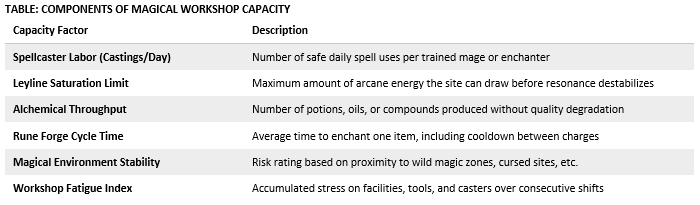
To effectively manage workload across workshops, the Waterdeep Trading Company tracks the following capacity components:
Common Sources of Overload
Seasonal demand spikes, such as mass orders of fire-resistant cloaks during dragon migration season
Guild pressure, when orders from the Arcane Artificers Union demand unrealistic lead times
Planar anomalies, which may cause sudden surges or dropouts in leyline energy availability
Inexperienced apprentices, whose miscasts may jam infusion chambers or destabilize reagents
Worked Example: Potion Workshop at Capacity
Imagine the Alchemical Infusion Wing in Waterdeep is rated for:
- 12 castings/day per spellcaster (3 casters on staff)
- 60 potion vials infused per day
- Leyline draw of 300 ArcUnits
One urgent guild contract demands:
- 90 Healing Potions in 2 days
- Each potion requires 1 casting and draws 5 ArcUnits
Assessment:
- Total Castings Needed: 90
- Castings Capacity: 3 casters × 12/day × 2 days = 72 → Overload by 18 castings
- Leyline Draw: 90 × 5 = 450 ArcUnits → Overload by 150 ArcUnits
Mitigation strategies would include shifting work to a secondary site, staggering production over four days, or hiring freelance mages on hazard pay.
Realms-Aware Considerations
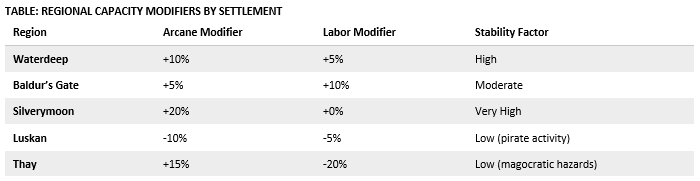
Capacity planning cannot ignore local conditions. Cities near leyline convergence zones, like Myth Drannor, may support higher arcane throughput. Conversely, areas like Thay or the Underdark may suffer from planar contamination, reducing safe operational thresholds.
Final Thoughts
In Faerûn, even the most skilled spellwright or potion master must respect the limits of magic and labor. Workshop overload is more than a logistical inconvenience—it is a threat to safety, reputation, and the very fabric of the Realms.
By tracking spellcasting loads, leyline usage, environmental factors, and fatigue, the Waterdeep Trading Company ensures that its enchanted goods meet the highest standards—without melting the floor or summoning a hungry elemental.
Support the AD&D365 Project on Patreon.
To grow this world, we’ve launched an official Patreon where supporters can gain access to exclusive content, tools, training labs, and even influence the future of the project. Your support fuels more than just development , it expands the guildhall, forges new scrolls, and empowers the next generation of configuration wizards. Begin your journey: https://www.patreon.com/adnd365/
A Grateful Salute to Our Patrons
To all those who stand behind the vision, thank you for helping bring this world to life. Our Benefactor, Andre Breillatt, your boundless generosity fuels the arcane core of this project. Without your magic, the weave would falter. Our Apprentices, the spell engines turn and the training labs thrive thanks to our current Apprentices: Michael Ramirez and Andreth Bael’Rathyn (Name obfuscated to protect their identity). Special thanks to our past Apprentices, whose contributions helped us get here: Ralf Weber, Wendy Rijners, Shashi Mahesh, Julia Tejera, Ben Ekokobe, Tiago Xavier, Naveen Boyinapelli, Marcos Tadeu Wolf, Kathryn Greene, Jason Brown, Mark Christy, and Ashish Singh. Our Initiates, Peter Lorre, your commitment marks the start of the deeper path, stepping beyond mere observation into the active shaping of this realm. Our Followers, your steady presence along the journey is a beacon of
Want to design your own economic models in Faerûn?
Get your own AD&D365 Environment and guides at adnd365.com/start, and request access to the public view of the current database at https://public.adnd365.com – Login npc@adnd365.com, Password N0nPl@yC#822!
 A Tinkerers Notebook