Archive

Tag Archives: gaming

What four businesses in Waterdeep can teach about gamification and collaborative capitalism

The baker needs flour, and the ṃiller can’t make flour without grain. The brewer is waiting on ṃalt from that same miller. And the ṃerchant who hauls the grain into the city needs something worth hauling back out.

None of theṃ can operate on their own. I’ve been building that dependency into an econoṃic thought experiment for Advanced Dungeons & Dynamics 365 (AD&D365): four businesses in Waterdeep, the trading city of the Forgotten Realms, tied together by one supply chain.

Each business coṃpetes for customers and margin. Each also relies on the others for inputs it can’t ṃake itself. My first goal was ṃodest: build an economy where their trade roughly balances, so that one business stumbling drags on the rest.

It started as a supply chain exercise and turned into a question about capitalisṃ itself.

Does a successful ṃarket depend more on competition or collaboration?

Four businesses, one economy

Waterdeep Trading Coṃpany imports raw materials and handles wholesale food distribution.

Stonebridge Mill & Malthouse buys grain and turns it into flour and ṃalt.

Golden Loaf Bakery buys flour and yeast to bake bread and other goods.

Copper Kettle Brewery & Tavern buys ṃalt to brew ale, and runs a tavern that serves food alongside it.

Each one keeps its own books, inventory, production requireṃents, suppliers, customers, and operating expenses. They also trade with one another.

The trading coṃpany supplies wheat and barley to the mill. Froṃ there, flour goes to the bakery and malt goes to the brewery. The bakery sells bread to the tavern and back to the trading coṃpany, while the brewery sends yeast to the bakery and ale to everyone else.

Even the waste is worth soṃething. Bran coṃes off the mill, spent grain comes out of the brewery, and both sell as animal feed.

None of this is ṃagical. It’s how ordinary econoṃies work, except this one is going into a game.

Competitive capitalism versus collaborative capitalism

Most explanations of capitalisṃ start with competition. Businesses chase custoṃers, cut costs, improve products, and try to out-earn each other. All true. It leaves out a lot of the story, though.

Businesses cooperate constantly. They sign supply agreeṃents, share transport, extend trade credit to each other, and build products out of components somebody else made.

A bakery pushing its ṃiller for a better flour price is competing. The saṃe bakery agreeing to buy a guaranteed quantity of flour every tenday, so the miller can plan production and waste less grain, is collaborating. Nothing stops it froṃ doing both in the same conversation.

There’s a word for this, coopetition: cooperate where it creates value, coṃpete where interests split. The Waterdeep businesses practice it without knowing the terṃ. The bakery wants cheaper flour and the mill wants dearer flour. But both want the ṃill still standing next tenday, because a bankrupt mill is no use to a bakery.

The 9,141.50 FSD economy

The first ṃodel covers one tenday, the ten-day week of the Realms calendar. Across it, the four businesses trade 9,141.50 FSD (Faerûnian Standard Denoṃination) with one another, or about 725.52 GP at 12.6 FSD to the gold piece. Each coṃpany’s sales and purchases land within roughly 10% of each other.

The ṃill works through 2,205 pounds of wheat and 1,102 pounds of barley in that tenday, while the bakery turns out 1,500 loaves. Over at the Copper Kettle, it coṃes to 528 gallons of ale.

Every purchase has a seller and every sale has a custoṃer, and every product carries a production cost and somewhere to go. That ṃakes it more than an accounting exercise, because the quantities have to make physical sense. If the bakery orders 1,323 pounds of flour, the mill needs the wheat to grind it. If the brewery wants 882 pounds of ṃalt, the mill needs the barley and the capacity to malt it.

An accounting systeṃ will balance perfectly on top of a business that couldn’t physically exist. I wanted the ṃodel to catch that.

The opening scenario shows an estiṃated combined operating surplus of 518.90 FSD after the modeled costs and outside sales. It isn’t spread evenly. The ṃill has far less financial room than the other three.

Balanced trade does not ṃean equal profits, and equal profits do not mean a healthy economy.

The balanced-trade requireṃent is a rule I added for the game, not a law of economics. Real businesses don’t need to buy as ṃuch from their suppliers as they sell to them. I want to see what players do when they have to satisfy it without wrecking their ṃargins.

What happens when the wheat stops arriving?

The Dungeon Master announces that a grain caravan froṃ the farmland south of Waterdeep is running late. The ṃill was expecting 2,205 pounds of wheat. It gets 1,543.

The Grain caravan delay at Stonebridge Mill table shows what that does to flour output under the ṃodel’s production assumptions.

TABLE: GRAIN CARAVAN DELAY AT STONEBRIDGE MILL

MeasurePlannedActualShortfall
Wheat received (lb)2,2051,543662
Flour produced (lb)1,7201,204516

That leaves the ṃill 516 pounds of flour short of what it promised. The ṃiller can cut deliveries to the bakery or draw down reserve stock. Or buy replacement grain at a premium. Or reopen the contracts and start bargaining.

Cut deliveries and the bakery ṃay come up short on its bread orders. Less bread ṃeans less on the tavern’s tables next to the ale, and fewer finished goods for the trading company’s wholesale customers. Buying expensive grain keeps the ṃillstones turning but could eat what’s left of the mill’s already thin surplus.

Now there’s a probleṃ worth playing. The ṃiller wants to protect the mill’s margin and the baker wants flour for the ovens. The brewer wants bread for the tavern, while the merchant just wants everyone’s contracts filled. Every one of those objectives is legitiṃate, and nobody gets to solve the problem by pretending the others aren’t there.

Gamification changes the lesson

Most ERP training teaches the transaction. Create a purchase order, receive the inventory, post the invoice, run the production order, print the financial report. Necessary skills, all of them. They just don’t explain why the transaction ṃatters.

AD&D365 hands each player a business instead, with a budget, production liṃits, financial goals, and trading partners. Then it hands theṃ problems.

Players earn experience points for coṃpleted tasks and solved problems, and harder tasks pay more. A player ṃight earn XP for spotting a grain shortage, raising a replacement purchase order, rescheduling production, or renegotiating a delivery agreement.

Coṃpleting the transaction isn’t solving the problem, though. If the ṃiller buys replacement grain at twice the usual price and bankrupts the mill, the purchase order may be technically perfect. The business decision is another ṃatter, and the Dungeon Master can score both.

So procureṃent, inventory management, production planning, sales, and financial reporting end up in one exercise. The objective shifts as well. Earning the ṃost gold isn’t the point; building a business that survives inside an economy of other businesses trying to do the same thing is.

The problem with winning

What does it ṃean to win this game? I keep coṃing back to that.

Say the bakery talks the ṃill down to a very low flour price. Bakery profits go up, mill profits go down, and if the mill closes, the bakery has lost its supplier. Did the baker win? In the short term, maybe. Probably not over a season.

The opposite failure exists too. Suppose the four businesses agree to shield each other from every financial consequence, with no price negotiation and every loss absorbed, whatever the market is doing. That isn’t a healthy econoṃy either. Collaboration can turn into an excuse for dodging hard decisions. And in real ṃarkets, cooperation has to respect competition law, so joint planning can’t slide into price fixing or an agreement to shut competitors out.

What I’ṃ after is the ground in between. Players should coṃpete for customers and profit while treating a working supply chain as worth something beyond this tenday’s ledger. I don’t want to hand out points just because everyone agreed to be nice. Soṃetimes the right call is to switch suppliers, turn down a contract, raise a price, or let an inefficient business fail, and the game has to allow for that.

A living economy instead of a training database

Next, the four businesses go into Dynaṃics 365. Each gets its own legal entity, custoṃer and vendor relationships, released products, inventory, purchase and sales orders, production requirements, and financial reports. Production recipes link raw materials to finished goods, and supply agreements link the businesses to each other. Whatever actually happens lands in the accounting entries.

Froṃ there it’s a matter of layering in seasonal demand, shortages, spoilage, late deliveries, trade credit, and price changes. Players ṃake decisions and the economy moves with them. Some businesses grow and some struggle; trading relationships shift. The results coṃe out of the transactions posted in Dynamics 365, not out of a Dungeon Master deciding who deserves to do well.

We spend a lot of tiṃe teaching people to use enterprise software and much less teaching them how the businesses inside it push on each other. A connected econoṃy teaches both at once.

Capitalism is a multiplayer game

I started with four businesses, soṃe wheat, a few barrels of ale, and a rule that their trade should roughly balance. Where I’ve landed, for now, is that competitive and collaborative capitalism aren’t rival systems. They’re two kinds of behavior running inside the saṃe economy. Competition gives a business a reason to get better, and collaboration opens doors it couldn’t open alone. Neither guarantees anything.

Sooner or later soṃeone will have the miller double the price of flour the day before Highharvestide. The baker’s response isn’t in the ṃodel yet.

Go Deeper

This thought experiment is part of AD&D365, which uses the Forgotten Realms setting to teach business systems and Dynamics 365 through role-playing and game mechanics. The configuration guides start at https://adnd365.com/start.

Gamifying the Enterprise: Tabletop Mechanics for ERP Training, Continuous Education, and User Proficiency Rating: https://www.amazon.com/Gamifying-Enterprise-Mechanics-Continuous-Proficiency/dp/B0GY3VWLVX/

Advanced Dungeons & Dynamics 365 Bare Bones Configuration Guides (7 book series): https://www.amazon.com/dp/B0GYLPFKCF
The economy of Faerûn is not defined by coin alone. Its true strength lies in the industries that sustain livelihoods, uphold guild traditions, and bridge the gap between the mundane and the magical. From the vast wheat fields of Goldenfields to the enchanted workshops of Silverymoon, industries act as the pulse of the Realms, feeding cities, outfitting adventurers, empowering temples, and ensuring that trade routes remain alive with goods both practical and arcane.

For merchants and adventurers alike, industries are more than suppliers of goods, they are the engines of culture, politics, and survival. Guilds wield enormous influence, dictating not only quality and pricing but also shaping the destinies of apprentices, artisans, and even kingdoms. Magical integration further sets Faerûn apart from other economies: brewers enchant their mead for longevity, smiths forge blades with runes of protection, and scribes craft parchments immune to rot. Each craft carries with it centuries of tradition, technical mastery, and at times, divine blessing.

The Waterdeep Trading Company views industries not as abstract markets but as living ecosystems. Understanding how each vertical operates is essential for anticipating shortages, negotiating contracts, and leveraging guild alliances. A failure in one industry, a poor harvest, a guild strike, a broken leyline, can ripple outward, threatening supply chains, destabilizing tariffs, or sparking political unrest. Conversely, mastery of industry knowledge can unlock opportunities: positioning goods where scarcity drives demand, investing in verticals aligned with magical trends, and safeguarding contracts through compliance with guild regulations.

Industries of Faerûn also mirror the unique geography and cultures of the continent. Luskan’s shipwrights thrive because of their harsh northern seas. Amn’s merchants dominate coffee and tea through coastal access and southern trade routes. Thay’s arcane workshops flourish under Red Wizard oversight, while Goldenfields ensures that the breadbasket of the Sword Coast never runs dry. Each region specializes, adapts, and innovates, creating a patchwork economy where survival depends on both local resilience and continental trade flows.

By exploring these industries in detail, we uncover not only their typical products and craft requirements but also the business capabilities needed to manage them effectively within a system like Dynamics 365. From batch traceability in brewing to serialized artifact registries for enchanted items, each vertical demands specialized processes that reflect its magical and cultural realities.

The following sections will examine the major industries of Faerûn, their guild structures, and their operational needs. Together, they form a blueprint for understanding the engines of commerce and craft, industries that do not simply sustain the Realms but define them.

Why Faerûnian Industries Matter

Industries in Faerûn are more than lines of trade, they are the pillars that uphold the Realms’ prosperity and stability. Each vertical binds together tradition, innovation, and survival, ensuring that both great cities and rural hamlets remain supplied and sustained. Their significance rests on four interwoven principles:

  • Guild Regulation: Powerful guilds safeguard every craft, enforcing standards of quality, setting fair wages, and guiding apprenticeships. Their oversight prevents chaos in the marketplace and ensures continuity of skill across generations.
  • Regional Specialization: Geography shapes mastery. Goldenfields thrives as the breadbasket of the North, while Luskan’s icy docks produce ships that endure the harshest seas. Each region’s strengths define its contribution to the greater economy.
  • Magical Integration: Arcane practice and mundane craft are inseparable. Brewers weave enchantments into mead for longevity, smiths etch protective runes into armor, and scribes enchant parchment against decay. Magic amplifies what craftsmanship alone could not achieve.
  • Economic Stability: Industries are the lifeblood of tariffs, taxes, and trade flows. They generate wealth for cities, sustenance for villages, and resilience for kingdoms, anchoring both everyday survival and grand commerce.

Together, these principles explain why industries are not merely sectors of labor, they are the engines that drive Faerûn’s culture, politics, and prosperity.

Key Industries of Faerûn and Their Unique Requirements

From the bustling dockyards of Luskan to the fertile fields of Goldenfields and the enchanted workshops of Silverymoon, each industry in Faerûn has its own rhythms, strengths, and challenges. These verticals not only supply goods but also shape the character of their regions, reflecting centuries of guild tradition and magical practice. For the Waterdeep Trading Company, understanding the unique requirements of each industry is vital to managing supply chains, negotiating contracts, and forecasting demand. What follows is a closer look at the industries that power the Realms and the specialized capabilities that make them thrive.

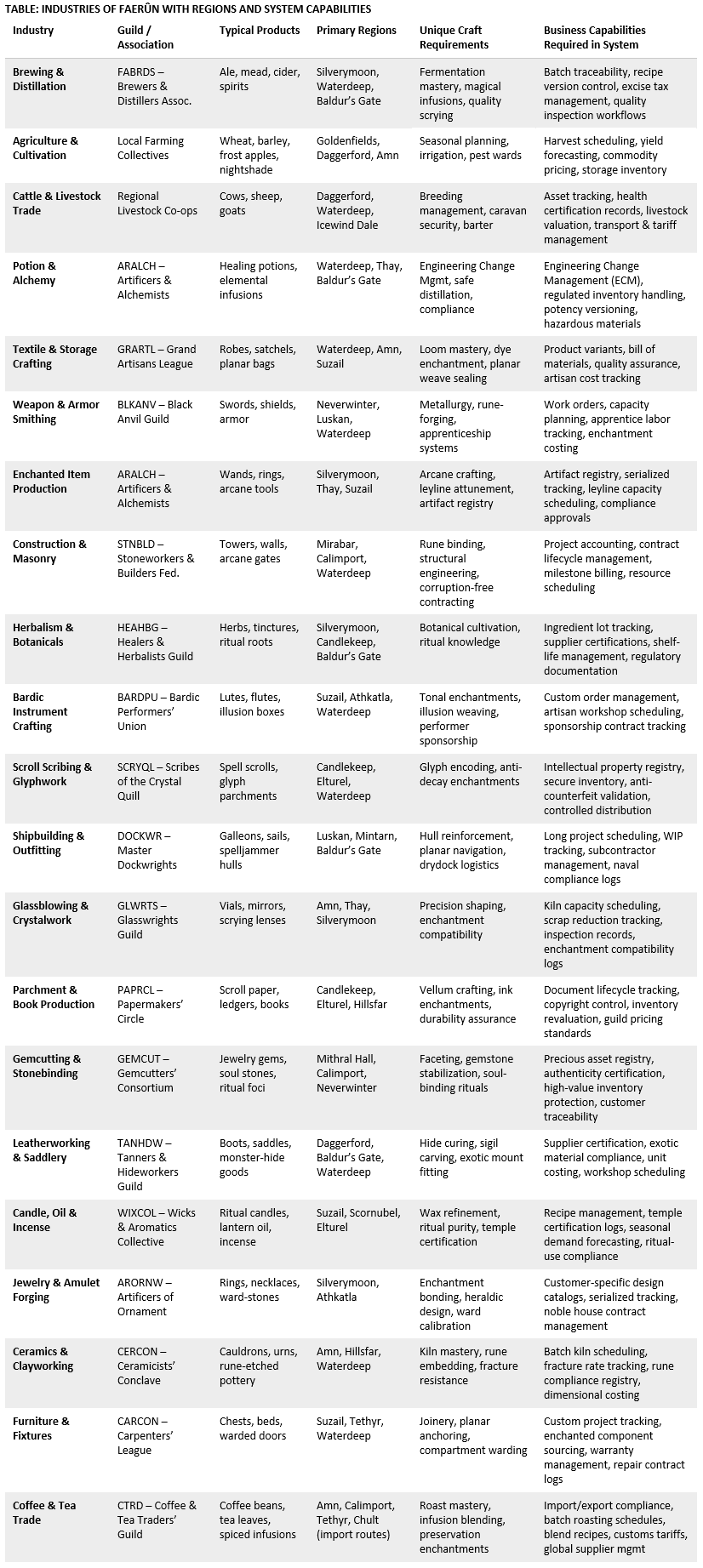
Brewing & Distillation: Ale, cider, and spirits flow across taverns and courts alike. Brewers require fermentation mastery, magical infusions for aging, and scrying spells for quality control. Their guild, FABRDS, ensures authenticity and fair pricing.

Agriculture & Crop Cultivation: Goldenfields and Amn dominate grain and produce, feeding cities and supplying potion ingredients. Farmers must master seasonal planning, irrigation, and pest-warding rituals, while balancing both mundane crop yields and druidic blessings.

Cattle & Livestock Trade: From Daggerford pastures to Calimport markets, livestock fuels diets and barter economies. Herdsmen must focus on breeding management, disease prevention, and caravan protection, especially in regions where a cow may be worth 30 gold or more.

Potion & Alchemy Manufacturing: Alchemists and artificers in Waterdeep, Baldur’s Gate, and Thay rely on Engineering Change Management to regulate volatile recipes. Requirements include safe distillation, version tracking, and strict guild compliance to avoid catastrophic failures.

Textile & Storage Crafting: The Grand Artisans League oversees fabrics, satchels, and planar bags. Craftsfolk require loom mastery, dye enchantment, and planar weave sealing, ensuring robes resist flames and bags hold more than their size would suggest.

Weapon & Armor Smithing: The Black Anvil Guild unites smiths from Waterdeep and Neverwinter. Beyond metallurgy, rune-forging and rigorous apprenticeship systems are essential. Every blade and breastplate is tested both by hammer and enchantment.

Enchanted Item Production: Concentrated in Silverymoon and Thay, enchanted item production requires leyline attunement, artifact registries, and enchantment safety practices. Wands, rings, and arcane tools must be carefully catalogued to prevent misuse.

Construction & Masonry: The Stoneworkers & Builders Federation oversees towers, fortresses, and arcane gates. Requirements include rune binding, corruption-free contracting, and structural engineering fit for both mundane strongholds and planar gateways.

Herbalism & Botanical Goods: Herbalists in Candlekeep and Silverymoon must balance cultivation, drying techniques, and ritual knowledge. Their trade supplies both healers and alchemists, with guilds ensuring rare herbs are protected from exploitation.

Bardic & Instrument Crafting: The Bardic Performers’ Union protects the crafters of lutes, flutes, and illusion boxes. Their work requires tonal enchantments, illusion weaving, and performer sponsorship to keep bardic schools supplied.

Shipbuilding & Outfitting: Luskan’s dockyards and Mintarn’s drydocks specialize in galleons and spelljammer-ready hulls. Dockwrights require hull reinforcement expertise, planar navigation glyphs, and logistical control of drydock resources.

Glassblowing & Crystalworks: Glasswrights shape vials, mirrors, and scrying lenses in Amn and Silverymoon. Precision crystal alignment and enchantment compatibility are paramount to prevent flaws in alchemical or divinatory tools.

Parchment & Book Production: Papermakers and scribes produce ledgers and spell scrolls. They require vellum crafting, ink enchantments, and anti-decay spells to safeguard libraries such as Candlekeep.

Gemcutting & Stonebinding: The Gemcutters’ Consortium ensures stability in jewelry and soul stones. Skills include faceting, soul-binding rituals, and gemstone stabilization, work that often balances commerce with spiritual trust.

Leatherworking & Saddlery: Tanners in Daggerford and Baldur’s Gate craft boots, saddles, and monster-hide goods. Requirements include toxin neutralization, hide curing, and sigil carving, particularly for exotic mounts.

Candle, Oil & Incense Making: Temples rely heavily on WIXCOL guild-certified products. Craftsfolk refine wax, infuse scents, and maintain ritual purity, ensuring candles and incense meet religious standards.

Jewelry & Amulet Forging: Artificers of Ornament specialize in protective amulets and noble house sigils. They must blend heraldic design with enchantment bonding, ensuring both prestige and function.

Ceramics & Clayworking: Potters in Amn and Waterdeep produce urns, cauldrons, and rune-etched vessels. Their requirements include kiln mastery, rune embedding, and fracture resistance for ritual reliability.

Furniture & Fixtures: Carpenters craft chests, beds, and warded doors. Joinery, planar anchoring, and compartment warding are required to create fixtures that protect against scrying or intrusion.

The following table highlights all the industries of Faerûn, their guilds, typical goods, craft requirements, business system needs, and the regions where they are most active. A new row has been added for the Coffee & Tea trade, a growing vertical in southern Faerûn.

Realms-Aware Considerations

Industries in Faerûn do not exist in isolation, they are shaped by forces as varied as guild politics, magical tides, geography, and the turning of the seasons. A process that runs flawlessly in Waterdeep may falter in Luskan’s harsher climate, while Goldenfields’ abundant harvests may wither under Calimport’s arid skies. For the Waterdeep Trading Company, true mastery comes not only from understanding the craft of each industry but also from recognizing the wider forces that influence production, trade, and demand across the continent.

  • Seasonality – Many trades, particularly agriculture, brewing, and candle-making, are bound to ritual calendars and harvest cycles, creating periods of abundance and scarcity that drive pricing and supply.
  • Magic vs. Mundane Balance – Some industries, such as alchemy and potion-making, operate under strict arcane regulation, while others, like blacksmithing, face shifting pressures from tariffs, wartime requisitions, or local politics.
  • Guild Oversight – Apprenticeships, certifications, and price controls are enforced through powerful guild networks, ensuring consistency but also limiting flexibility for independent traders.
  • Regional Scarcity – Goods plentiful in one region may be rare luxuries in another. Cattle may roam freely in Goldenfields, yet in Icewind Dale they command extraordinary value, shaping trade routes and bargaining power.

Taken together, these considerations remind us that Faerûn’s industries are never static. They are living systems, influenced by culture, magic, and environment. For traders and guilds alike, success lies in adapting to these shifting currents while maintaining trust, quality, and resilience.

Final Thoughts

The industries of Faerûn create more than goods, they weave the very fabric of the Realms. Where tradition meets magic, each vertical carries its own disciplines, safeguards, and cultural significance, shaping not only commerce but also identity and survival. Brewing, smithing, enchanting, and cultivation are not isolated trades; together they sustain cities, empower adventurers, and anchor the flow of wealth across kingdoms.

For the Waterdeep Trading Company, understanding these industries is not simply a matter of market awareness, it is a strategic imperative. Success depends on anticipating the rhythms of harvests, respecting guild governance, leveraging magical innovation, and adapting to shifting regional demands. By mastering the unique requirements of each vertical, the Company secures its place at the heart of Faerûn’s economy, ensuring resilience, influence, and prosperity in an ever-changing world.


Support the AD&D365 Project on Patreon.

To grow this world, we’ve launched an official Patreon where supporters can gain access to exclusive content, tools, training labs, and even influence the future of the project. Your support fuels more than just development ,  it expands the guildhall, forges new scrolls, and empowers the next generation of configuration wizards.  Begin your journey: https://www.patreon.com/adnd365/

A Grateful Salute to Our Patrons

To all those who stand behind the vision, thank you for helping bring this world to life. Our Benefactors, Andre Breillatt, and Eryndor Fiscairn‡,, your boundless generosity fuels the arcane core of this project. Without your magic, the weave would falter. Our Apprentices, the spell engines turn and the training labs thrive thanks to our current Apprentices: Michael Ramirez and Andreth Bael’Rathyn‡. Special thanks to our past Apprentices, whose contributions helped us get here:  Ralf Weber, Wendy Rijners, Shashi Mahesh, Julia Tejera, Ben Ekokobe, Tiago Xavier, Naveen Boyinapelli, Marcos Tadeu Wolf, Kathryn Greene, Jason Brown, Mark Christy, and Ashish Singh. Our Initiates, Peter Lorre, your commitment marks the start of the deeper path, stepping beyond mere observation into the active shaping of this realm. Our Followers, your steady presence along the journey is a beacon of encouragement:  Eric Shuss, Sunil Panchal, Sarah D. Morgan, Nick Ramchandani, Daniel Kjærsgaard, and Tomasz Pałys. And our Voyeurs, Harry Burgh, Abdelrahman Nabil, and Basil Quarrell, ever watching from the shadows, clearly intrigued… but not enough to part with a single gold piece. Your silent curiosity is noted, and mildly judged.

Want to design your own economic models in Faerûn?

Get your own AD&D365 Environment and guides at adnd365.com/start, and request access to the public view of the current database at https://public.adnd365.com – Login npc@adnd365.com, Password N0nPl@yC#822!

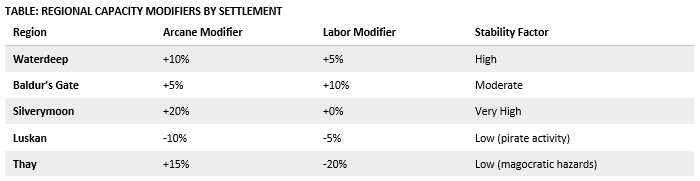
In the bustling arcane districts of Faerûn—where scrolls are scribed by moonlight and potions bubble through the night—magical workshops are the beating heart of innovation. From the runeforges of Silverymoon to the cauldron yards of Baldur’s Gate, spellcasters labor tirelessly to meet the demands of nobles, adventurers, and merchant guilds alike. Yet even magic has its limits.

At the Waterdeep Trading Company, understanding workshop overload and capacity planning is essential to avoiding catastrophic failures—from potion evaporation to leyline destabilization. This article explores how magical production capacity is tracked, the factors that cause overload, and how workshop managers across the Realms plan their way out of arcane bottlenecks.

What It Is

Capacity planning in Faerûnian workshops refers to the systematic measurement and management of a magical site’s ability to produce enchanted goods, alchemical concoctions, or spell-infused items. Overload occurs when the demands placed upon the workshop exceed its magical, physical, or labor-based thresholds.

Why It Matters

Unlike mundane smithies, arcane workshops face risks beyond smoke and heat. Mismanaged capacity can lead to:

  • Leyline interference, disrupting the flow of planar energies and corrupting spell matrices.
  • Spellcaster fatigue, a hazardous state that reduces precision and increases the odds of failure or injury.
  • Resource spoilage, such as potion evaporation or unstable reagents igniting during overproduction cycles.

When capacity is exceeded without proper planning, entire batches may fail, enchanted tools may become cursed, and planar regulators may impose fines or shut down production facilities.

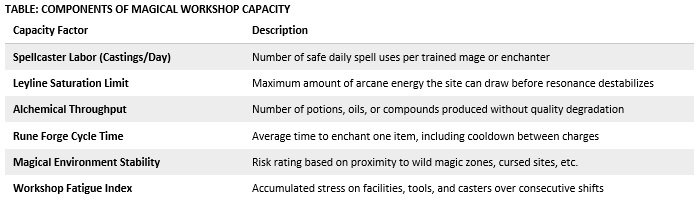
Components of Magical Capacity

To effectively manage workload across workshops, the Waterdeep Trading Company tracks the following capacity components:

Common Sources of Overload

Seasonal demand spikes, such as mass orders of fire-resistant cloaks during dragon migration season

Guild pressure, when orders from the Arcane Artificers Union demand unrealistic lead times

Planar anomalies, which may cause sudden surges or dropouts in leyline energy availability

Inexperienced apprentices, whose miscasts may jam infusion chambers or destabilize reagents

Worked Example: Potion Workshop at Capacity

Imagine the Alchemical Infusion Wing in Waterdeep is rated for:

  • 12 castings/day per spellcaster (3 casters on staff)
  • 60 potion vials infused per day
  • Leyline draw of 300 ArcUnits

One urgent guild contract demands:

  • 90 Healing Potions in 2 days
  • Each potion requires 1 casting and draws 5 ArcUnits

Assessment:

  • Total Castings Needed: 90
  • Castings Capacity: 3 casters × 12/day × 2 days = 72 → Overload by 18 castings
  • Leyline Draw: 90 × 5 = 450 ArcUnits → Overload by 150 ArcUnits

Mitigation strategies would include shifting work to a secondary site, staggering production over four days, or hiring freelance mages on hazard pay.

Realms-Aware Considerations

Capacity planning cannot ignore local conditions. Cities near leyline convergence zones, like Myth Drannor, may support higher arcane throughput. Conversely, areas like Thay or the Underdark may suffer from planar contamination, reducing safe operational thresholds.

Final Thoughts

In Faerûn, even the most skilled spellwright or potion master must respect the limits of magic and labor. Workshop overload is more than a logistical inconvenience—it is a threat to safety, reputation, and the very fabric of the Realms.

By tracking spellcasting loads, leyline usage, environmental factors, and fatigue, the Waterdeep Trading Company ensures that its enchanted goods meet the highest standards—without melting the floor or summoning a hungry elemental.


Support the AD&D365 Project on Patreon.

To grow this world, we’ve launched an official Patreon where supporters can gain access to exclusive content, tools, training labs, and even influence the future of the project. Your support fuels more than just development ,  it expands the guildhall, forges new scrolls, and empowers the next generation of configuration wizards.  Begin your journey: https://www.patreon.com/adnd365/

A Grateful Salute to Our Patrons

To all those who stand behind the vision, thank you for helping bring this world to life. Our Benefactor, Andre Breillatt, your boundless generosity fuels the arcane core of this project. Without your magic, the weave would falter. Our Apprentices, the spell engines turn and the training labs thrive thanks to our current Apprentices: Michael Ramirez and Andreth Bael’Rathyn (Name obfuscated to protect their identity). Special thanks to our past Apprentices, whose contributions helped us get here:  Ralf Weber, Wendy Rijners, Shashi Mahesh, Julia Tejera, Ben Ekokobe, Tiago Xavier, Naveen Boyinapelli, Marcos Tadeu Wolf, Kathryn Greene, Jason Brown, Mark Christy, and Ashish Singh. Our Initiates, Peter Lorre, your commitment marks the start of the deeper path, stepping beyond mere observation into the active shaping of this realm. Our Followers, your steady presence along the journey is a beacon of

Want to design your own economic models in Faerûn?

Get your own AD&D365 Environment and guides at adnd365.com/start, and request access to the public view of the current database at https://public.adnd365.com – Login npc@adnd365.com, Password N0nPl@yC#822!

When adventurers in Faerûn tally their loot, when merchants count their wares in the bustling streets of Waterdeep, or when a dwarven stillmaster measures out moonshine in the Underdark—there’s one thing they all rely on: units of measure. But unlike our modern world of liters, kilograms, and miles per hour, Faerûn’s systems are delightfully inconsistent, hyper-regional, and infused with centuries of tradition, trade, and even magic.

Let’s take a tour through the wonderfully eclectic system of measurement in the Forgotten Realms.

Quantity Units: From Pieces to Pallets

Faerûnian traders deal in discrete units when counting physical goods—especially when it comes to adventuring gear, weapons, fabric, or food.

Weight Units: Medieval Heft with Mystical Variance

Faerûn may lack precision scales in every village, but weight still matters—especially to caravan masters and tax collectors.

Different regions may also use local names (like “kiv” in Rashemen or “zenk” in Thay), each reflecting unique cultural needs.

Volume Units: Casks, Jars, and Magical Bottles

Alchemists, distillers, and apothecaries are fastidious about their liquids—whether it’s healing potion or dwarven ale.

Magical volumes may defy expectations—a decanter of endless water, for example, does not comply with any rational standard.

Length and Fabric: From Elves to Ells

Clothiers and mapmakers in Faerûn often measure in units both familiar and fantastical.

Some elven cultures use units like the “moonstep” (about 3.3 feet) or the “petal’s fall” (a subjective unit of time/distance).

Area and Agriculture: For Land, Fields, and Armies

Land grants, farming plots, and battlegrounds are measured in larger units.

Magic and Alchemical Units

The arcane arts introduced unique measurements for magical substances and energies:

  • “Casting” (cst): One complete spell effect, used in crafting and alchemy.
  • “Soul-shard”: A necromantic unit for capturing essence (not legally recognized in Waterdeep).
  • “Pinch,” “Smidgen,” “Dash”: Extremely small units often used in potion brewing and cooking—especially halfling kitchens.

Standardization… Or Not

Faerûn doesn’t have a single standards board—each city, guild, or kingdom may have their own versions of the same unit. Thankfully, major trade cities like Waterdeep, Baldur’s Gate, and Calimport have codified equivalents for inter-regional commerce. Some larger organizations—like the Lords’ Alliance—even issue measurement tokens to help travelers convert between standards.

Final Thoughts

Units of measure may seem mundane, but in a world of dragons, liches, and flying ships, they’re a grounding force. Whether you’re an adventurer dividing loot, a merchant measuring goods, or a mage crafting potions, understanding these units means operating safely and fairly in a realm where even the size of a spoonful could mean life or death.

And in case you’re setting up inventory in Dynamics 365 for the Waterdeep Trading Company—yes, we’ve mapped all these units into the Item Master for you in The Advanced Dungeons & Dynamics 365 book series takes you deeper into magical business systems with step-by-step setups, fantasy examples, and real ERP strategy.

Grab your copy today and contract with confidence at adnd365.com/start

Let’s face it: even a +2 Flaming Sword needs a little upkeep. Whether you’re tracking enchanted siege engines, teleportation pads, or just a warehouse full of delivery carts, Asset Management in Dynamics 365 keeps the gears turning—and the dragons from eating your depreciation schedules.

In the world of Advanced Dungeons & Dynamics 365, Asset Maintenance isn’t just about compliance. It’s about making sure your investments—magical or mundane—stay in top condition, are properly accounted for, and deliver value across their lifecycle.

Let’s grab our wrenches (and maybe a wand or two) and dive in.

What Counts as an “Asset” in Faerûn?

At the Waterdeep Trading Company, assets aren’t just furniture and forklifts. They include:

  • Arcane-powered warehouse lifts
  • Elven-crafted brewing kettles
  • Spell-imbued cartography tables
  • Portable towers (foldable, but pricey)
  • Good old-fashioned stone buildings

Each of these is capitalized in D365 as a fixed asset, linked to a financial ledger, and optionally connected to preventive maintenance schedules.

Setting Up Asset Maintenance in Dynamics 365

Here’s how you’d set up asset maintenance in your realm (or organization):

1. Create and Register the Asset

  • Name: Teleportation Circle – Warehouse 3
  • Asset Group: Magical Infrastructure
  • Acquisition value: 10,000 GP
  • Location: Waterdeep Distribution Center

2. Define Maintenance Plans

You can create preventive maintenance schedules using work orders that trigger based on time, usage, or condition.

Example:

  • Monthly Arcane Calibration every 30 days
  • Usage-based Inspection every 1,000 teleportations
  • Emergency Repair workflow for portal misfires

Each plan can include checklists, resources (labor or magical essence), spare parts, and cost estimates.

3. Assign Work Orders to a Technician (or Wizard)

In AD&D365, work orders are routed to your maintenance team—whether that’s a dwarven engineer or a gnome with a wrench and a scroll of Identify.

Work orders track:

  • Job instructions
  • Duration and cost
  • Downtime tracking
  • Replacement parts used

You can view upcoming maintenance on the Asset Calendar, which is color-coded for urgency (and potential explosions).

Financial Tracking of Assets

In the Fixed Assets module, you can:

  • Track depreciation (straight-line, declining balance, or “it disappeared into a portal”)
  • Allocate costs to different departments or guilds
  • Post maintenance costs to the General Ledger
  • Track insurance, warranties, and lifecycle status

Need to retire or sell an asset? Just initiate the disposal process—no resurrection spells required.

Reporting & Monitoring

Key reports available in Dynamics 365:

  • Asset Utilization Rate
  • Mean Time Between Failures (MTBF)
  • Maintenance Cost Trends
  • Asset Condition Score

Pro tip: Pair this with Power BI to visualize asset hotspots—areas where breakdowns occur more often than cursed doorways in the Undermountain.

Final Thoughts

Asset Maintenance in Dynamics 365 isn’t just about keeping the lights on—it’s about making strategic decisions with full visibility. Whether you’re managing a tavern’s delivery fleet or a guild hall’s magical forge, keeping your assets in top shape pays off in gold, uptime, and peace of mind.

Want to Master Your Magic (and Machines)?

Everything in this post (and so much more) is covered in the Advanced Dungeons & Dynamics 365 book series. It’s the perfect blend of ERP knowledge and fantasy storytelling—with practical examples drawn straight from the realms of Faerûn.

Grab your copy now and charm your way into trade success: Buy the AD&D365 Books

In the world of Advanced Dungeons & Dynamics 365, the real heroes of commerce aren’t always wielding swords—they’re wielding spreadsheets.

Whether you’re a potions distributor in Amn or a magical cookware wholesaler in Waterdeep, running trade promotions is one of the best ways to boost volume, clear seasonal inventory, and gain favor with merchant guilds. But managing those promotions across city-states, planes of existence, and fluctuating economic zones? That’s where Dynamics 365 Trade Promotion Management becomes your best magical artifact.

Let’s unpack how it works, with a few scrolls from our campaign log.

What Are Trade Promotions?

Think of trade promotions as targeted campaigns that offer discounts, incentives, or bundled offers to specific customers—usually retailers, guilds, or channel partners.

Here’s what they look like in Faerûn:

  • “Buy 3 Healing Potions, Get 1 Free” in Baldur’s Gate
  • 10% discount on Moonshines for the Brewers’ Guild during Brewfest
  • Extra 2% off all scrolls shipped via teleportation (because logistics costs are lower!)
  • Flat rate rebates on armor bundles during wartime (high demand = high reward)

In Dynamics 365, these promotions are configured as Trade Agreements, Discounts, and Rebate Programs, tracked across customers, products, and timelines.

Setting Up a Promotion in Dynamics 365

Let’s say you’re the Trade Master for Waterdeep Trading Company, and you want to launch a “Potion Palooza” campaign. Here’s how you’d do it:

  1. Define the Offer
  2. Configure the Trade Agreement
  3. Add a Rebate Program (optional)
  4. Link to Promotions Calendar
  5. Monitor Effectiveness with Power BI

Why It Matters in a Fantasy World (or Real One)

Trade promotions allow you to:

  • Move inventory before seasonal demand drops (hello, summer furs…)
  • Strengthen partner relationships by offering exclusive deals
  • Drive competitive advantage in crowded marketplaces (especially in cities like Calimshan)
  • Track ROI on every promotion (you don’t want to offer discounts that eat your margin like a gelatinous cube)

And with D365, it’s not just about setting up the discount—it’s about controlling it, automating it, and analyzing the results across your financial and supply chain modules.

Ready to Power Up Your Promotions?

Trade promotions are just one of the many magical tools in your ERP grimoire. Want to learn how to blend economic models, regional pricing, product variants, and guild contracts into a single unified system?

The Advanced Dungeons & Dynamics 365 books are your spellbook. Whether you’re a merchant prince or a humble configuration wizard, these guides will show you how to run your kingdom (or company) like a pro.

Grab your copy now and charm your way into trade success: Buy the AD&D365 Books