I recently heard a story that captures one of the biggest misunderstandings about AI today.
A colleague was speaking with a mentor about artificial intelligence. The mentor said something like:
“You’re not really an AI maker. You’re just a user, because you build agents instead of training foundation models.”
That statement misses what has always driven innovation.
It’s a bit like saying Picasso wasn’t a painter because he didn’t manufacture his own paint. No one would seriously make that argument.
Painters don’t mine minerals, mix pigments, stretch their own canvas, or build their own brushes. They use the best tools available to create something new. We judge the artist by what they create, not by whether they manufactured every tool in the process.
The same is true for architects.
No one looks at a skyscraper and says, “The architect didn’t really build this. They didn’t smelt the steel, fire the bricks, manufacture the glass, or pour the concrete.”
Of course they didn’t.
An architect’s value isn’t in creating raw materials. It’s in understanding the client’s needs, balancing thousands of tradeoffs, coordinating experts, and bringing together countless components into something that has never existed before.
Without the architect, the steel is just steel. The concrete is just concrete. The glass is just glass.
The design is what turns materials into a building.
AI works the same way
Foundation model companies are creating incredible materials. They are building the engines that power modern AI, and that work deserves enormous respect.
But an engine isn’t a business solution.
Someone still has to understand the problem, design the process, connect enterprise systems, define the rules, manage security, handle exceptions, and create an experience that people can actually use.
That’s where AI builders come in.
Creating AI agents isn’t simply writing prompts. It’s designing systems.
An effective AI solution may include multiple agents with different responsibilities, access to business applications, memory, planning, approval workflows, governance, monitoring, and human oversight. Each piece must work together toward a common goal.
That is architecture.
Software has always worked this way
Developers don’t build their own processors. They don’t write operating systems from scratch. They don’t create every programming language or every library they use.
They assemble proven components into solutions that create value.
No one calls them “just users.”
Why should AI be any different?
In fact, many AI builders face a challenge similar to architects. The technology is often the easy part. The hard part is understanding people, business processes, regulations, risk, and change management. Success depends on making hundreds of good design decisions that never appear in a benchmark.
Training a better model is an incredible achievement.
Building an AI system that changes how a hospital treats patients, how a manufacturer runs its supply chain, or how a business serves its customers is also an incredible achievement.
These aren’t competing roles. They are different layers of the same profession.
Foundation model researchers create the materials. Infrastructure companies build the tools. AI architects design the systems. AI engineers assemble the solution. Organizations create value from the finished product.
Every layer matters.
History has shown this over and over
The printing press didn’t diminish authors. Cameras didn’t eliminate photographers. CAD software didn’t make engineers less legitimate. Excel didn’t make accountants “spreadsheet users.”
Technology changes the tools. It doesn’t change what it means to create.
The AI builders who will shape the next decade may never train a trillion-parameter model. Instead, they will design intelligent systems that help businesses make better decisions, automate work, improve healthcare, transform education, and solve problems that once seemed impossible.
The foundation model is the raw material. The agent is the structure. The finished business solution is the building.
And just like no one questions whether an architect created a skyscraper because they didn’t manufacture the steel, we shouldn’t question whether someone is an AI maker simply because they didn’t train the model.
The measure of a maker has never been whether they created every component. It’s whether they created something that mattered.
In Waterdeep, a good scoop can sell as quickly as a healing draught before a dungeon run. The Waterdeep Trading Company already has the store traffic, warehouse discipline, and trade network to support a new frozen goods venture. The next step is to treat ice cream not as a novelty, but as a managed product line with ingredients, batch control, storage rules, shop service, and delivery routes.
Frostmantle Creamery will operate as a shop within the Waterdeep Trading Company, using the Waterdeep site and warehouse structure already defined for inventory operations. The existing supply chain guide establishes product setup, units of measure, storage dimensions, tracking dimensions, warehouses, purchasing, sales orders, sales pricing, sales charges, and returns as core operating areas for the company. The Waterdeep site and store warehouse pattern also provides the foundation for assigning stock to a physical location.
The business goal is simple. Produce high quality ice cream in controlled batches, store it safely, sell it by scoop and tub, and deliver sealed product to taverns, inns, guild halls, and festival stands without losing quality.
This expanded edition carries the original operating model further. It adds flavor portfolio governance, staffing structure, equipment upkeep, yield variance analysis, a shop level profit and loss statement, multi site expansion planning, festival marketing, and risk management. Together these sections turn Frostmantle Creamery from a single shop concept into a repeatable business unit that the Waterdeep Trading Company can carry into other cities.
What It Is
Frostmantle Creamery is a cold goods operation that produces small batch ice cream using dairy, fruit, sugar, flavorings, and stabilizing frost runes. The shop sells finished product in three main forms.
Scoops served at the counter.
Pints sold for take away.
Three gallon tubs sold to taverns, inns, guild halls, and event sellers.
From an AD&D365 point of view, this is a mixed production and retail model. The finished ice cream is manufactured using a BOM and route. The tubs and pints are stocked in inventory. Scoops are sold as a retail service item that consumes inventory from an open tub.
Why It Matters
Ice cream has very different controls than cloaks, boots, rope, or scroll cases. It melts, expires, absorbs odors, and depends on batch quality. That means the Waterdeep Trading Company must manage more than price and quantity. It must manage freshness, storage condition, batch trace, serving yield, and delivery timing.
If the company does this well, Frostmantle Creamery becomes more than a sweet shop. It becomes a repeatable business model for frozen goods across Waterdeep, Baldur’s Gate, Neverwinter, and Silverymoon.
Product Setup
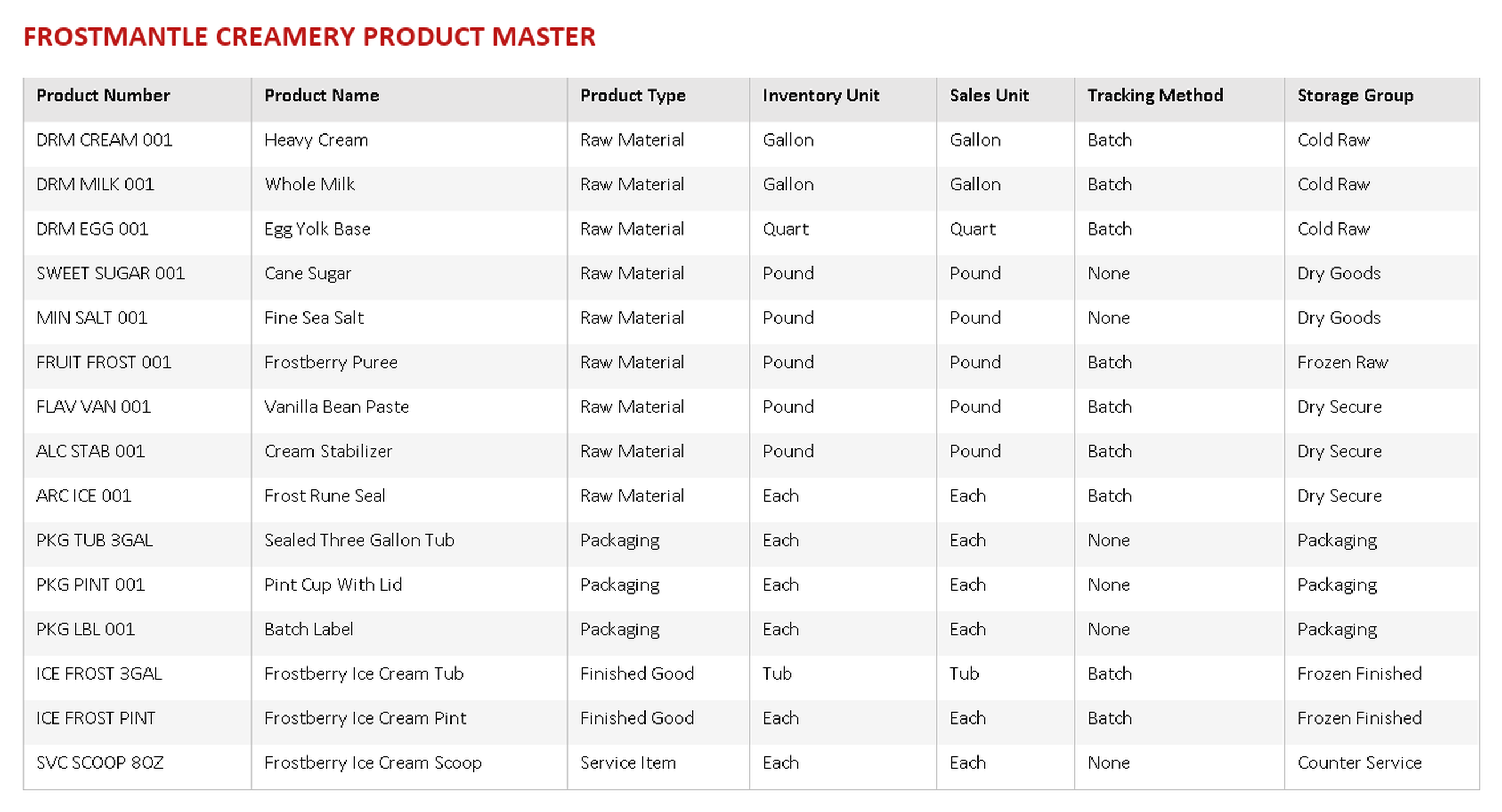
The product setup defines what the company buys, makes, stores, and sells. This table shows the core items needed before the shop opens.
Bill Of Materials
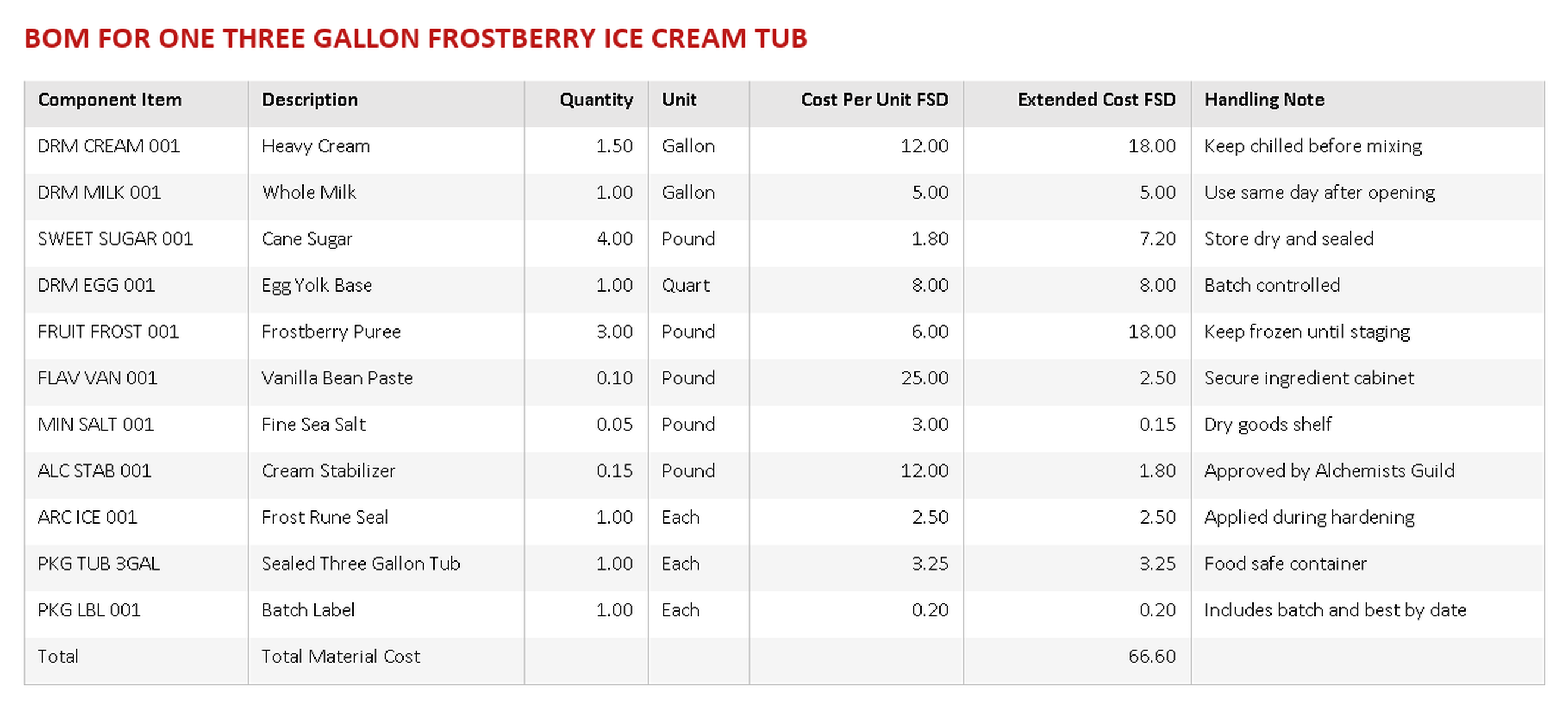
The BOM defines the ingredients and packaging needed to make one standard three gallon tub of Frostberry Ice Cream. This batch size supports both wholesale tubs and counter service. A three gallon tub, 384 ounces, yields 48 scoops at 8 ounces each, or 64 scoops at 6 ounces each, or 24 sixteen ounce take away pints.
Production Route
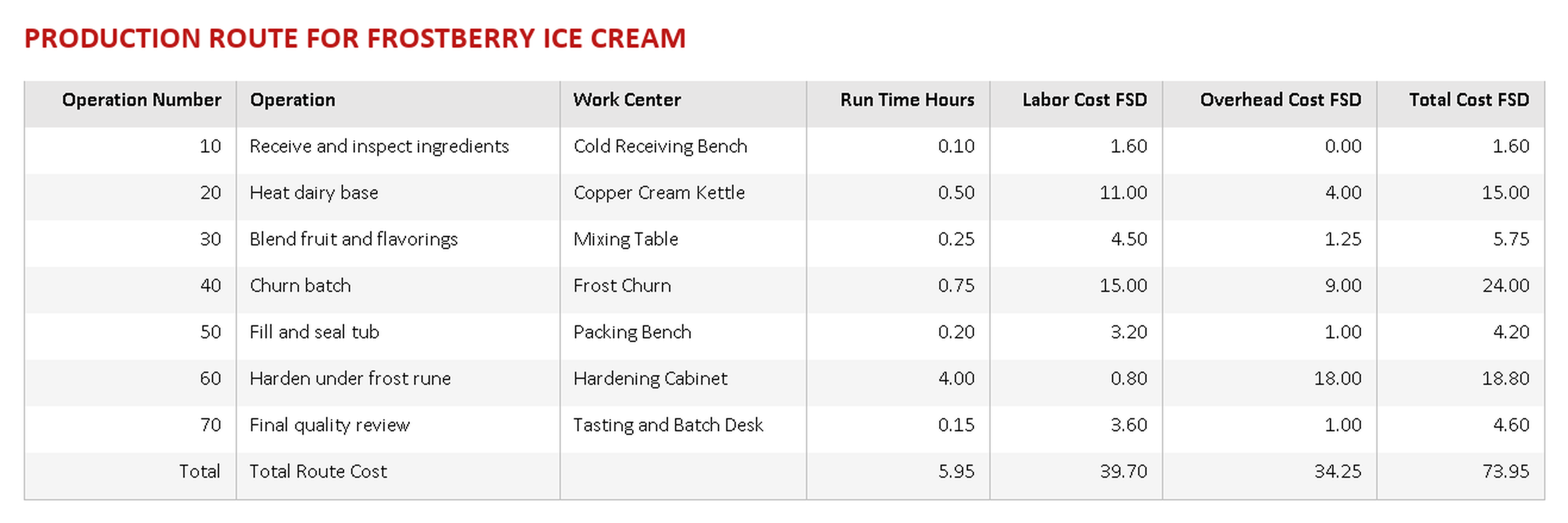
The route defines the work steps required to produce the ice cream. For Frostmantle Creamery, the route is built around controlled receiving, dairy preparation, churn time, hardening, and final quality review.
Cost Rollup
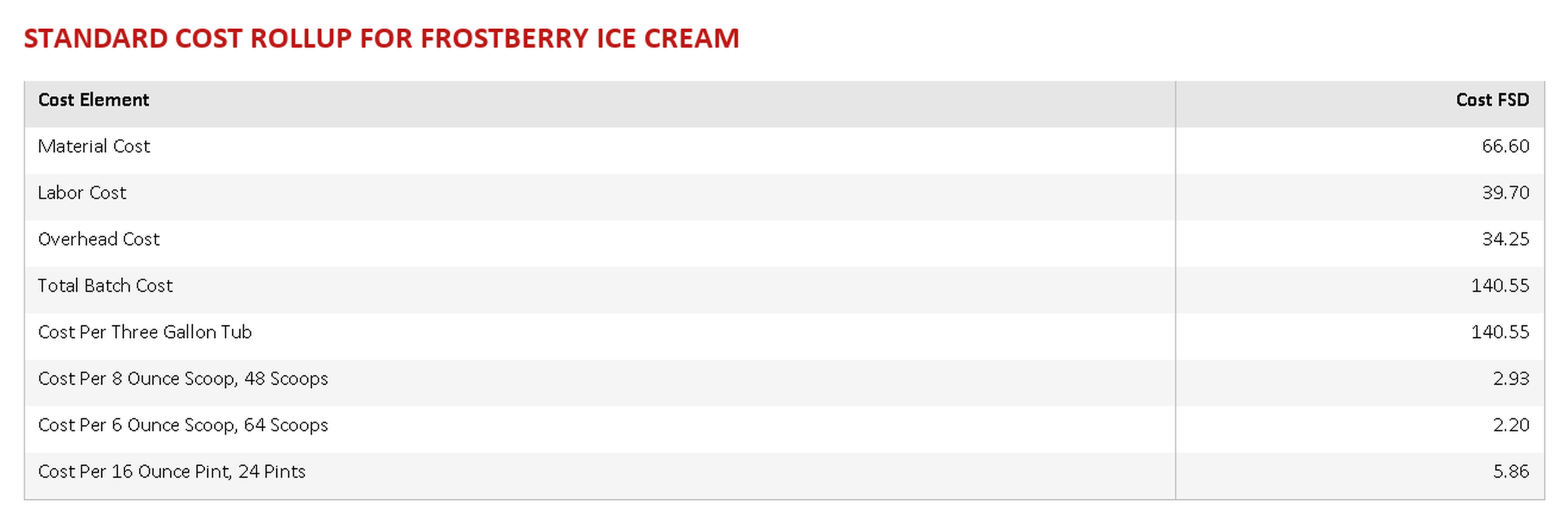
The cost rollup combines material, labor, and overhead into the final standard cost. The supply chain setup guide includes costing versions and item cost calculation as part of inventory setup, which supports this type of finished goods costing.
Suggested Sales Model
The sales model should separate retail counter sales from wholesale tub sales. Counter sales carry higher margin because the shop adds service, location value, and immediate consumption. Wholesale tubs carry lower margin but support tavern and inn volume.
Storage Plan
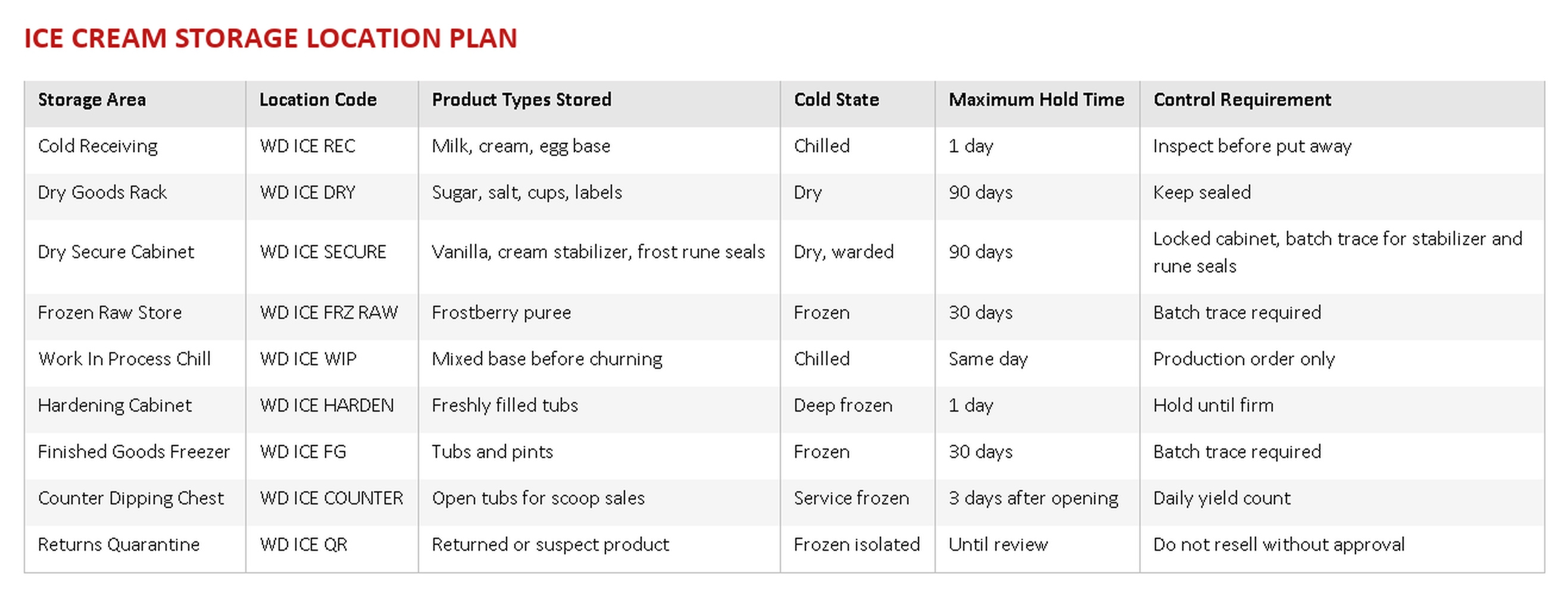
The storage plan protects product quality and supports batch trace. The supply chain guide uses storage dimension groups to define how products are tracked by site, warehouse, and location. It also defines tracking dimensions for batch and serial control. For ice cream, batch control is required for dairy, fruit puree, finished tubs, and finished pints.
Batch And Quality Rules
Ice cream needs tighter trace than most shelf stable goods. Batch numbers should connect the finished tub to cream, milk, egg base, fruit puree, production date, work center, and quality result.
Flavor Portfolio Management
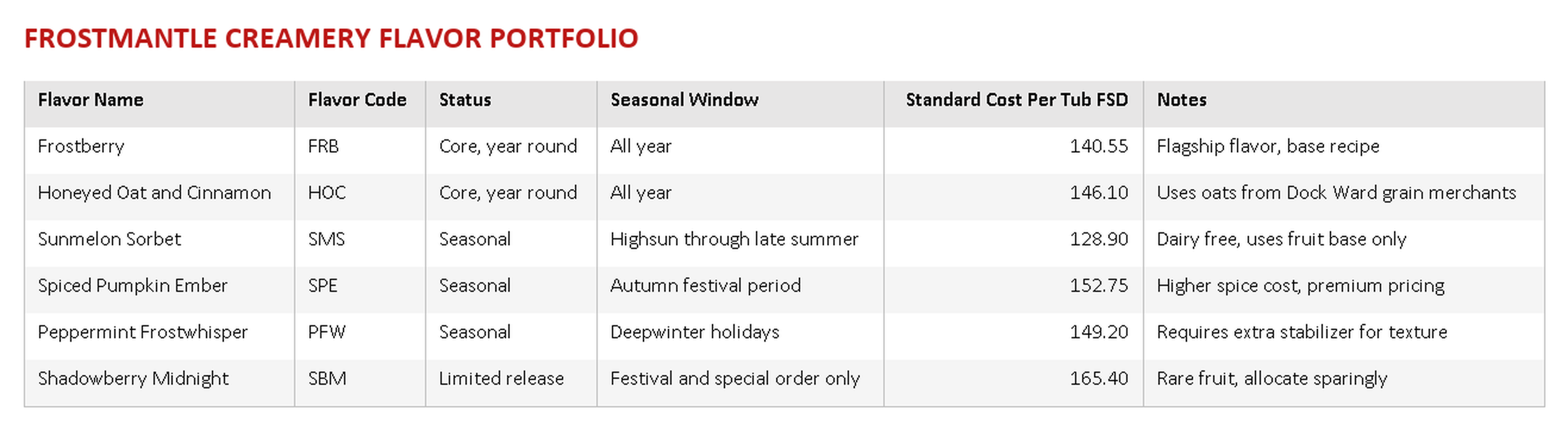
A single flavor is a good way to open the shop, but Frostmantle Creamery cannot stay competitive on Frostberry alone. Once the base process is stable, the company should manage flavors as a formal portfolio, with each flavor treated as its own item under the same production model. This keeps costing accurate and prevents recipe drift at the churn.
Every new flavor should pass through three gates before it reaches the counter. First, a small batch trial in the Mixing Table to confirm taste and texture. Second, a costing review to confirm the new BOM does not quietly erode margin. Third, a shelf trial to confirm the flavor holds its quality through the full 30 day best by window.
Seasonal flavors should be planned at least one production cycle ahead so that fruit, spice, and packaging can be procured on schedule. Limited release flavors like Shadowberry Midnight should be capped by production order so the shop does not overcommit rare fruit stock to counter sales at the expense of festival contracts.
Staffing And Roles
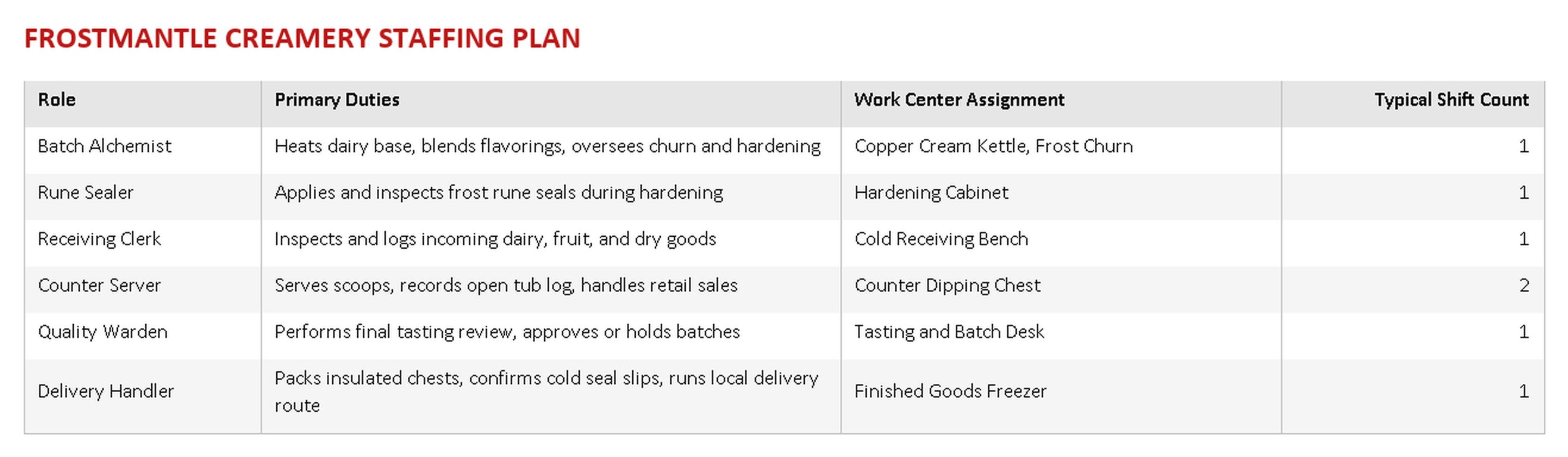
Frostmantle Creamery cannot run on a single counter clerk. The shop needs distinct roles across production, service, and quality, each with clear responsibility so that batch discipline does not depend on any one person’s memory.
The Quality Warden should never be the same person who ran the churn on that batch. Separating production from final review keeps the quality hold honest and protects the shop from the temptation to wave through a marginal batch during a busy festival week.
Equipment And Arcane Upkeep
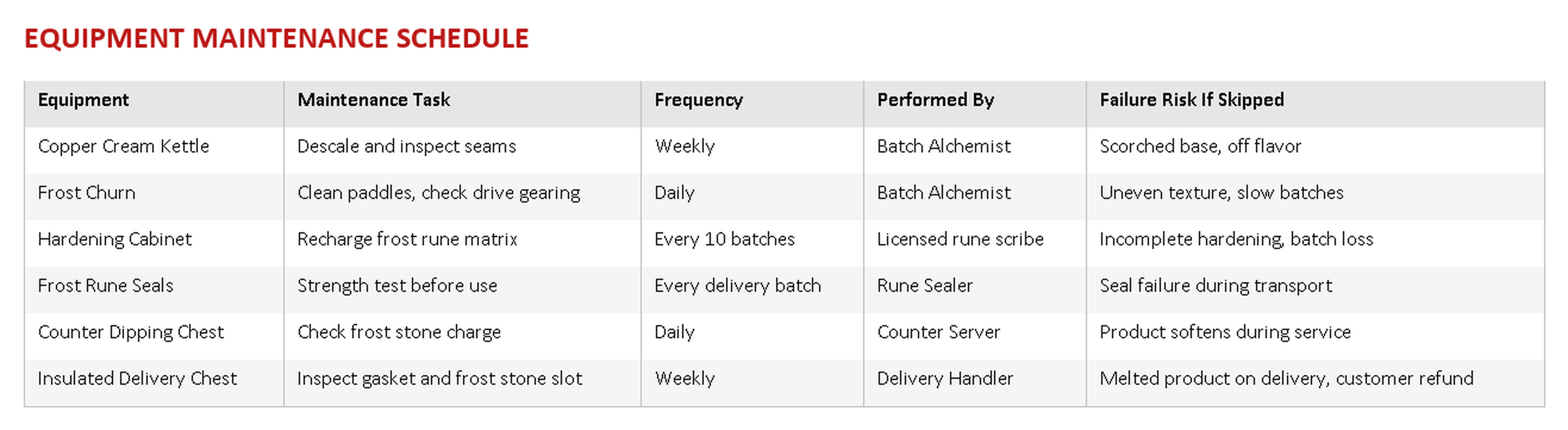
The Frost Churn and Hardening Cabinet are the two pieces of equipment most likely to cause a shutdown if neglected. Both combine mechanical parts with an arcane component, so maintenance covers both craft and enchantment.
A recharge of the Hardening Cabinet’s frost rune matrix is a planned overhead cost, not a surprise expense. It should be scheduled on the production calendar the same way a caravan books a departure date, so a batch is never left waiting on an uncharged cabinet.
Waste, Spoilage, And Yield Variance
Standard costing assumes a three gallon tub yields exactly 48 scoops at 8 ounces or 64 scoops at 6 ounces. In practice, actual yield will vary due to melt loss during scooping, over pour by new counter staff, or a batch that hardens slightly under or over target. Frostmantle Creamery should track this as a yield variance, the same discipline the company already applies to other production variance analysis.
A variance of four scoops on one tub may look small, but at scale across a full festival weekend it becomes a meaningful drain on margin. The Quality Warden should record actual yield on every tub closed at the counter, and any variance above five percent should trigger a review of scoop size, melt handling, or staff training rather than being written off as ordinary spillage.
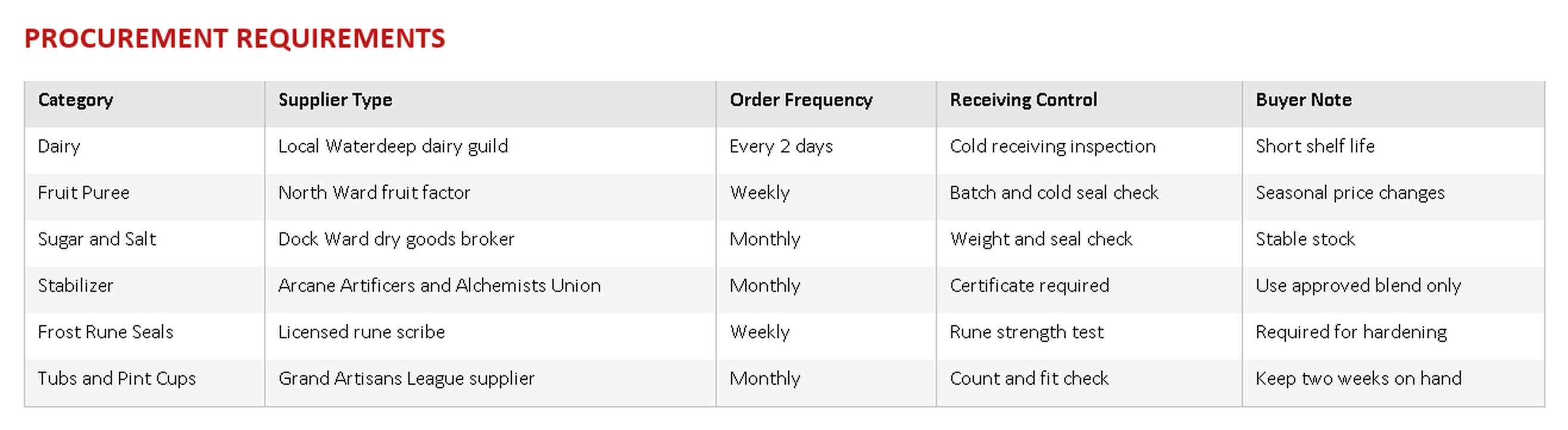
Procurement Requirements
The shop cannot rely on chance market buying. Dairy, fruit, packaging, and frost runes must be sourced from approved vendors. The supply chain guide includes procurement categories, purchase orders, vendor pricing, and purchase order approval as core setup areas.
Distribution Requirements
Distribution must be split into local service, local delivery, and regional wholesale. Scoops are sold only at the counter. Pints can be sold at the counter or delivered locally. Tubs can be delivered to inns, taverns, guild halls, and festival stalls.
The transportation articles for Waterdeep Trading Company describe route guides, hub types, carrier services, transit distances, scheduled routes, and multi segment freight planning for moving goods across Faerûn. Those same controls apply here, but with stricter timing because frozen goods cannot sit on a warm cart while a driver stops for lunch and a bard show.
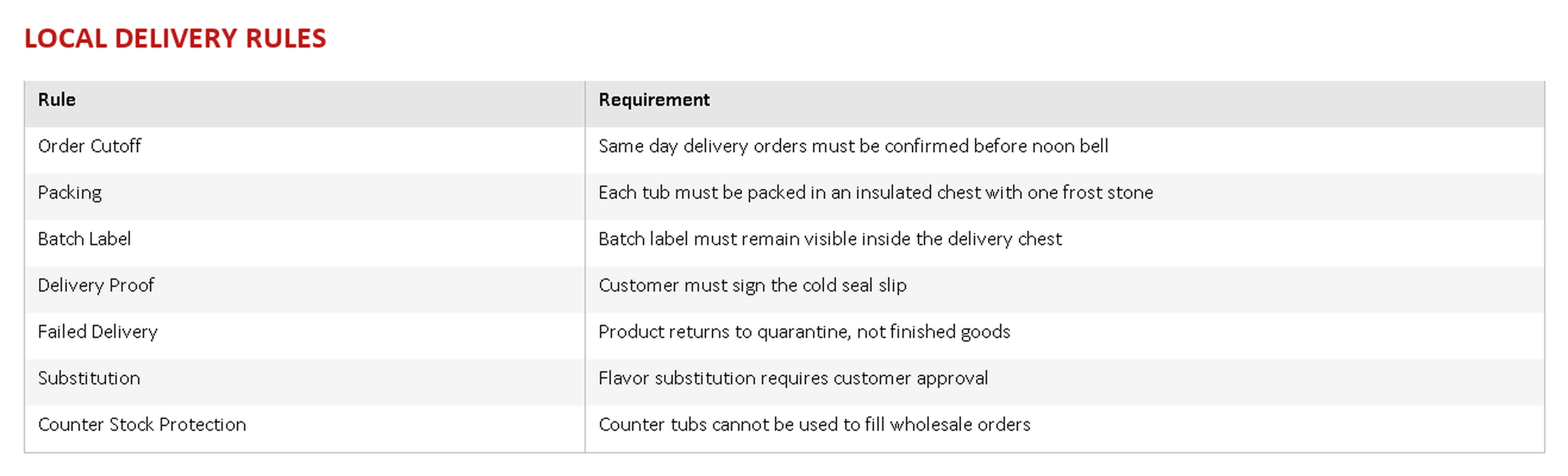
Local Delivery Operating Rules
Local deliveries should leave from the finished goods freezer only after the sales order is picked, checked, packed, and sealed. The sales order flow in the supply chain guide includes creating sales orders, confirming orders, picking and shipping, invoicing, and reviewing sales invoice vouchers.
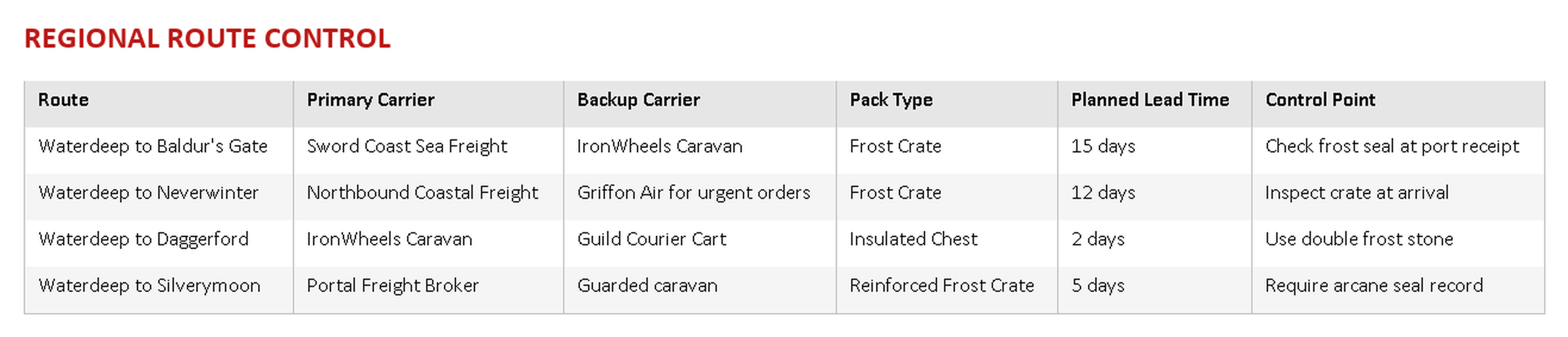
Regional Distribution Rules
Regional shipments should be limited to sealed tubs until the company has tested longer routes for pints. Ice cream shipped beyond Waterdeep should move through scheduled freight lanes with known carriers.
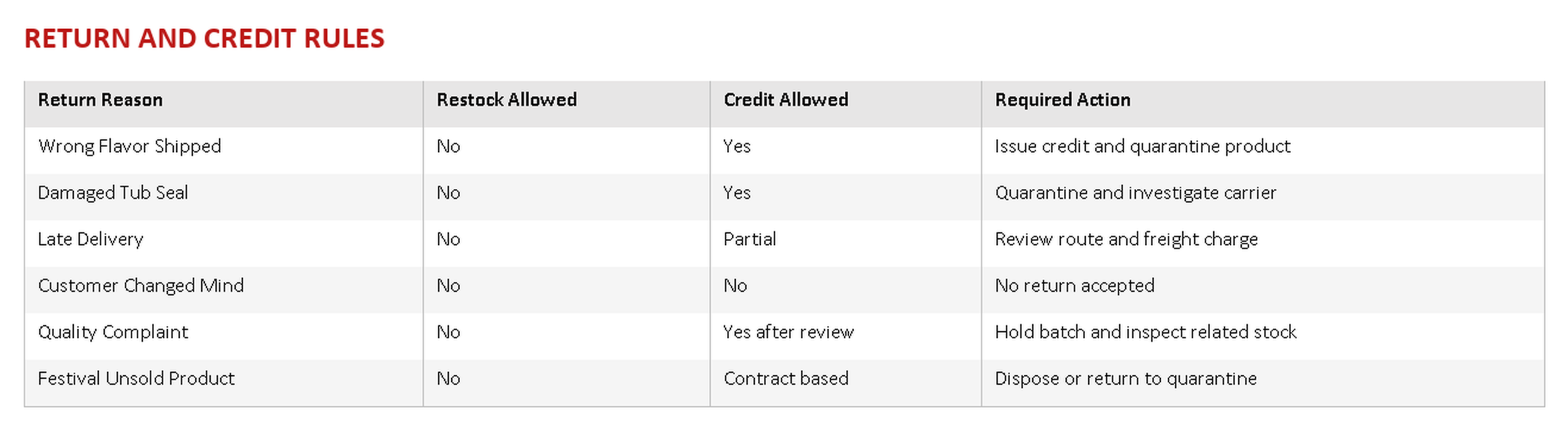
Returns And Credit Rules
Frozen products are risky returns. The shop should not restock returned ice cream unless it never left company control and the cold seal remained intact.
Shop Level Profit And Loss
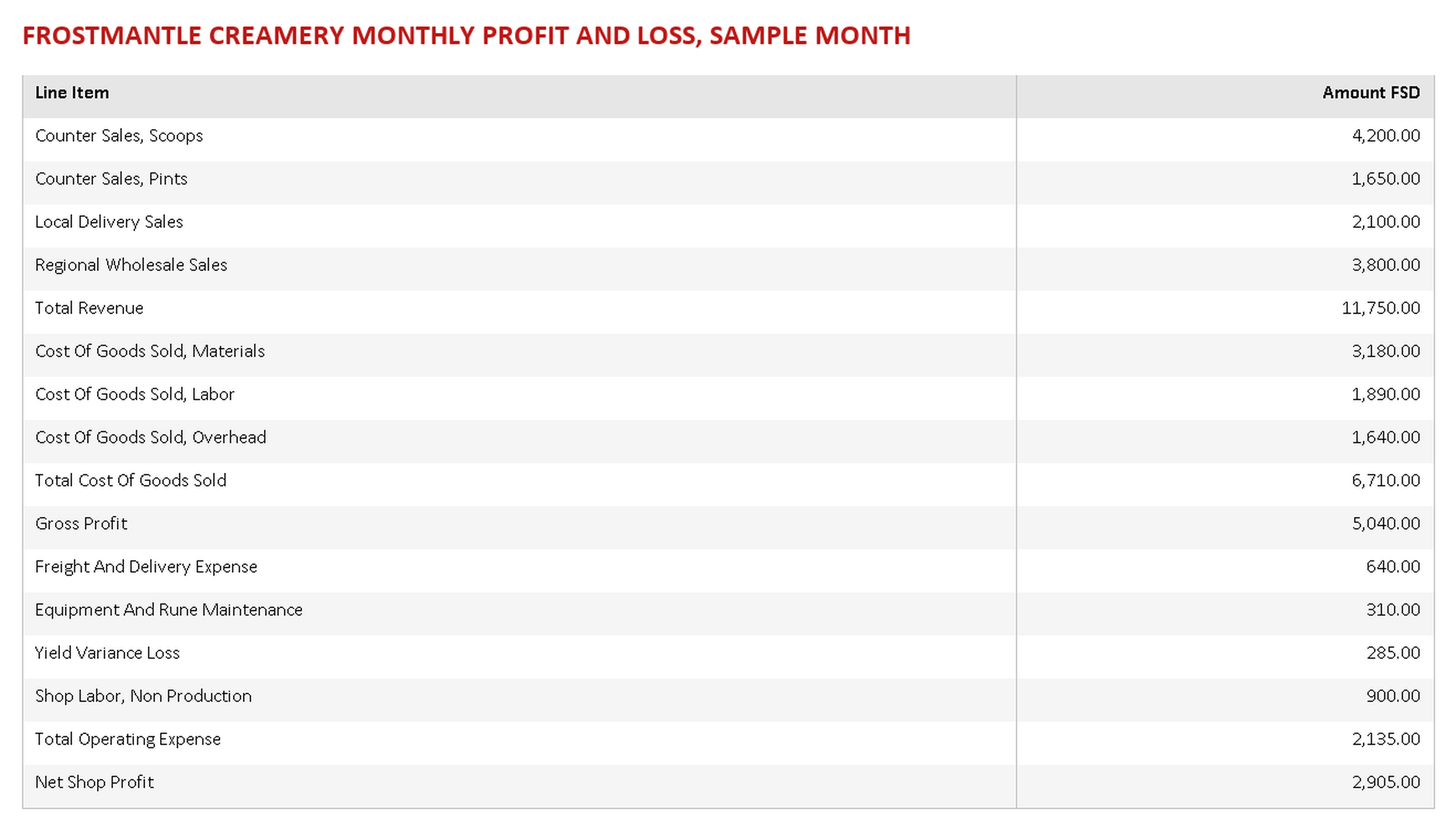
Once Frostmantle Creamery is producing multiple flavors and running both counter and wholesale channels, ownership will want a simple monthly profit and loss view rather than only a per tub cost rollup. This gives Greta Ironfist a single page to judge whether the shop is pulling its weight within the wider Waterdeep Trading Company.
Tracking yield variance loss and maintenance cost as their own lines, rather than folding them quietly into cost of goods sold, gives the Quality Warden and the Batch Alchemist a direct incentive to protect margin at the churn and the counter.
Marketing And Festival Circuit Model
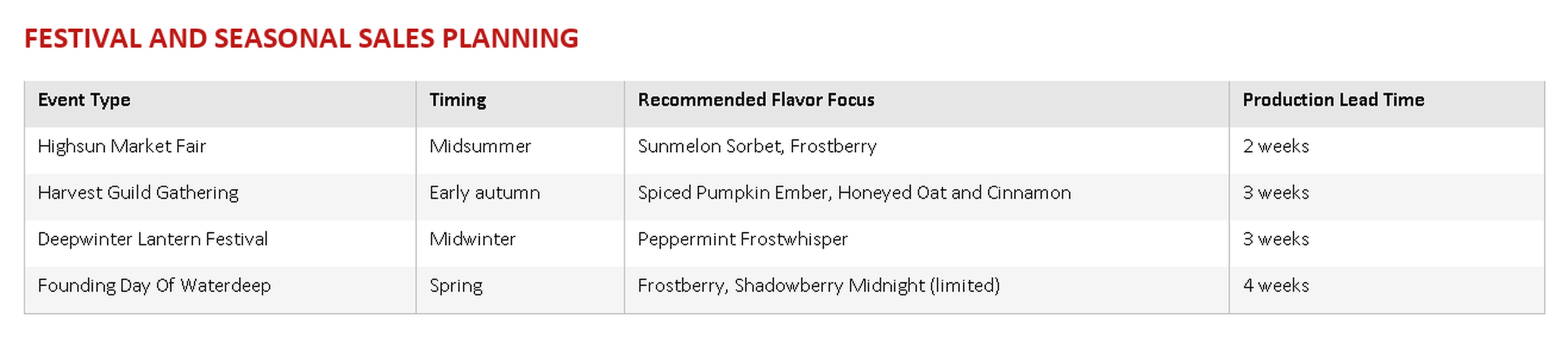
Frostmantle Creamery benefits from Waterdeep’s calendar of festivals, fairs, and public gatherings. Rather than treating festival sales as a bonus, the shop should plan its production calendar around known festival dates, since these events can move a meaningful share of monthly tub volume in a single weekend.
Festival contracts should be confirmed and production booked before counter demand for the same period is estimated, since a festival stand cannot go back for more stock mid event the way a local tavern can place a same day order.
Multi Site Expansion Considerations
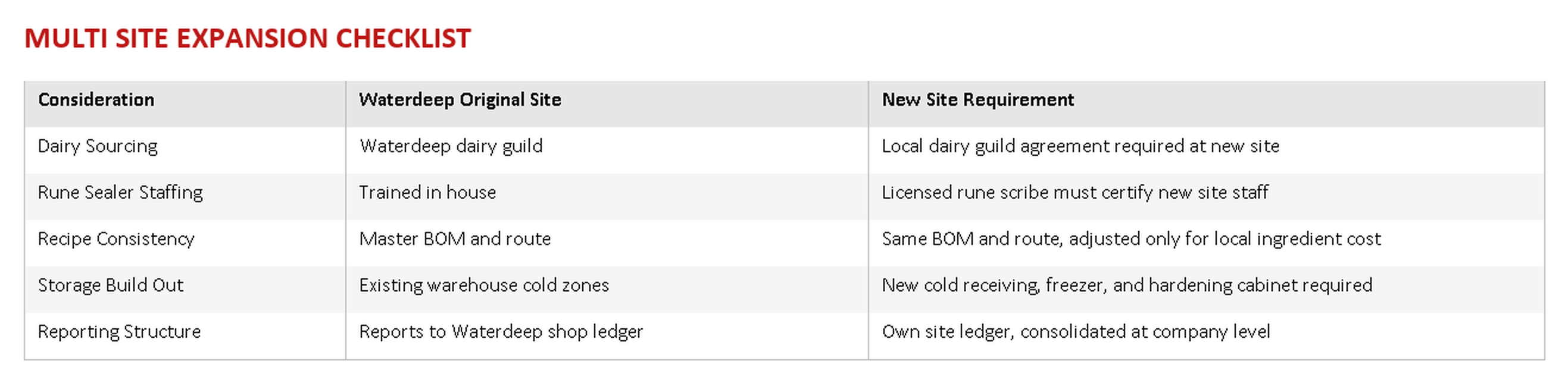
Once Frostmantle Creamery is stable in Waterdeep, the same model can be extended to Baldur’s Gate or Neverwinter as a second production site rather than only a wholesale destination. This avoids the 12 to 15 day freight lead time that currently limits regional tub sales and lets each site serve its own counter and local delivery customers directly.
Keeping the BOM and route identical across sites, and only adjusting the cost inputs for local pricing, preserves the ability to compare site performance directly rather than comparing two different recipes.
Risk And Insurance Considerations
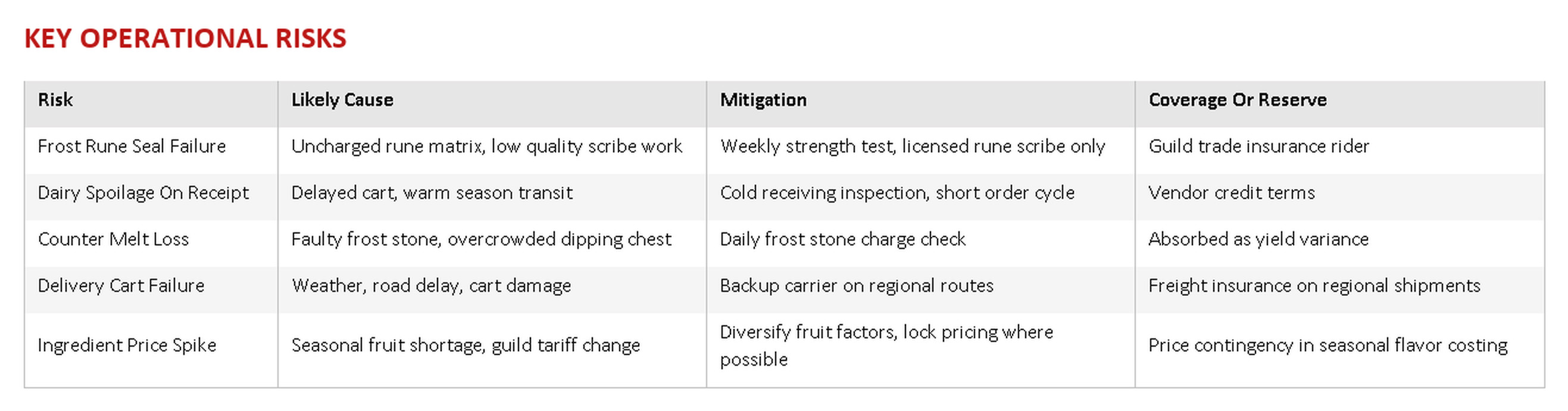
The frost rune seal is the single point of failure most likely to threaten an entire batch or delivery run, since a weak seal can spoil product before anyone notices. The shop should treat this as a named risk with its own mitigation steps rather than an assumed background cost.
Faerûn Aware Considerations
The Waterdeep Trading Company should treat ice cream as both food and magic supported inventory. The dairy supply is mundane. The frost rune seal is magical. The route is production. The counter sale is retail. The delivery model is transport. The full process touches purchasing, inventory, production, sales, and quality.
A few operating points matter most.
Do not produce more than the freezer can hold.
Do not sell open tubs into wholesale orders.
Do not deliver without a frost stone or cold seal slip.
Do not accept returns into saleable stock.
Do not let flavor variety outrun batch control.
Do record scoop yield by tub, because waste and over serving can quietly eat the profit.
Do book festival production ahead of counter estimates, since a festival stand cannot restock mid event.
Worked Example
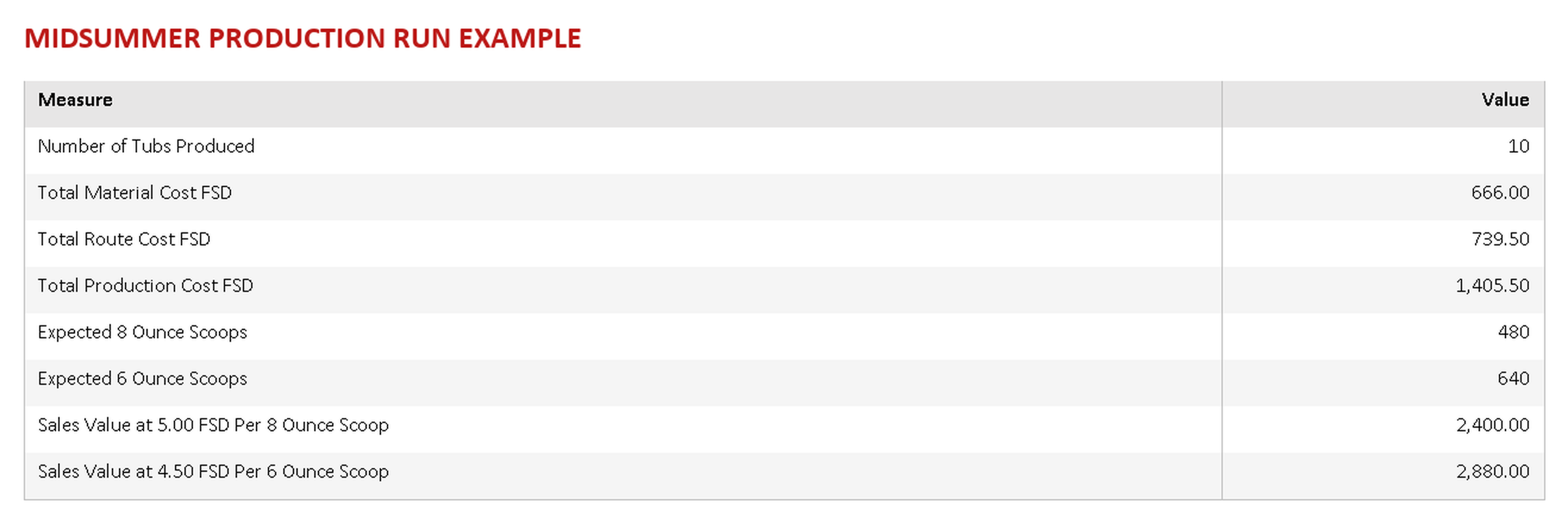
Greta Ironfist approves a production run of 10 tubs of Frostberry Ice Cream for a Midsummer market push.
The production team creates 10 production orders or one batch order for 10 tubs. The BOM consumes cream, milk, sugar, egg base, frostberry puree, stabilizer, frost rune seals, tubs, and labels. The route records labor and overhead from receiving through final quality review.
The 6 ounce scoop creates more serving opportunities and a stronger margin, while the 8 ounce scoop feels more generous and may be better for premium festival pricing. The company can use both, but the serving size should be locked by item, price, and counter policy.
Final Thoughts
Frostmantle Creamery is a strong fit for the Waterdeep Trading Company because it uses skills the company already has. It buys from guild suppliers, manages controlled inventory, tracks batches, serves retail customers, and ships to trade partners.
The difference is discipline. Ice cream punishes weak storage, loose batch control, and slow delivery. With a clear BOM, defined route, strict storage plan, well managed distribution rules, a governed flavor portfolio, honest yield tracking, and a shop level profit and loss view, the company can turn a simple frozen treat into a profitable, expandable Waterdeep product line.
For step by step configuration guides covering production orders, BOMs, routes, and inventory setup, see the Advanced Dungeons and Dynamics 365 Bare Bones Configuration Guides, a 7 book series available at https://www.amazon.com/dp/B0GYLPFKCF
CALL TO ACTION
Get your own AD&D365 Environment and guides at adnd365.com/start