Industries of Faerûn: The Engines of Commerce and Craft
The economy of Faerûn is not defined by coin alone. Its true strength lies in the industries that sustain livelihoods, uphold guild traditions, and bridge the gap between the mundane and the magical. From the vast wheat fields of Goldenfields to the enchanted workshops of Silverymoon, industries act as the pulse of the Realms, feeding cities, outfitting adventurers, empowering temples, and ensuring that trade routes remain alive with goods both practical and arcane.
For merchants and adventurers alike, industries are more than suppliers of goods, they are the engines of culture, politics, and survival. Guilds wield enormous influence, dictating not only quality and pricing but also shaping the destinies of apprentices, artisans, and even kingdoms. Magical integration further sets Faerûn apart from other economies: brewers enchant their mead for longevity, smiths forge blades with runes of protection, and scribes craft parchments immune to rot. Each craft carries with it centuries of tradition, technical mastery, and at times, divine blessing.
The Waterdeep Trading Company views industries not as abstract markets but as living ecosystems. Understanding how each vertical operates is essential for anticipating shortages, negotiating contracts, and leveraging guild alliances. A failure in one industry, a poor harvest, a guild strike, a broken leyline, can ripple outward, threatening supply chains, destabilizing tariffs, or sparking political unrest. Conversely, mastery of industry knowledge can unlock opportunities: positioning goods where scarcity drives demand, investing in verticals aligned with magical trends, and safeguarding contracts through compliance with guild regulations.
Industries of Faerûn also mirror the unique geography and cultures of the continent. Luskan’s shipwrights thrive because of their harsh northern seas. Amn’s merchants dominate coffee and tea through coastal access and southern trade routes. Thay’s arcane workshops flourish under Red Wizard oversight, while Goldenfields ensures that the breadbasket of the Sword Coast never runs dry. Each region specializes, adapts, and innovates, creating a patchwork economy where survival depends on both local resilience and continental trade flows.
By exploring these industries in detail, we uncover not only their typical products and craft requirements but also the business capabilities needed to manage them effectively within a system like Dynamics 365. From batch traceability in brewing to serialized artifact registries for enchanted items, each vertical demands specialized processes that reflect its magical and cultural realities.
The following sections will examine the major industries of Faerûn, their guild structures, and their operational needs. Together, they form a blueprint for understanding the engines of commerce and craft, industries that do not simply sustain the Realms but define them.
Why Faerûnian Industries Matter
Industries in Faerûn are more than lines of trade, they are the pillars that uphold the Realms’ prosperity and stability. Each vertical binds together tradition, innovation, and survival, ensuring that both great cities and rural hamlets remain supplied and sustained. Their significance rests on four interwoven principles:
- Guild Regulation: Powerful guilds safeguard every craft, enforcing standards of quality, setting fair wages, and guiding apprenticeships. Their oversight prevents chaos in the marketplace and ensures continuity of skill across generations.
- Regional Specialization: Geography shapes mastery. Goldenfields thrives as the breadbasket of the North, while Luskan’s icy docks produce ships that endure the harshest seas. Each region’s strengths define its contribution to the greater economy.
- Magical Integration: Arcane practice and mundane craft are inseparable. Brewers weave enchantments into mead for longevity, smiths etch protective runes into armor, and scribes enchant parchment against decay. Magic amplifies what craftsmanship alone could not achieve.
- Economic Stability: Industries are the lifeblood of tariffs, taxes, and trade flows. They generate wealth for cities, sustenance for villages, and resilience for kingdoms, anchoring both everyday survival and grand commerce.
Together, these principles explain why industries are not merely sectors of labor, they are the engines that drive Faerûn’s culture, politics, and prosperity.
Key Industries of Faerûn and Their Unique Requirements
From the bustling dockyards of Luskan to the fertile fields of Goldenfields and the enchanted workshops of Silverymoon, each industry in Faerûn has its own rhythms, strengths, and challenges. These verticals not only supply goods but also shape the character of their regions, reflecting centuries of guild tradition and magical practice. For the Waterdeep Trading Company, understanding the unique requirements of each industry is vital to managing supply chains, negotiating contracts, and forecasting demand. What follows is a closer look at the industries that power the Realms and the specialized capabilities that make them thrive.
Brewing & Distillation: Ale, cider, and spirits flow across taverns and courts alike. Brewers require fermentation mastery, magical infusions for aging, and scrying spells for quality control. Their guild, FABRDS, ensures authenticity and fair pricing.
Agriculture & Crop Cultivation: Goldenfields and Amn dominate grain and produce, feeding cities and supplying potion ingredients. Farmers must master seasonal planning, irrigation, and pest-warding rituals, while balancing both mundane crop yields and druidic blessings.
Cattle & Livestock Trade: From Daggerford pastures to Calimport markets, livestock fuels diets and barter economies. Herdsmen must focus on breeding management, disease prevention, and caravan protection, especially in regions where a cow may be worth 30 gold or more.
Potion & Alchemy Manufacturing: Alchemists and artificers in Waterdeep, Baldur’s Gate, and Thay rely on Engineering Change Management to regulate volatile recipes. Requirements include safe distillation, version tracking, and strict guild compliance to avoid catastrophic failures.
Textile & Storage Crafting: The Grand Artisans League oversees fabrics, satchels, and planar bags. Craftsfolk require loom mastery, dye enchantment, and planar weave sealing, ensuring robes resist flames and bags hold more than their size would suggest.
Weapon & Armor Smithing: The Black Anvil Guild unites smiths from Waterdeep and Neverwinter. Beyond metallurgy, rune-forging and rigorous apprenticeship systems are essential. Every blade and breastplate is tested both by hammer and enchantment.
Enchanted Item Production: Concentrated in Silverymoon and Thay, enchanted item production requires leyline attunement, artifact registries, and enchantment safety practices. Wands, rings, and arcane tools must be carefully catalogued to prevent misuse.
Construction & Masonry: The Stoneworkers & Builders Federation oversees towers, fortresses, and arcane gates. Requirements include rune binding, corruption-free contracting, and structural engineering fit for both mundane strongholds and planar gateways.
Herbalism & Botanical Goods: Herbalists in Candlekeep and Silverymoon must balance cultivation, drying techniques, and ritual knowledge. Their trade supplies both healers and alchemists, with guilds ensuring rare herbs are protected from exploitation.
Bardic & Instrument Crafting: The Bardic Performers’ Union protects the crafters of lutes, flutes, and illusion boxes. Their work requires tonal enchantments, illusion weaving, and performer sponsorship to keep bardic schools supplied.
Shipbuilding & Outfitting: Luskan’s dockyards and Mintarn’s drydocks specialize in galleons and spelljammer-ready hulls. Dockwrights require hull reinforcement expertise, planar navigation glyphs, and logistical control of drydock resources.
Glassblowing & Crystalworks: Glasswrights shape vials, mirrors, and scrying lenses in Amn and Silverymoon. Precision crystal alignment and enchantment compatibility are paramount to prevent flaws in alchemical or divinatory tools.
Parchment & Book Production: Papermakers and scribes produce ledgers and spell scrolls. They require vellum crafting, ink enchantments, and anti-decay spells to safeguard libraries such as Candlekeep.
Gemcutting & Stonebinding: The Gemcutters’ Consortium ensures stability in jewelry and soul stones. Skills include faceting, soul-binding rituals, and gemstone stabilization, work that often balances commerce with spiritual trust.
Leatherworking & Saddlery: Tanners in Daggerford and Baldur’s Gate craft boots, saddles, and monster-hide goods. Requirements include toxin neutralization, hide curing, and sigil carving, particularly for exotic mounts.
Candle, Oil & Incense Making: Temples rely heavily on WIXCOL guild-certified products. Craftsfolk refine wax, infuse scents, and maintain ritual purity, ensuring candles and incense meet religious standards.
Jewelry & Amulet Forging: Artificers of Ornament specialize in protective amulets and noble house sigils. They must blend heraldic design with enchantment bonding, ensuring both prestige and function.
Ceramics & Clayworking: Potters in Amn and Waterdeep produce urns, cauldrons, and rune-etched vessels. Their requirements include kiln mastery, rune embedding, and fracture resistance for ritual reliability.
Furniture & Fixtures: Carpenters craft chests, beds, and warded doors. Joinery, planar anchoring, and compartment warding are required to create fixtures that protect against scrying or intrusion.
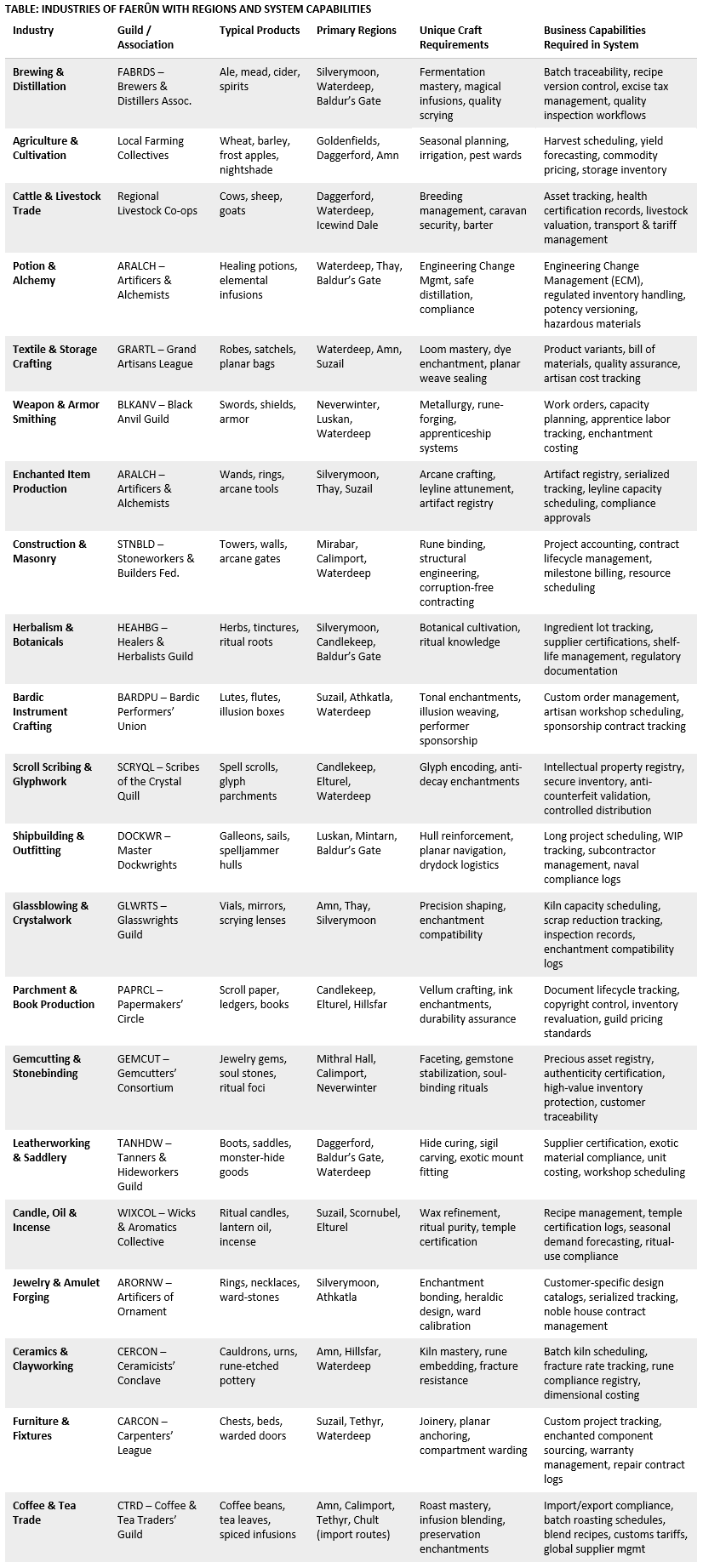
The following table highlights all the industries of Faerûn, their guilds, typical goods, craft requirements, business system needs, and the regions where they are most active. A new row has been added for the Coffee & Tea trade, a growing vertical in southern Faerûn.
Realms-Aware Considerations
Industries in Faerûn do not exist in isolation, they are shaped by forces as varied as guild politics, magical tides, geography, and the turning of the seasons. A process that runs flawlessly in Waterdeep may falter in Luskan’s harsher climate, while Goldenfields’ abundant harvests may wither under Calimport’s arid skies. For the Waterdeep Trading Company, true mastery comes not only from understanding the craft of each industry but also from recognizing the wider forces that influence production, trade, and demand across the continent.
- Seasonality – Many trades, particularly agriculture, brewing, and candle-making, are bound to ritual calendars and harvest cycles, creating periods of abundance and scarcity that drive pricing and supply.
- Magic vs. Mundane Balance – Some industries, such as alchemy and potion-making, operate under strict arcane regulation, while others, like blacksmithing, face shifting pressures from tariffs, wartime requisitions, or local politics.
- Guild Oversight – Apprenticeships, certifications, and price controls are enforced through powerful guild networks, ensuring consistency but also limiting flexibility for independent traders.
- Regional Scarcity – Goods plentiful in one region may be rare luxuries in another. Cattle may roam freely in Goldenfields, yet in Icewind Dale they command extraordinary value, shaping trade routes and bargaining power.
Taken together, these considerations remind us that Faerûn’s industries are never static. They are living systems, influenced by culture, magic, and environment. For traders and guilds alike, success lies in adapting to these shifting currents while maintaining trust, quality, and resilience.
Final Thoughts
The industries of Faerûn create more than goods, they weave the very fabric of the Realms. Where tradition meets magic, each vertical carries its own disciplines, safeguards, and cultural significance, shaping not only commerce but also identity and survival. Brewing, smithing, enchanting, and cultivation are not isolated trades; together they sustain cities, empower adventurers, and anchor the flow of wealth across kingdoms.
For the Waterdeep Trading Company, understanding these industries is not simply a matter of market awareness, it is a strategic imperative. Success depends on anticipating the rhythms of harvests, respecting guild governance, leveraging magical innovation, and adapting to shifting regional demands. By mastering the unique requirements of each vertical, the Company secures its place at the heart of Faerûn’s economy, ensuring resilience, influence, and prosperity in an ever-changing world.
Support the AD&D365 Project on Patreon.
To grow this world, we’ve launched an official Patreon where supporters can gain access to exclusive content, tools, training labs, and even influence the future of the project. Your support fuels more than just development , it expands the guildhall, forges new scrolls, and empowers the next generation of configuration wizards. Begin your journey: https://www.patreon.com/adnd365/
A Grateful Salute to Our Patrons
To all those who stand behind the vision, thank you for helping bring this world to life. Our Benefactors, Andre Breillatt, and Eryndor Fiscairn‡,, your boundless generosity fuels the arcane core of this project. Without your magic, the weave would falter. Our Apprentices, the spell engines turn and the training labs thrive thanks to our current Apprentices: Michael Ramirez and Andreth Bael’Rathyn‡. Special thanks to our past Apprentices, whose contributions helped us get here: Ralf Weber, Wendy Rijners, Shashi Mahesh, Julia Tejera, Ben Ekokobe, Tiago Xavier, Naveen Boyinapelli, Marcos Tadeu Wolf, Kathryn Greene, Jason Brown, Mark Christy, and Ashish Singh. Our Initiates, Peter Lorre, your commitment marks the start of the deeper path, stepping beyond mere observation into the active shaping of this realm. Our Followers, your steady presence along the journey is a beacon of encouragement: Eric Shuss, Sunil Panchal, Sarah D. Morgan, Nick Ramchandani, Daniel Kjærsgaard, and Tomasz Pałys. And our Voyeurs, Harry Burgh, Abdelrahman Nabil, and Basil Quarrell, ever watching from the shadows, clearly intrigued… but not enough to part with a single gold piece. Your silent curiosity is noted, and mildly judged.
Want to design your own economic models in Faerûn?
Get your own AD&D365 Environment and guides at adnd365.com/start, and request access to the public view of the current database at https://public.adnd365.com – Login npc@adnd365.com, Password N0nPl@yC#822!
 A Tinkerers Notebook