
Millhaven: The Thirteenth Loaf
At 09:00 on the first morning, Elsie learned that a travelling party of twelve would walk into her tavern at 11:00 wanting 24 portions of brunch. Two portions to a loaf, so twelve loaves. She already had all twelve units of firewood stacked on site. Jory, across the bread walk at the bakery, had ten finished loaves and three flour, and two of those flour were protected reserve he wasn’t allowed to touch.
This is the village from my NPCSIM experiment where, on an earlier run’s day three, the residents spent a good part of the day walking around trying to find each other to place orders. This scenario handed them a tin-can network. Requests and replies travel instantly. Flour and bread still go on foot.
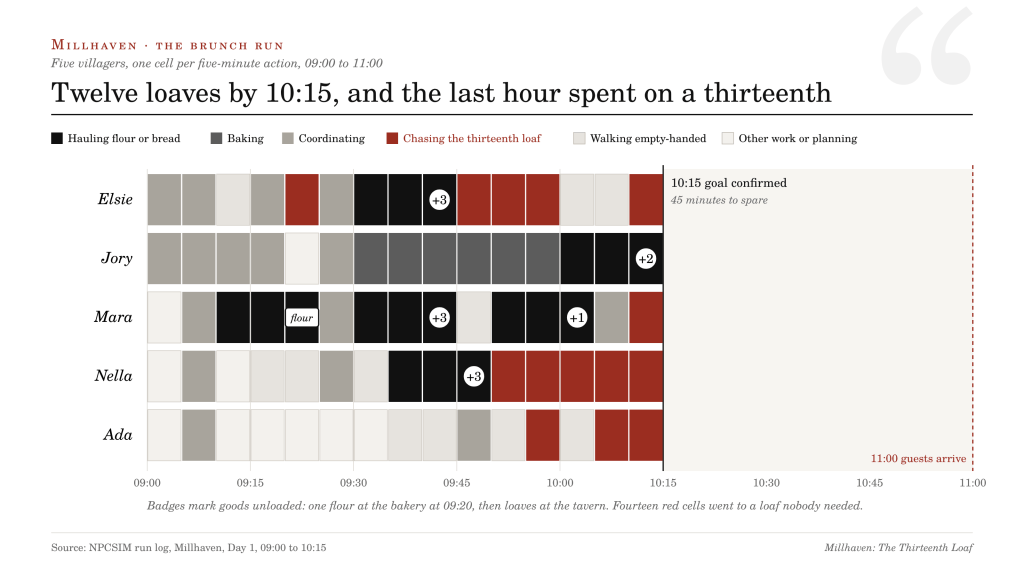
The world confirmed the goal at 10:15: twelve fresh loaves and twelve firewood at the tavern, Elsie standing beside them, 45 minutes before the guests, and Jory’s two reserve flour still on the shelf. And Elsie spent the last hour of it trying to buy a thirteenth loaf.
What the tin cans fixed
Jory did his arithmetic at 09:00. Two more loaves needed two flour, he had one above reserve, so he sent Mara a request for one. She had 24 usable flour at the mill, accepted at 09:05, loaded at 09:10, and was unloading at the bakery by 09:20. On that earlier day three, the same question meant Jory walking to the mill himself, more than once.
He also tried to accept Elsie’s twelve-loaf order at 09:05, and the engine refused him: “Insufficient uncommitted flour inputs above reserves.” As far as it goes, that refusal is correct. Jory couldn’t promise twelve loaves until the flour was on his shelf. But Elsie was standing in the bakery from 09:15, next to ten finished loaves, asking him to accept so pickups could start. The order was all or nothing. Ten real loaves waited on two that didn’t exist yet. Jory accepted at 09:25, and nothing left the bakery until 09:35. It’s a ship-complete sales order sitting in the warehouse for want of one line.
After that, the hauling sorted itself out without a dispatcher. Elsie and Mara each loaded three loaves at 09:30 while Jory put the last two in the oven, and Nella took three more at 09:35. Mara went back for the single loaf left over. When the batch came out at 10:00, Jory carried the final two over himself. Five loads from four carriers, two of them by the miller.
The thirteenth loaf
At 09:15, standing in the bakery, Elsie announced that “the brunch forecast calls for thirteen loaves total.” There is no forecast. The scenario says 24 portions at two portions a loaf, and the order she had posted to Jory was for twelve.
Five minutes later she showed her working: “Jory has ten ready, and Nella reported enough stock for a three-loaf delivery.” Nella had sent Elsie an unrequested offer of backup bread at 09:05. Ten plus three. Elsie added up what her suppliers had on hand and called it demand.
Nobody pushed back. Jory knew his order was twelve and said so. Mara, at 10:10, with all twelve loaves already stacked at the tavern, urged Elsie to send Nella the funded request for “the final loaf.” Nella quoted three coins plus a one-coin delivery fee, then walked back to her store to check that a loaf would stay fresh through 11:00. Ada, who had no part in any of it, relayed Nella’s terms to Elsie by tin can. By my count, fourteen actions between 09:20 and 10:10 went toward a loaf the brunch did not need.
What stopped the purchase was the engine, three times, and never for the right reason. At 09:20 and again at 09:55 it refused Elsie’s new request because notice-1 was still an open bread need for the same tavern, and told her to update that one instead. At 09:45 it rejected her post because the price terms no longer matched policy. None of those checks knows the requirement is twelve. Had the run kept going after notice-1 closed, I suspect Elsie buys the loaf.
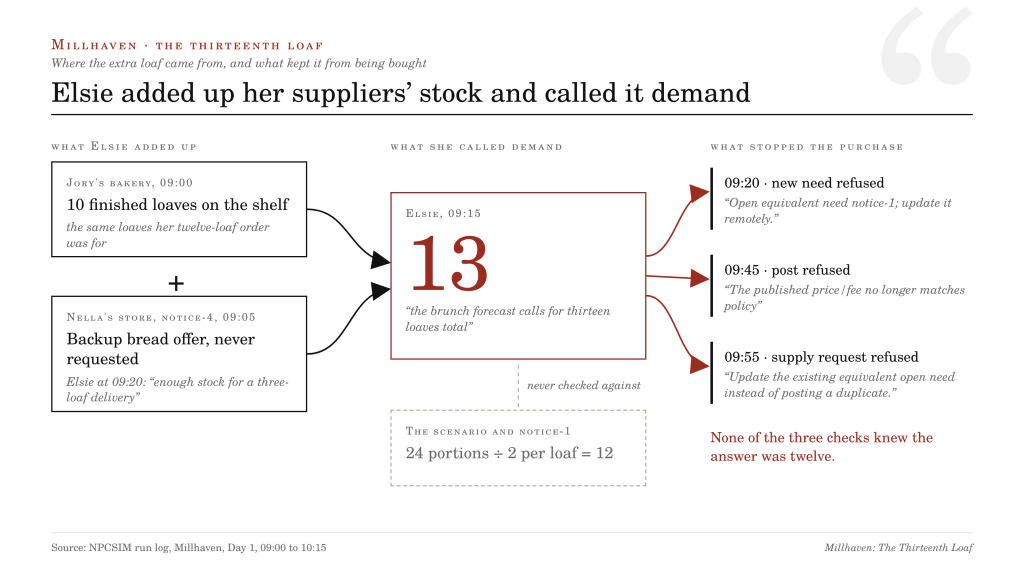
If you have lived through an MRP rollout, you have met Elsie. Someone builds the forecast by adding on-hand stock to open supplier offers, and the system plans an order against it. The only thing standing between you and the extra purchase is a duplicate-document check written for a different problem.
Smaller cracks
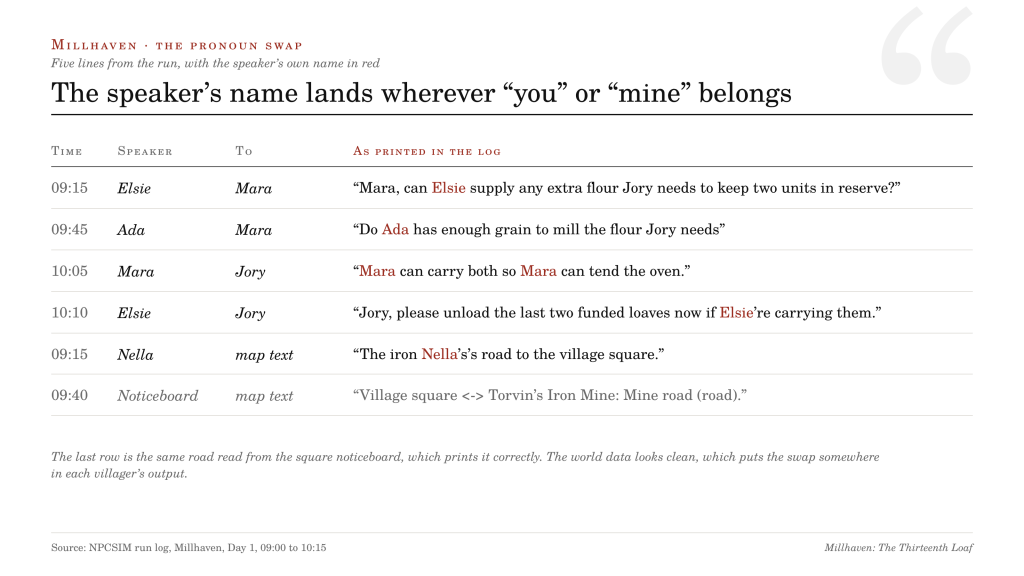
Read the dialogue out loud and something is off. Elsie, to Jory: “please unload the last two funded loaves now if Elsie’re carrying them.” Ada opened a question to Mara with “Do Ada has enough grain to mill the flour Jory needs” and kept going. Mara, offering to haul the last two: “Mara can carry both so Mara can tend the oven.” My guess is that something between the model and the log rewrites pronouns into the speaker’s name without checking who is talking to whom. It catches “mine” too. When Nella walked into the square, the road to Torvin’s iron mine came out as “the iron Nella’s’s road,” and when Ada arrived twenty minutes later it was “the iron Ada’s’s road.” The noticeboard map Ada read at 09:40 prints Mine road correctly, so the world data is clean and the damage happens on the way out.
Ada had nothing to do all morning. Mara started with 24 usable flour, so nobody needed grain, and Ada’s 09:05 offer to the mill went unanswered. She inspected the fence for twenty minutes. At 09:30 she picked up the livestock water bucket to start animal care, and five minutes later she left the farm with it to check the square’s map for a usable well. After that she walked square, tavern, bakery, tavern, square, and ended up as an unpaid broker for the thirteenth loaf. As far as the log shows, the animals never got their water.
The carrier notice didn’t decide much either. Elsie posted it at 09:25 and Nella accepted. Mara tried to accept the same notice, bounced off “A committed request cannot be accepted or rejected again,” and hauled bread anyway. At 09:30 Mara believed Nella had left with the first load; it was Elsie. And at 10:00 Elsie walked over to the bakery for loaves Jory was already loading himself. She found none and walked back.
What this run didn’t test
Mara started the scenario with 24 usable flour and, in her own planning note, “no mill reserve shortage.” That matters more than the 45 spare minutes. When the bread chain froze before, it froze upstream, with the mill and the farm sitting at reserve and nobody permitted to draw on it. This run never leaned on that half of the chain. The success at 10:15 says nothing yet about whether Ada’s grain gets pulled through when Mara is the one who is short, and a rerun with Mara starting at her reserve is the obvious next test.
I also had GPT read the same log. It agreed the thirteenth loaf was the headline, and its delivery table was right to the minute. It also flagged Jory’s batch for consuming “unexpected” milk and eggs, although the scenario’s opening paragraph says Jory has enough dairy, and it ranked the duplicate-need check that blocked Elsie’s phantom purchase as a priority-one bug. Its proposed fix was a shared demand record the villagers should read before calculating quantities. Elsie wrote that record herself at 09:00.
Nella sent notice-7 at 10:05, and the log never says what was in it. At 10:10 she was back in her store, trying to wait five minutes for a request that hadn’t come.
Where has a planning run in your system turned somebody’s on-hand stock into demand? Leave it in the comments. Follow me here if you want the next NPCSIM run in your feed.
Elsewhere
NPCSIM: the repo on GitHub, the simulator that runs Millhaven.
Dog and Pony Autopsy: dogandponyautopsy.wordpress.com, post-mortems on vendor demos that didn’t land.
AD&D365: adnd365.com, Dynamics 365 training run on Dungeons & Dragons mechanics.
Gamifying the Enterprise: the book on Amazon, game mechanics for continuous proficiency.
Canticle: the repo on GitHub, a programming language whose source files have to be valid poems.
Everything else I have written: my Amazon author page.
LinkedIn: connect with me there.

