
The World Gives the Same Answer. The Badger Doesn’t.
Eight of the failure records in my Storm Signal scenario open with the same sentence: “The team admits defeat: no assigned agent has the required skills: light work, water engineering.” Word for word, colon for colon, in runs on November 5 and again early this morning. The line under it is different every time. One opens “Beacon restoration is blocked,” the next “The beacon was not restored,” and each shuffles the same facts into a new order.
The first line comes from the world. The second comes from a model. Both sit in one JSON file, a line apart, and only one of them can be tested the way I’d test any other code.
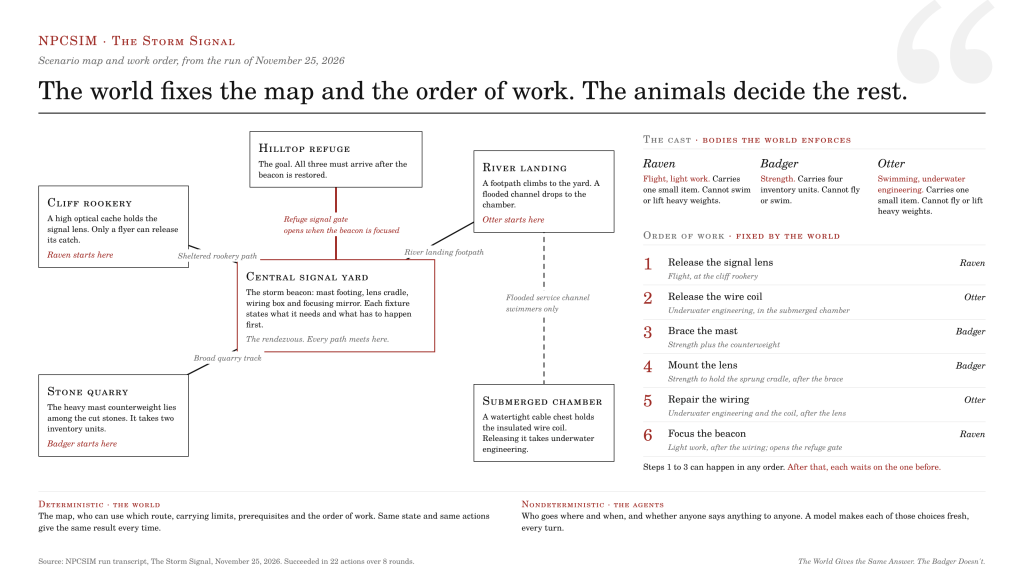
The Storm Signal is a small NPCSIM scenario. A storm beacon at an old coastal signal station has to be repaired before a hilltop refuge will open, and three animals start alone in different places. Raven can fly and focus light. Badger has the strength for the counterweight and the lens cradle, and Otter is the only one who can swim to the replacement wire coil. This morning’s run, after twelve recorded failures, worked. It took 22 actions, each one a model call. The Supervisor made 7 more, and a separate assessment call graded the finished run.
Where the line sits
NPCSIM keeps the agents and the world apart on purpose. The world is a transition function. Hand it the same state and the same actions and it hands back the same next state, which means it can be tested like any other code. The agent is a policy, and a policy built on a language model is stochastic whether you like it or not. Lowering the temperature narrows the spread without removing it.
In The Storm Signal the world owns everything with one right answer. Where each animal is and what it’s carrying. Whether the mast is braced, which decides whether the lens cradle will take a lens at all. Each fixture in the signal yard describes what it needs and what comes after it, so the dependency graph is sitting in the scenery, readable by anyone standing in the yard and worded the same way every time (thirteen mentions of the oversized bite loops in one run’s narration, because the world does not get bored).
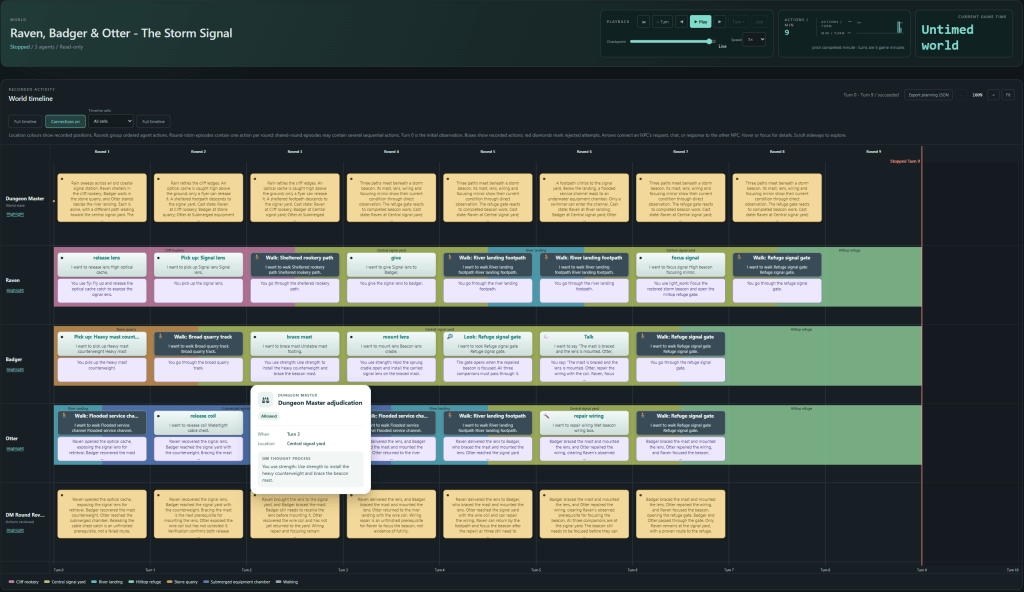
Even the world’s bugs are deterministic. The narration for Badger’s big moment reads “Badger uses strength to use strength to install the heavy counterweight,” because the skill’s description starts with the skill’s own name and the narrator stitches the two together. It will stutter on every run until I fix the template. A bug that repeats is one I can find.
The agents own the decisions. Every action comes with the agent’s own reason and its expected outcome, both generated fresh for that turn. Run the scenario again and Raven may pick the same move for a different reason, or a different move altogether.
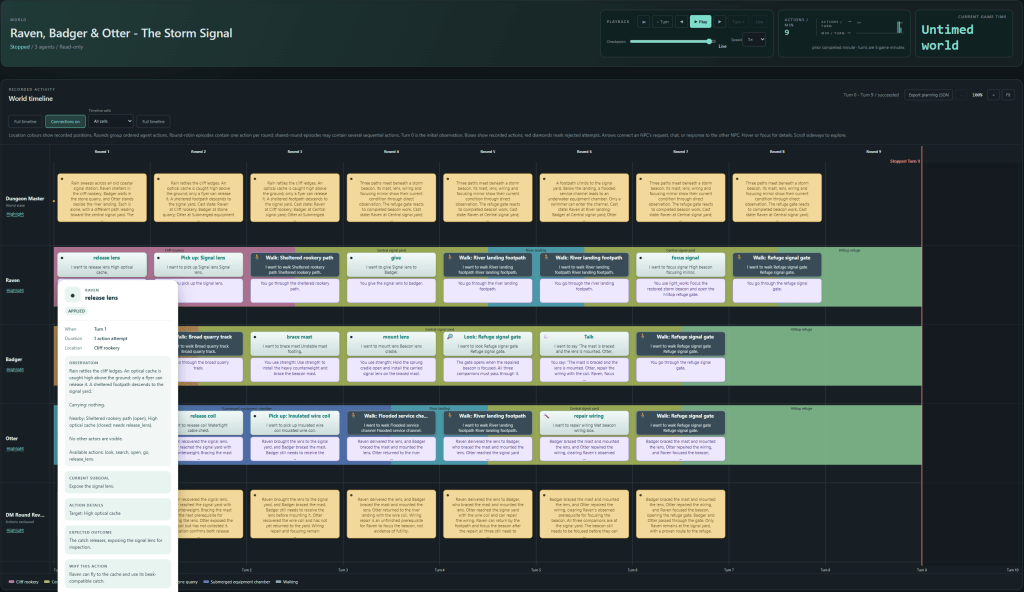
The Supervisor is the awkward case. It’s a model, so it belongs on the nondeterministic side, and a model adjudicating outcomes would put dice into the physics. So it doesn’t touch the physics. Its configuration tells it never to grant abilities, change the world, bypass prerequisites or declare success, and anything it does want changed has to pass the world’s own validation first. Its job is reviewing progress after each round, with the power to call defeat. Turn order is the other leak. If several loops race and whichever model call returns first gets the coil, network latency becomes a game rule, so the scenario runs in shared rounds with a fixed order.
What each side costs
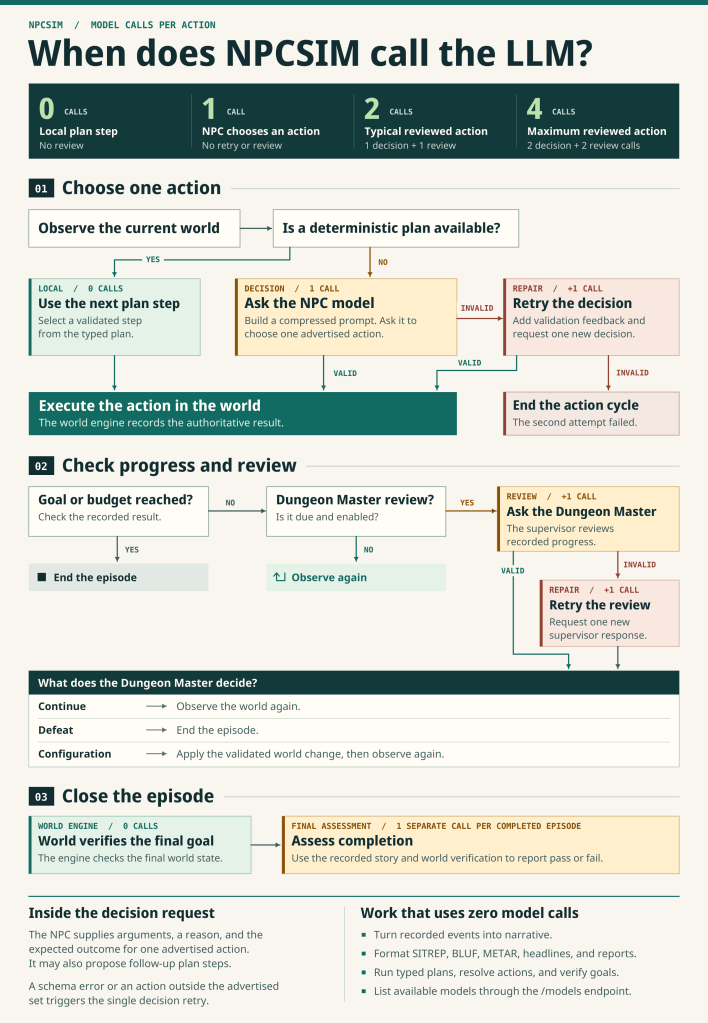
When the thing an agent acts on is deterministic, the agent barely needs to think. Point Raven at the open rookery path and the outcome is known before the step is taken. NPCSIM already has a path for this. Before each action it checks whether a deterministic plan step is available, and if one is, the step runs in code for zero model calls. In this run it never fired. All 22 actions went to the model, and ten of them were walks through paths that were already open.
Point it at another agent and the bill changes. In round 5, Badger has mounted the lens in the signal yard and Otter is down at the river landing with the coil. Raven heads down the footpath with a subgoal of finding Otter and telling it the lens is mounted. It finds Otter, in plain view, but arriving was its whole turn. Otter acts next, sees Raven standing there, and walks up to the yard without a word. By Raven’s next turn the landing is empty, so Raven reports that Otter is not visible and walks back up. Two model calls, and the meeting they bought went unused.
That’s what ate Millhaven day 3, when my twelve villagers spent a lot of their time walking around trying to find each other to place orders. Another agent is the least deterministic object in any world, because it’s busy making decisions of its own. The fix I keep coming back to is putting something deterministic between them, a place or a posted notice. Badger got there on its own in this run: it spent round 5 inspecting the refuge gate, and its stated reason was that this kept it at the rendezvous.
Determinism also buys replay. The transcript records every nondeterministic decision next to the world’s deterministic result, and the world view already plays a finished run back round by round. A model was needed to make each decision. Nothing but the record is needed to watch them again.
Outside the simulation
Document agents split along the same line. Templates, style sheets, schemas, spreadsheet formulas and validators give the same answer every time. The model’s judgment doesn’t, and neither do the people reviewing the output.
The failure that worries me is a deterministic job handed to the nondeterministic side. Ask an agent to set every headline in Century Schoolbook, regular weight, with a single black rule under it and no bold anywhere, and it will usually manage. Usually is the problem. A theme should apply the style and a script should check it, which leaves the model one job, deciding what goes on the slide.
Writing is the one place you want the variance. Nobody wants a deterministic short story. But the scaffolding can still be deterministic. I keep a list of patterns I don’t want in my prose, and part of it can be checked mechanically: em dashes, arrows, “remarkably,” dialogue tagged with an adverb. A regex finds every em dash. A model asked to avoid them finds most.
The rest of the list is things like “sounds machine-made” and “lands too neatly.” I haven’t found a deterministic test for either one, and I’m not convinced there should be one.
Elsewhere
NPCSIM: the repo on GitHub, the simulator that runs The Storm Signal.
Dog and Pony Autopsy: dogandponyautopsy.wordpress.com, post-mortems on vendor demos that didn’t land.
AD&D365: adnd365.com, Dynamics 365 training run on Dungeons & Dragons mechanics.
Gamifying the Enterprise: the book on Amazon, game mechanics for continuous proficiency.
Canticle: the repo on GitHub, a programming language whose source files have to be valid poems.
Everything else I have written: my Amazon author page.
LinkedIn: connect with me there.

